Lipomas: Symptoms, Diagnosis, And Treatment Guide
Discover the facts about lipomas: benign fatty lumps, their causes, diagnosis, and when treatment is needed for peace of mind.
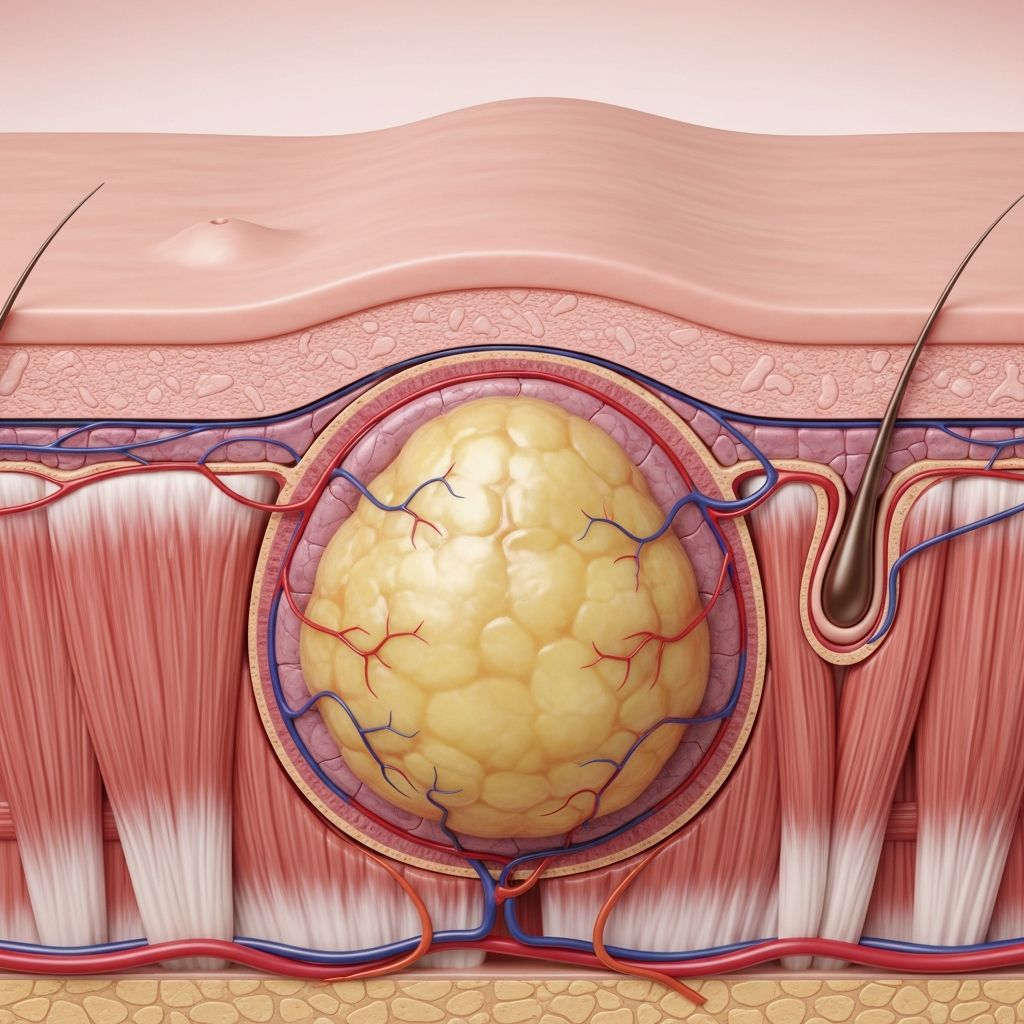
Lipomas represent one of the most frequent benign tumors encountered in medical practice, consisting primarily of mature fat cells that form a distinct lump beneath the skin’s surface. These growths are typically slow-developing, soft to the touch, and movable, posing no threat to health in the vast majority of cases.
Recognizing the Characteristics of Lipomas
A lipoma usually appears as a rounded, rubbery mass that shifts easily under gentle pressure, distinguishing it from more rigid or fixed lesions. They most often develop in subcutaneous tissue on the trunk, arms, legs, or neck, though they can emerge anywhere with adequate fat stores. Sizes vary from pea-sized nodules to larger masses exceeding several centimeters, but growth is generally gradual over months or years.
- Soft, doughy texture upon palpation
- Well-defined borders with underlying mobility
- Typically painless unless pressing on nerves
- Slow expansion without sudden changes
While solitary lipomas are commonplace, some individuals experience multiple formations, potentially signaling underlying syndromes.
Common Locations Where Lipomas Form
These fatty accumulations favor areas rich in adipose tissue. The upper back, shoulders, abdomen, thighs, and forearms serve as prime sites, with occasional occurrences in deeper muscular layers or internal organs like the gastrointestinal tract.
| Body Region | Frequency | Notes |
|---|---|---|
| Trunk (back, abdomen) | High | Most common site |
| Proximal limbs (arms, thighs) | Moderate | Often superficial |
| Neck and shoulders | Moderate | Can affect appearance |
| Intramuscular or internal | Low | May cause symptoms |
Primary Types and Variants of Lipomas
Beyond the standard conventional lipoma, several histological variants exist, each with unique cellular compositions that influence presentation and management. Recognition of these subtypes aids in precise diagnosis and ruling out malignancy.
- Conventional lipoma: Pure adipose tissue, encapsulated and subcutaneous.
- Angiolipoma: Contains vascular elements, often tender.
- Fibrolipoma: Mixed with fibrous tissue, firmer texture.
- Spindle cell lipoma: Features elongated cells, typically on upper back or neck.
- Pleomorphic lipoma: Varied cell shapes, benign despite appearance.
- Intramuscular lipoma: Embedded within muscle, potentially limiting motion.
- Hibernoma: Brown fat-derived, warmer to touch.
- Atypical lipomatous tumor (ALT): Deeper, with atypical cells; requires MDM2 testing for confirmation.
These distinctions are primarily confirmed via biopsy, as clinical features overlap significantly.
Factors Contributing to Lipoma Development
The precise etiology remains elusive, but genetic predisposition plays a prominent role, with familial patterns observed in many cases. Conditions such as familial multiple lipomatosis or Dercum’s disease promote multiple lipomas.
Other associations include:
- Minor trauma to fatty areas
- Heavy alcohol intake in select populations
- Adipose-rich body habitus
Malignant transformation is extraordinarily rare, with primary concern being differentiation from liposarcoma.
Signs That Warrant Medical Attention
Most lipomas remain asymptomatic, but certain changes prompt evaluation to exclude serious pathology. Seek prompt assessment if the lump exhibits rapid enlargement, hardening, fixation to underlying structures, pain, erythema, or overlying skin alterations.
Related Stories



- Rapid growth over weeks
- Hard consistency or immobility
- New-onset tenderness or pain
- Multiple new lumps appearing suddenly
- Functional interference (e.g., joint restriction)
Diagnostic Approaches for Confirmation
Initial assessment involves a detailed history and physical exam, noting duration, growth rate, mobility, and symptoms. Imaging modalities enhance accuracy:
- Ultrasound: First-line, delineates fatty composition and depth.
- MRI: Gold standard for soft tissue characterization, distinguishing from sarcomas.
- CT scan: Useful for calcifications or deep lesions.
- Biopsy: Core needle, incisional, or excisional for histological verification, especially if atypical features present.
Physical exam alone suffices for classic cases, but imaging or biopsy ensures no malignancy.
Treatment Strategies: When and How
Observation suffices for small, asymptomatic lipomas, termed watchful waiting, with periodic monitoring. Intervention is reserved for symptomatic, enlarging, or cosmetically bothersome lesions.
Surgical Excision
The definitive approach, involving complete capsule removal under local or general anesthesia. Outpatient for small lesions (<5 cm); operative for larger or deep ones. Recurrence is minimal post-excision.
Liposuction
A minimally invasive suction technique suitable for superficial, larger lipomas. Faster recovery but higher recurrence risk due to incomplete capsule removal.
Steroid Injections
Occasionally used to reduce size via fat atrophy; not curative, multiple sessions needed.
| Method | Indications | Pros | Cons |
|---|---|---|---|
| Excision | Symptomatic, recurrent | Curative, low recurrence | Scar, anesthesia risks |
| Liposuction | Cosmetic, large superficial | Minimal scarring | Higher recurrence |
| Injections | Small, multiple | Non-surgical | Temporary, incomplete |
Managing Life with Lipomas
Daily life proceeds normally for most, as lipomas rarely impair function. Cosmetic concerns or rare compressive effects (e.g., on nerves or organs) may necessitate removal. Regular self-exams and annual physician checks monitor stability.
Post-treatment, scars fade over time, and surveillance is unnecessary for confirmed benign lipomas.
Associated Conditions and Multiple Lipomas
Syndromic multiple lipomas link to disorders like:
- Familial multiple lipomatosis
- Dercum’s disease (painful lipomas)
- Madelung’s disease (alcohol-related neck/shoulder)
- Adiposis dolorosa
Internal lipomas may cause bowel obstruction or bleeding, requiring endoscopic or contrast studies.
Frequently Asked Questions (FAQs)
Are lipomas cancerous?
No, lipomas are benign. However, rare mimics like liposarcoma necessitate biopsy if suspicious.
Do lipomas go away on their own?
Rarely; they persist unless treated, but often require no intervention.
Can diet or exercise prevent lipomas?
No direct link, though obesity may predispose. Genetic factors dominate.
Is removal covered by insurance?
Often if symptomatic; cosmetic cases may not be.
How long is recovery after surgery?
Days for small excisions; weeks for larger, with activity restrictions.
Preventive Insights and Outlook
No proven prevention exists, but trauma avoidance and alcohol moderation may help in at-risk groups. Prognosis is excellent, with lipomas rarely recurring post-excision and no malignant potential.
References
- Lipoma: Symptoms, Causes, Stages, Diagnosis and Treatment — OncoDaily. 2023. https://oncodaily.com/oncolibrary/cancer-types/lipoma
- Lipoma and Atypical Lipomatous Tumors — American Academy of Orthopaedic Surgeons (AAOS). 2023-07-01. https://orthoinfo.aaos.org/en/diseases–conditions/lipoma
- Lipoma: What Is It, Causes, Symptoms, Types, Treatment — Cleveland Clinic. 2023-11-15. https://my.clevelandclinic.org/health/diseases/15008-lipomas
- Understanding a Lipoma — Northwestern Medicine. 2024. https://encyclopedia.nm.org/Search/3,90737
- Lipoma – Symptoms, diagnosis and treatment — BMJ Best Practice US. 2025-01-10. https://bestpractice.bmj.com/topics/en-us/981
- Lipoma — NHS. 2023-07-25. https://www.nhs.uk/conditions/lipoma/
Similar Articles








Read full bio of Sneha Tete