Urticaria And Angioedema: Diagnosis And Treatment Essentials
Comprehensive guide to hives, swelling causes, diagnosis, management, and emergencies in urticaria and angioedema.
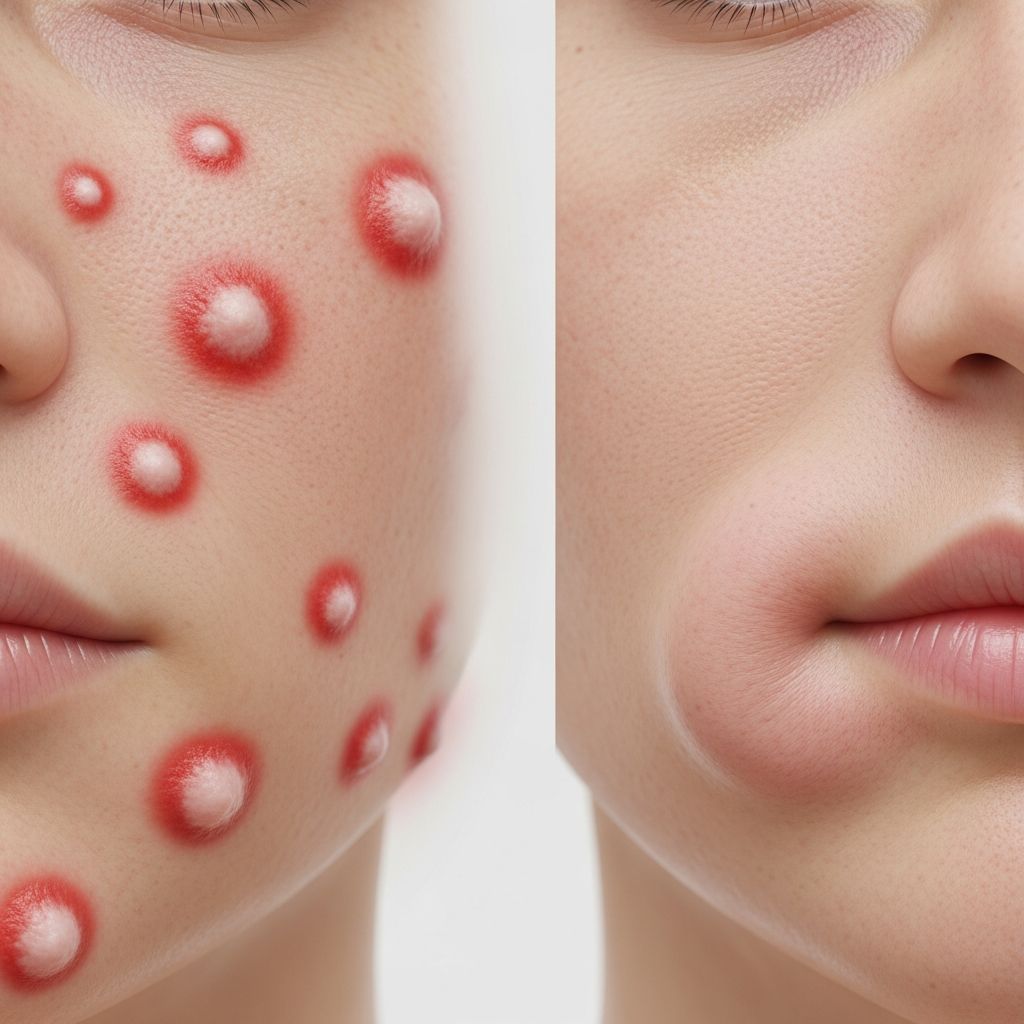
Urticaria, commonly known as hives, and angioedema represent mast cell-driven conditions characterized by transient wheals and deeper swellings, respectively. These emergencies require prompt recognition, particularly when airway involvement threatens life. Up to 20% of individuals experience urticaria sometime in life, with angioedema complicating 40-50% of cases.
What is urticaria?
Urticaria manifests as pruritic wheals—raised, erythematous plaques with central pallor—resulting from dermal histamine release causing vascular leakage. Lesions are polymorphic, ranging from millimeters to centimeters, and migrate across the body, resolving within 24 hours without residua. In skin of colour, wheals may appear lighter or darker than surrounding tissue.
What is angioedema?
Angioedema involves subcutaneous or submucosal edema, presenting as non-pitting swellings often affecting the face, lips, eyelids, tongue, hands, feet, or genitals. Unlike urticaria, it is typically non-pruritic and painful, lasting up to 72 hours. Throat or laryngeal involvement constitutes a medical emergency due to airway obstruction risk. Abdominal angioedema may mimic surgical pathology with cramping pain.
Clinical features
- Urticaria: Itchy wheals with flare; transient (<24h per lesion); can coalesce into large plaques.
- Angioedema: Asymmetric, non-pruritic swelling; common sites: periorbital, perioral, extremities; resolves slower (24-72h).
- Combined: Occurs in 40-50% of urticaria cases.
Symptoms arise minutes to hours post-trigger. Severe cases feature anaphylaxis: hypotension, wheezing, throat closure.
Classification
Urticaria/angioedema classify by duration and mechanism:
| Type | Duration | Prevalence/Causes |
|---|---|---|
| Acute | <6 weeks | 50% of cases; infections (viral common), foods, drugs, insects. |
| Chronic spontaneous | >6 weeks, idiopathic | Most chronic; autoimmune mast cell activation. |
| Inducible (physical) | >6 weeks, triggered | Dermographism, cold, heat, pressure, cholinergic, aquagenic, vibratory. |
Hereditary angioedema (HAE, C1-inhibitor deficiency) and acquired forms are bradykinin-mediated, lacking urticaria.
Causes and triggers
- Allergic: IgE-mediated; foods (nuts, shellfish), drugs (penicillin, NSAIDs), latex, stings.
- Non-allergic: Aspirin/NSAIDs (pseudoallergic), radiocontrast, opiates.
- Infections: Viral (e.g., hepatitis, EBV), bacterial, parasitic.
- Physical: Pressure (delayed 4-6h), cold (familial cold autoinflammatory syndrome), cholinergic (exercise/heat).
- Autoimmune: Chronic spontaneous urticaria (CSU); anti-FcεRI antibodies.
- Hereditary/Acquired: Types I-III HAE; ACE inhibitor-induced.
Chronic cases often idiopathic; food allergy rare beyond acute phase.
History and examination
Key history: onset timing, triggers (foods, drugs <60min suggestive allergy), duration, family history (HAE), medications (ACEi). Examine for wheal patterns, dermographism (scratching test), mucosal swelling.
| Clinical Clue | Suggestive Diagnosis |
|---|---|
| New drug/NSAID | Drug-induced |
| Food <1h | IgE allergy |
| Recurrent abdominal pain, no urticaria | HAE |
| Pressure-induced delayed | Delayed pressure urticaria |
Investigations
- First-line: CBC (eosinophilia?), ESR/CRP (systemic?), thyroid function (autoimmune association).
- Specific: Tryptase (acute mastocytosis/anaphylaxis), C1-INH levels/function (HAE), skin prick tests, serum IgE.
- Chronic: Basophil activation, autologous serum skin test (ASST) for autoimmunity.
- Challenge tests: Only specialist settings.
Routine allergy testing low-yield in chronic urticaria.
Differential diagnosis
- Mastocytosis: Darier sign (urticate on stroking lesions).
- Urticarial vasculitis: Fixed >24h, purpura, systemic (biopsy).
- Herpes gestationis, bullous pemphigoid (blisters).
- Ergotism, Schnitzler syndrome (monoclonal gammopathy).
- Anaphylaxis mimics: distributive shock.
Treatment: first-line
- Non-sedating H1-antihistamines: Bilastine 20mg OD, cetirizine 10mg OD; up to 4x dose if needed.
- Sedating H1: Chlorphenamine 4mg/6h PRN nights.
- Short-course steroids: Prednisolone 0.5mg/kg 3-5 days (avoid chronic).
- Triggers: Avoid identified allergens, aspirin, NSAIDs, tight clothing.
Related Stories



Management: second-line
For refractory CSU:
- H2-antihistamines: Ranitidine 150mg BD or famotidine.
- Montelukast: 10mg OD (leukotriene inhibitor).
- Omalizumab: Anti-IgE monoclonal; 300mg SC monthly (licensed CSU).
- Cyclosporin: 3-5mg/kg (steroid-sparing; monitor BP/renal).
- Dupilumab: Emerging for antihistamine-refractory cases.
Emergency management
Airway compromise (stridor, dysphonia):
- IM adrenaline 0.5mg (0.5ml 1:1000) stat, repeat 5min PRN.
- High-flow O2, IV access, nebulized salbutamol.
- Chlorphenamine IV 10mg, hydrocortisone 200mg IV.
- Intubate/OTC if needed; ICU transfer.
HAE attacks: C1-INH concentrate, icatibant (bradykinin B2 antagonist), ecallantide.
Inducible urticaria management
| Type | Triggers | Treatment |
|---|---|---|
| Dermographism | Scratching | High-dose H1 |
| Cold | Cold exposure | Antihistamines; warm-up prevention |
| Cholinergic | Heat/exercise | Danazol, anticholinergics |
| Delayed pressure | Pressure 4-6h | H1 + montelukast; avoid pressure |
Prognosis
Acute: self-limits <6 weeks. Chronic spontaneous: 50% remit 1y, >80% 5y. Inducible persists longer. Quality-of-life impact akin to severe ischaemic heart disease.
Patient education
- Recognize early swelling progression.
- Carry adrenaline auto-injector if history anaphylaxis.
- Urticaria app for trigger diary.
- Avoid unproven triggers (stress helps but not causative).
Frequently Asked Questions (FAQs)
Q: Is chronic urticaria a food allergy?
A: No, <5% cases; elimination diets ineffective and risky.
Q: Can urticaria be cured?
A: Acute yes; chronic remits spontaneously majority long-term.
Q: When to seek emergency care?
A: Difficulty breathing/swallowing, rapid swelling progression.
Q: Are antihistamines safe long-term?
A: Yes, non-sedating preferred; up to 4x dosing evidence-based.
Q: What if standard treatment fails?
A: Refer immunology; omalizumab/cyclosporin options.
References
- Angioedema – NHS — NHS. 2023. https://www.nhs.uk/conditions/angioedema/
- Hives (Urticaria) & Angioedema Overview — American Academy of Allergy, Asthma & Immunology. 2024. https://www.aaaai.org/tools-for-the-public/conditions-library/allergies/hives-(urticaria)-and-angioedema-overview
- Urticaria and Angioedema: A Practical Approach — American Academy of Family Physicians. 2004-03-01. https://www.aafp.org/pubs/afp/issues/2004/0301/p1123.html
- Urticaria and angioedema – Patient Info Leaflets — Primary Care Dermatology Society. 2025-01-31. https://www.pcds.org.uk/patient-info-leaflets/urticaria-and-angioedema
- Angioedema and Urticaria: Learn More About These Allergic Reactions — Allergy Fort Worth. 2023. https://www.allergyfortworth.com/angioedema-and-urticaria-learn-more-about-these-allergic-reactionsd47c8520
Similar Articles








Read full bio of Sneha Tete