UVA1 Phototherapy: Complete Guide To Benefits, Uses & Dosage
UVA1 phototherapy is an effective treatment for atopic dermatitis, sclerotic skin conditions like morphea, and other inflammatory dermatoses.
Author: Dr. Amanda Oakley, Dermatologist, Hamilton, New Zealand. Reviewed: 2023-10-01.
What is UVA1 phototherapy?
UVA1 phototherapy is a specialized form of ultraviolet light therapy utilizing the long-wave ultraviolet A1 (UVA1) spectrum, ranging from 340–400 nm. Unlike narrower UVB or broadband UVA, UVA1 penetrates deeper into the dermis, targeting cells in the superficial dermis and addressing conditions unresponsive to superficial therapies. Sessions typically last 10 minutes to 1 hour, administered 3–5 times weekly, with cumulative doses varying by protocol: low (10–30 J/cm²), medium (30–60 J/cm²), or high (60–130 J/cm²).
This deeper penetration enables UVA1 to induce apoptosis in infiltrating T lymphocytes, suppress antigen-presenting Langerhans cells, and stimulate fibroblasts to produce matrix metalloproteinases (MMPs) like collagenase-1, which degrade excess collagen. These mechanisms make it particularly effective for T-cell mediated inflammatory diseases and sclerotic conditions.
History
UVA1 phototherapy originated in the early 1990s in Germany, where it was first applied to severe atopic dermatitis. Pioneering studies demonstrated superior efficacy over conventional UVA/UVB, with faster clinical improvement after 10 sessions. Its adoption expanded to sclerotic diseases following observations of collagen reduction in morphea patients. Over 25 years, real-world evidence has refined its positioning, confirming efficacy in atopic dermatitis, morphea, urticaria pigmentosa, and select resistant dermatoses while clarifying limitations in others.
Mechanism of action
UVA1 exerts multiple immunomodulatory and structural effects:
- T-cell apoptosis: Induces programmed cell death in skin-infiltrating T-helper cells, reducing inflammation in atopic dermatitis and cutaneous T-cell lymphoma (CTCL). This leads to loss of T cells from eczematous lesions.
- Fibroblast modulation: Stimulates MMP production (e.g., collagenase-1) via singlet oxygen and hydrogen peroxide, breaking down excess dermal collagen. Simultaneously inhibits procollagen synthesis, achieving net collagen reduction in sclerotic diseases like morphea and scleroderma.
- Immune suppression: Inhibits Langerhans cell antigen presentation, thickens stratum corneum, and reduces pathogen susceptibility in atopic skin.
- Mast cell effects: Reduces immature mast cell activity, beneficial in mastocytosis and urticaria pigmentosa.
These actions explain UVA1’s versatility across inflammatory, neoplastic, and fibrotic dermatoses.
Indications for UVA1 phototherapy
UVA1 is indicated for deep dermal conditions:
- Acute severe and chronic atopic dermatitis
- Morphea (localized scleroderma)
- Scleroderma (systemic sclerosis)
- Cutaneous T-cell lymphoma (CTCL, e.g., mycosis fungoides)
- Urticaria pigmentosa / adult mastocytosis
- Lichen sclerosus
- Graft-versus-host disease (GVHD)
- Keloids and hypertrophic scars
- Chronic hand/foot eczema (dyshidrotic)
- Prurigo nodularis
- Granuloma annulare, sarcoidosis, and others resistant to NB-UVB
High-dose UVA1 (60–130 J/cm²) suits acute atopic dermatitis and CTCL; medium-dose (30–60 J/cm²) for morphea; low-dose (10–30 J/cm²) for mastocytosis and milder cases.
Dosing regimens
Doses are tailored by condition and skin type:
| Regimen | Dose (J/cm²) | Indications | Sessions/Week |
|---|---|---|---|
| Low-dose | 10–30 | Mastocytosis, early morphea, prurigo | 3–5 |
| Medium-dose | 30–60 | Morphea, lichen sclerosus, atopic dermatitis | 3–5 |
| High-dose | 60–130 | Severe atopic dermatitis, CTCL, dyshidrotic eczema | 3–5 |
Treatment courses span 20–40 sessions, with improvement often continuing post-therapy. Ultrasound confirms dermal softening in morphea.
Efficacy evidence
Atopic dermatitis
Systematic reviews of RCTs show high-dose UVA1 superior to UVA/UVB, with peak response after 10 treatments. Medium-dose effective in chronic cases; low-dose viable alternative.
Morphea and sclerotic diseases
In 201 morphea patients, medium-dose UVA1 yielded complete response in most, with ultrasound showing reduced dermal thickness and increased elasticity. Effective in scleredema, lichen sclerosus.
Related Stories



CTCL and neoplasms
Induces T-cell apoptosis, aiding mycosis fungoides resistant to NB-UVB.
Other conditions
Low-dose excels in mastocytosis (high satisfaction >65 TSQM score), keloids (normalized collagen), hand eczema (superior to PUVA cream).
Side effects of UVA1 phototherapy
Generally well-tolerated:
- Acute: Erythema (dose-dependent), pruritus, xerosis, pigmentary changes (hyper/hypopigmentation).
- Long-term risks: Theoretical photoaging, carcinogenesis (unknown due to recency; caution in <18 years). No increased NMSC in studies.
Lower erythema risk than UVB; eye protection mandatory.
Contraindications and precautions
Absolute: Photosensitivity disorders (e.g., lupus, porphyria), xeroderma pigmentosum, history of skin cancer.
Relative: Pregnancy, immunosuppression, high-dose in children. Protective eyewear required; sun avoidance post-treatment.
Practical issues
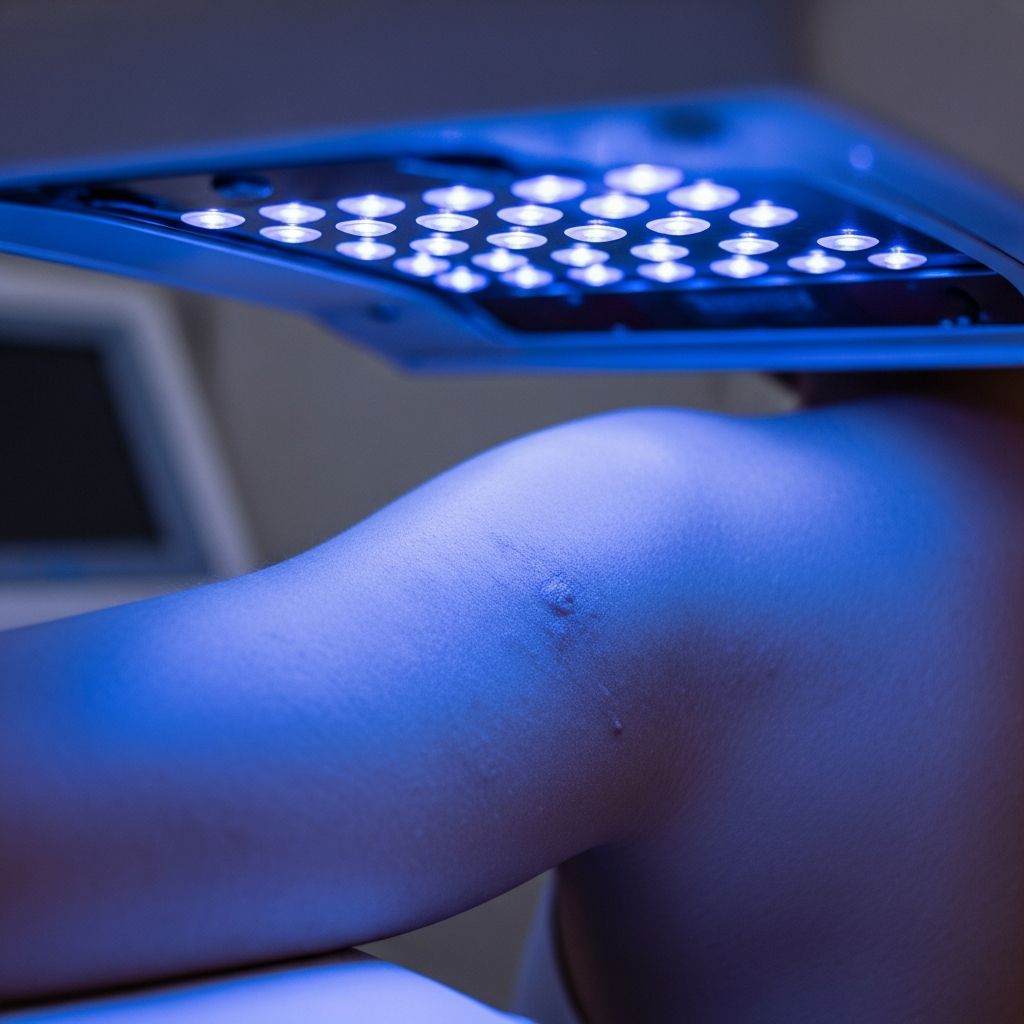
Delivered in whole-body cabins or localized panels. No psoralens needed (unlike PUVA). Maintenance not routine; monitor via clinical/ultrasound assessment. Cost-effective for resistant cases.
Frequently asked questions
What skin conditions does UVA1 phototherapy treat?
Primarily atopic dermatitis, morphea, scleroderma, CTCL, mastocytosis, keloids, and chronic eczema.
How many sessions are needed?
Typically 20–40 sessions over 4–12 weeks, 3–5/week.
Is UVA1 safer than other phototherapies?
Lower erythema risk; long-term risks unknown but favorable profile.
Can children receive UVA1?
Cautiously; not routine under 18 due to unknown long-term effects.
What devices deliver UVA1?
Sellamed UVA1 sources or similar filtered cabinets.
UVA1 phototherapy vs other phototherapies
| Modality | Wavelength | Depth | Key Uses | Side Effects |
|---|---|---|---|---|
| UVA1 | 340–400 nm | Deep dermis | Morphea, atopic, CTCL | Low erythema |
| NB-UVB | 311 nm | Epidermis | Psoriasis, vitiligo | Burn risk |
| PUVA | 320–400 nm + psoralen | Dermis | Psoriasis, CTCL | High carcinogenicity |
UVA1 preferred for dermal targets without psoralen toxicity.
References
- Efficacy and Satisfaction of Low Doses UVA1 Phototherapy — Pabón CCAS, et al. National Library of Medicine. 2023-03-23. https://pmc.ncbi.nlm.nih.gov/articles/PMC10059657/
- The realistic positioning of UVA1 phototherapy after 25 years — Brazzelli V, et al. Frontiers in Medicine. 2023-11-09. https://www.frontiersin.org/journals/medicine/articles/10.3389/fmed.2023.1295145/full
- UVA1 phototherapy — DermNet NZ. 2023-10-01. https://dermnetnz.org/topics/uva1-phototherapy
- The Use of UVA1 to Treat Skin Disorders — Sewon Kang, MD, Johns Hopkins. YouTube (transcript). 2010. https://www.youtube.com/watch?v=HaplVbafK9I
- Ultraviolet (UVA and UVB) Light Therapy in the Treatment of… — ClinicalTrials.gov. U.S. National Library of Medicine. 2005-08-04 (updated). https://clinicaltrials.gov/study/NCT00129415
Similar Articles








Read full bio of Sneha Tete