Vascular Skin Problems: 8 Common Lesions & Laser Treatments
Comprehensive guide to conditions affecting blood vessels in the skin, including diagnosis and vascular laser treatments.
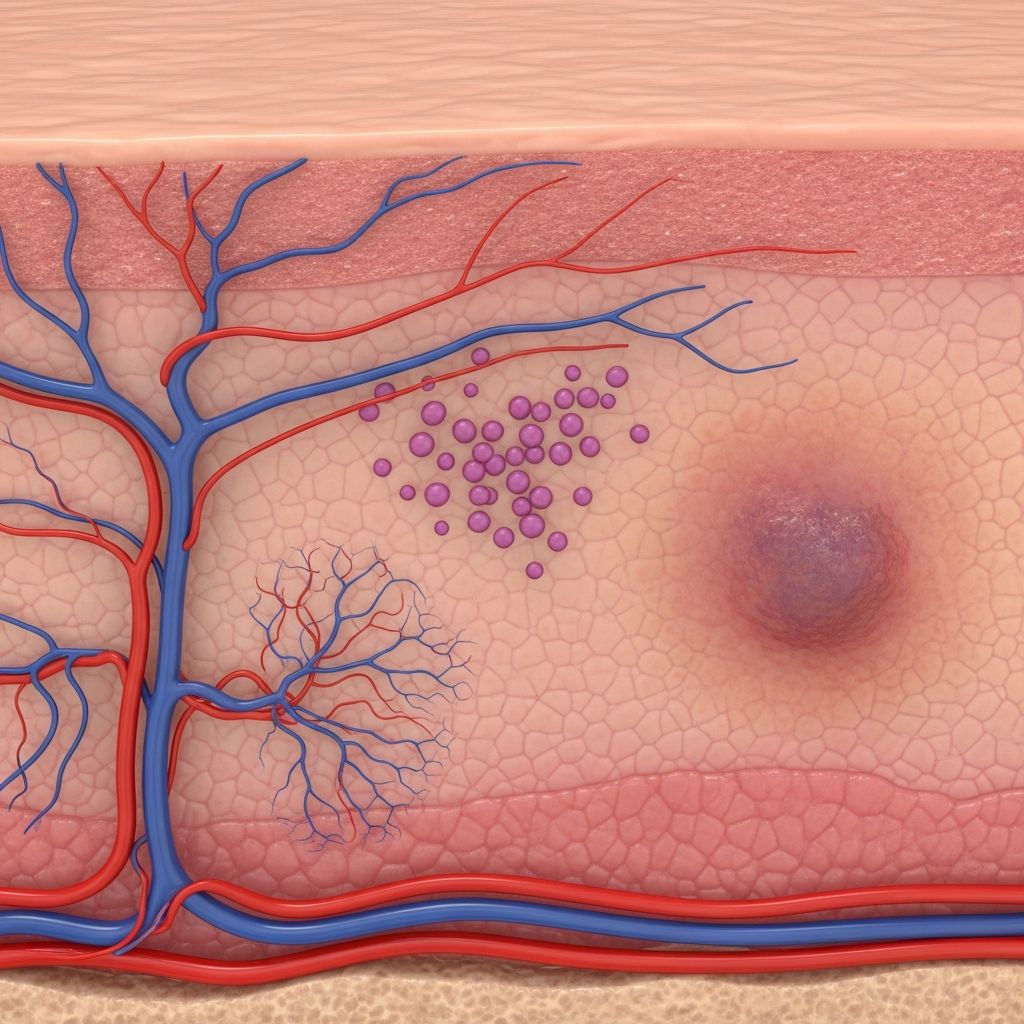
Conditions affecting blood vessels in the skin manifest as visible red, purple, or blue lesions due to dilated, malformed, or increased blood vessels. These vascular skin problems range from benign proliferations to pathological dilatations and are commonly treated with vascular lasers and light devices.
Conditions Affecting Blood Vessels
Vascular skin lesions arise from abnormalities in the structure or function of cutaneous blood vessels. They can be congenital or acquired, appearing as macules, papules, plaques, or nodules. Common types include telangiectasias (dilated small vessels), cherry angiomas (benign capillary proliferations), venous lakes (dilated venules on sun-exposed areas), and spider angiomas (central arteriole with radiating vessels). These conditions often increase with age, sun exposure, or hormonal changes.
Key vascular skin conditions include:
- Cherry angiomas: Small, bright red, dome-shaped papules (1-5 mm) from proliferated capillaries. Common after age 30, increasing in number with age. Harmless but cosmetically concerning.
- Telangiectasias: Fine, thread-like red lines from dilated capillaries or venules. Seen on legs (often with varicose veins), face, or sun-damaged skin. May indicate rosacea or scleroderma.
- Spider angiomas: Central red dot with radiating legs, pulsating with pressure. Common in pregnancy, liver disease, or estrogen excess.
- Venous lakes: Dark blue-purple, soft, compressible papules on lips, ears, or cheeks in elderly sun-exposed skin.
- Pyogenic granulomas: Rapidly growing, red, friable nodules that bleed easily, often post-trauma.
- Angiokeratomas: Dark red to black, warty papules, such as in Fabry disease or isolated on genitals.
- Glomus tumors: Painful, blue-red nodules under nails or skin from modified smooth muscle cells.
- Kaposi sarcoma: Purple plaques/patches from HHV-8 in immunocompromised patients.
These lesions are diagnosed clinically but may require dermoscopy or biopsy to exclude malignancy. Risk factors include genetics, UV exposure, pregnancy, and systemic diseases like cirrhosis or autoimmune disorders.
Clinical Features and Variations
In lighter skin types, vascular lesions appear bright red; in darker skin, they may look purple or violaceous due to pigment contrast. For example, cherry angiomas show heightened visibility against pale backgrounds, while telangiectasias blend subtly in brown skin.
Complications can include bleeding (pyogenic granulomas), cosmetic distress, or secondary infection. Systemic associations warrant investigation, e.g., multiple spider angiomas suggest liver dysfunction.
Vascular Lasers and Light Devices
Vascular lasers target hemoglobin in blood vessels, causing selective photothermolysis—heating and coagulating vessels without damaging surrounding skin. Pulsed dye lasers (PDL, 585-595 nm) are gold standard for superficial lesions, absorbing oxyhemoglobin efficiently.
| Device Type | Wavelength (nm) | Target Lesions | Advantages |
|---|---|---|---|
| Pulsed Dye Laser (PDL) | 585-595 | Telangiectasias, port-wine stains, hemangiomas | High efficacy, minimal scarring; purpura common but resolves. |
| Nd:YAG Laser | 1064 | Leg veins, deeper vessels | Penetrates deeper; good for darker skin types. |
| KTP Laser | 532 | Facial telangiectasias, cherry angiomas | Precise, less purpura than PDL. |
| Intense Pulsed Light (IPL) | 500-1200 | Diffuse telangiectasias, rosacea | Broad spectrum; treats pigmentation too. |
| Diode Laser | 810-940 | Small leg veins | Portable, cost-effective. |
Treatment protocols involve 1-4 sessions, spaced 4-6 weeks apart. Cooling devices minimize pain and epidermal damage. Post-treatment: bruising, crusting (resolves 7-14 days). Contraindications include active tanning, photosensitizing medications, or keloid scarring history.
Treatment Outcomes and Considerations
Success rates: 70-90% clearance for PDL on facial telangiectasias. Recurrence possible due to new vessel formation; maintenance sessions advised. Darker skin types (Fitzpatrick IV-VI) require longer wavelengths (Nd:YAG) to avoid dyspigmentation.
Sclerotherapy (hypertonic saline or polidocanol) complements lasers for larger leg veins (>1 mm). Topical agents like brimonidine offer temporary camouflage for diffuse erythema.
Diagnosis of Vascular Skin Problems
Most are clinical, aided by dermoscopy: cherry angiomas show red lakes, spiders pulsate. Biopsy rarely needed unless atypical (e.g., amelanotic melanoma mimic). Vascular studies (duplex ultrasound) for leg veins assess reflux.
Related Stories



Differential diagnoses:
- Melanocytic nevi or basal cell carcinoma (pearly borders absent).
- Infectious (impetigo, bacillary angiomatosis).
- Inflammatory (granuloma annulare).
Prevention and Management
Sun protection (SPF 50+ daily) prevents photoaging-induced telangiectasias. Leg elevation, compression stockings for venous insufficiency. Avoid trauma to prevent pyogenic granulomas. Regular skin checks for high-risk patients.
Frequently Asked Questions (FAQs)
Q: Are cherry angiomas dangerous?
A: No, cherry angiomas are benign and do not become cancerous, though rapid change warrants evaluation.
Q: How many laser sessions for leg telangiectasias?
A: Typically 2-4 sessions, depending on vessel size and response; Nd:YAG preferred for deeper veins.
Q: Can vascular lasers be used on dark skin?
A: Yes, with caution using longer wavelengths like 1064 nm Nd:YAG to minimize pigment risks.
Q: What causes spider angiomas?
A: Often idiopathic or linked to pregnancy, liver disease, or estrogen; resolve post-partum or treatment.
Q: Is sclerotherapy painful?
A: Mild stinging during injection; compression post-procedure minimizes discomfort and bruising.
Related Topics
This comprehensive overview draws from dermatological expertise on vascular anomalies, emphasizing safe, effective laser therapies for improved skin appearance and function.
References
- Vascular Lesions: Diagnosis and Management — American Academy of Dermatology. 2024-01-15. https://www.aad.org/public/diseases/a-z/vascular-lesions
- Pulsed Dye Laser Treatment of Vascular Lesions — Journal of the American Academy of Dermatology (PubMed). 2023-05-20. https://pubmed.ncbi.nlm.nih.gov/37178901/
- Guidelines on Laser Treatment for Cutaneous Vascular Lesions — British Association of Dermatologists. 2024-03-10. https://www.bad.org.uk/pils/vascular-lasers/
- Telangiectasias and Vascular Malformations — UpToDate (Wolters Kluwer). 2025-11-01. https://www.uptodate.com/contents/telangiectasias
- NHS Guidelines: Vascular Skin Conditions — National Health Service UK. 2024-08-22. https://www.nhs.uk/conditions/cherry-angioma/
Similar Articles








Read full bio of Sneha Tete