Vasopressors: Types, Uses, and Side Effects
Understanding vasopressors: medications that restore blood pressure and tissue perfusion in critical care.
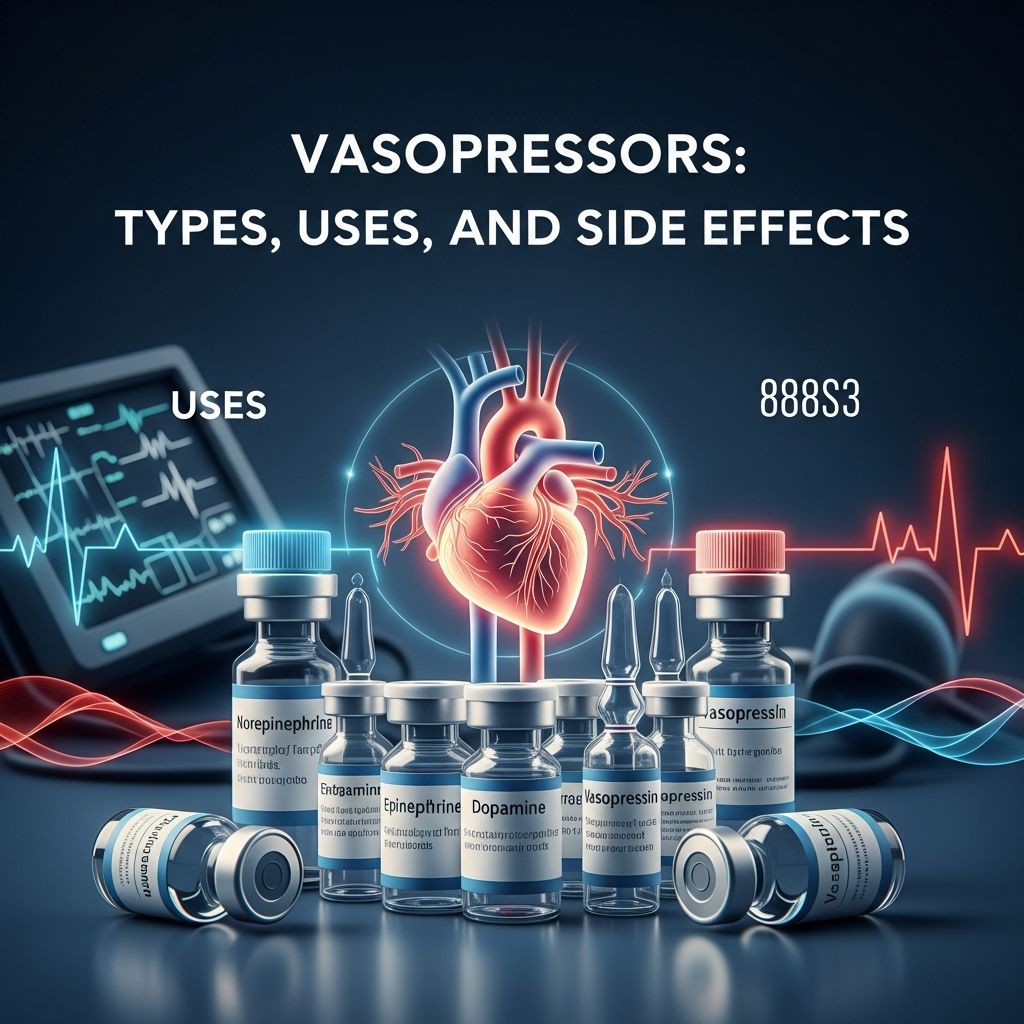
What Are Vasopressors?
Vasopressors are powerful medications used to restore and maintain blood pressure in patients experiencing shock or severe hypotension. These drugs work by narrowing blood vessels and increasing heart contractility, which helps improve blood flow to vital organs and prevent organ dysfunction. Vasopressors are essential medications in intensive care units (ICUs), used in approximately 27% of patients admitted to critical care settings. They represent a cornerstone of treatment for various types of shock, including septic shock, cardiogenic shock, and other life-threatening conditions characterized by inadequate tissue perfusion.
How Do Vasopressors Work?
Vasopressors function through different mechanisms depending on their specific classification. These medications stimulate receptors on blood vessel walls and the heart, triggering physiological responses that increase blood pressure and improve organ perfusion. By increasing blood vessel tone and cardiac output, vasopressors help maintain a minimum mean arterial pressure of at least 65 mm Hg, which is considered adequate for preserving organ function. The restoration of blood pressure improves tissue perfusion and helps reverse or prevent organ dysfunction, a critical outcome in managing critically ill patients.
Types of Vasopressors
Vasopressors are classified into several categories based on their mechanism of action and primary effects on the cardiovascular system:
Catecholamine Vasopressors
Norepinephrine is considered the first-line vasopressor for treating shock and hypotension. It works by stimulating alpha and beta receptors, providing both vasoconstriction and modest increases in heart contractility. Norepinephrine is preferred in most clinical situations because it maintains cerebral and coronary blood flow while increasing systemic vascular resistance.
Epinephrine is typically reserved for situations where norepinephrine alone is insufficient. It has stronger beta-receptor activity, leading to increased heart rate and contractility in addition to vasoconstriction. However, high-dose epinephrine use is associated with potential complications including increased lactate levels and potential worsening of organ perfusion in certain conditions.
Dopamine acts in a dose-dependent manner. At lower doses, it may improve renal perfusion, but at higher doses, it primarily causes vasoconstriction. Dopamine is less commonly used as a first-line agent compared to norepinephrine due to its less predictable effects.
Non-Catecholamine Vasopressors
Vasopressin is a non-catecholamine option used as a second-line adjunctive agent when standard catecholamine therapy is insufficient. It works as a V1 and V2 agonist, leading to peripheral vasoconstriction and water reabsorption. Vasopressin is particularly useful in helping to decrease catecholamine dosage requirements. Research shows that vasopressin response—defined as achieving adequate blood pressure with decreased catecholamine requirements—is associated with better clinical outcomes, including lower mortality risk and improved clinical trajectories in septic shock patients.
Angiotensin II represents a newer addition to the vasopressor arsenal. The ATHOS-3 study investigated angiotensin II as a treatment for vasodilatory shock patients and demonstrated its effectiveness in certain populations. This agent offers an alternative mechanism of action and may help limit the toxicities associated with high-dose catecholamine monotherapy.
Phenylephrine is a selective alpha-1 receptor agonist that causes pure vasoconstriction without direct effects on heart contractility. It is useful in situations where increasing heart rate is undesirable.
Administration Routes and Methods
Traditionally, vasopressors have been administered through central venous catheters to minimize the risk of local tissue damage from extravasation. However, recent clinical research has challenged this requirement, opening new possibilities for vasopressor administration.
Related Stories



Central Venous Catheter Administration
Central venous catheters remain the preferred method for vasopressor administration in many clinical settings. While they provide a reliable route for medication delivery, CV catheter insertion and maintenance carry significant risks. Procedural complications include pneumothorax (occurring in 1.5% to 3.1% of patients), arterial puncture (6.3% to 15%), hematoma formation (3.8% to 4.4%), and deep vein thrombosis (affecting approximately 15% of patients). Additionally, catheter-related bloodstream infections represent a serious complication associated with prolonged CV catheter use.
Peripheral Intravenous Catheter Administration
Growing evidence supports the safe use of peripheral intravenous catheters for vasopressor administration under specific protocols. Peripheral administration shortens the time required to initiate vasopressor therapy, which can be critical in emergency situations. While PIV catheter use is associated with local adverse events such as tissue infiltration, these complications infrequently require intervention and rarely lead to catastrophic outcomes such as compartment syndrome or amputation. Protocols allowing peripheral vasopressor administration typically limit infusion duration to 24 to 48 hours and include strict monitoring requirements.
When implementing peripheral vasopressor administration, careful protocols are essential. These include preset catheter sizes and locations, confirmation of placement with ultrasonography, assessment every 2 hours, and norepinephrine dosage limitations (typically maximum 15 μg/min). In cases of extravasation, immediate intervention including stopping the infusion, aspiration of residual medication, and application of phentolamine can prevent tissue injury.
Clinical Uses of Vasopressors
Vasopressors are employed in various critical clinical scenarios where blood pressure support is necessary:
Septic Shock
In septic shock, vasopressors aim to improve tissue perfusion and prevent persistent organ dysfunction. Recent research emphasizes a personalized approach to vasopressor selection based on individual patient hemodynamics rather than applying standardized protocols to all patients. Understanding whether a patient has normal cardiac function, impaired cardiac function, or hyperdynamic circulation helps guide the choice between vasopressors and their combination with inotropic agents.
Cardiogenic Shock
Vasopressors support blood pressure when the heart’s pumping ability is compromised, working in conjunction with other supportive measures to maintain vital organ perfusion.
Anaphylactic Shock
Epinephrine serves as the primary treatment for anaphylaxis, combining vasopressor effects with anti-inflammatory properties.
Postoperative Hypotension
Following major surgery, vasopressors may be necessary to maintain adequate blood pressure during recovery, particularly when standard fluid resuscitation proves insufficient.
Side Effects and Complications
Like all medications, vasopressors carry potential side effects and complications that must be carefully monitored:
Common Side Effects
Patients receiving vasopressors may experience increased heart rate, anxiety, tremor, and headache. These effects typically result from the stimulation of sympathetic nervous system receptors.
Serious Complications
Prolonged high-dose catecholamine use can lead to increased lactate levels, potential tissue ischemia, and worsening organ perfusion in certain conditions. Excessive vasoconstriction may compromise perfusion to peripheral tissues, potentially resulting in digital ischemia or gangrene in severe cases. Additionally, vasopressor-induced hypertension can precipitate cardiac arrhythmias, myocardial ischemia, and stroke.
Local Complications with Peripheral Administration
Extravasation of vasopressors through peripheral lines can cause local tissue infiltration and inflammation. Immediate recognition and treatment, including vasopressor discontinuation and phentolamine application, can prevent serious tissue damage.
Monitoring and Management Considerations
Appropriate vasopressor management requires continuous monitoring and individualized titration:
Hemodynamic Monitoring
Regular assessment of blood pressure, heart rate, and markers of tissue perfusion guides vasopressor dosing decisions. Understanding the patient’s underlying cardiac function—whether normal, impaired, or hyperdynamic—is crucial for selecting appropriate vasopressor therapy. Patients with hyperdynamic circulation may require different vasopressor strategies compared to those with depressed cardiac function.
Personalized Treatment Approach
Modern critical care emphasizes a holistic, individualized approach to vasopressor therapy. Rather than applying standardized protocols to all patients, clinicians should assess each patient’s unique hemodynamic profile. The choice and combination of medications should be tailored to the patient’s underlying cardiovascular function, with consideration for how each agent affects myocardial contractility and systemic vascular resistance.
Duration of Therapy
Vasopressor therapy should be titrated to the lowest effective dose and discontinued as soon as clinical improvement allows. Prolonged high-dose therapy increases the risk of complications, making regular reassessment essential.
Adjunctive Vasopressor Therapy
In patients with inadequate response to first-line vasopressors, adjunctive agents may be added. Vasopressin, when added to catecholamine therapy, can help decrease the required catecholamine dose in approximately 45% of patients. Early response to vasopressin—demonstrated by achieving adequate blood pressure with reduced catecholamine requirements within 6 hours of initiation—predicts better clinical trajectories, including lower 28-day mortality risk and reduced risk of chronic critical illness.
The concept of multimodal vasopressor therapy is gaining acceptance, with the recognition that combining different classes of agents with distinct mechanisms of action may provide superior outcomes compared to monotherapy with escalating doses of a single agent.
Key Clinical Considerations
Several important principles guide optimal vasopressor use in clinical practice. First, vasopressors should be used promptly when indicated, as delayed initiation can contribute to irreversible organ damage. Second, the choice of vasopressor should be individualized based on the underlying cause of hypotension and the patient’s hemodynamic profile. Third, vasopressor therapy should be combined with definitive treatment of the underlying cause—such as antibiotics in sepsis or revascularization in acute coronary syndromes. Finally, regular reassessment and titration to the minimum effective dose helps minimize complications while maintaining adequate organ perfusion.
Frequently Asked Questions
Q: Can vasopressors be given through a peripheral IV line?
A: Yes, growing evidence supports peripheral IV administration of vasopressors under strict protocols, though central lines remain preferred in most ICU settings. Peripheral administration can shorten time to vasopressor initiation and may reduce some risks associated with central catheter placement. Duration is typically limited to 24-48 hours with close monitoring.
Q: What is the difference between vasopressors and inotropes?
A: Vasopressors primarily work by increasing blood vessel tone (vasoconstriction), while inotropes primarily increase heart contractility. Some agents like epinephrine have both effects. The choice depends on the underlying cause of hypotension—whether it results from inadequate vascular tone or poor cardiac output.
Q: Why is norepinephrine the first-line vasopressor?
A: Norepinephrine is preferred because it maintains blood flow to vital organs (brain and heart) while increasing systemic blood pressure. It has a more predictable effect profile and better outcomes compared to other first-line options in most shock states.
Q: How long can patients stay on vasopressors?
A: Duration depends on the underlying condition and clinical response. While vasopressors are continued as long as needed, prolonged high-dose therapy increases complication risks. Most critically ill patients are weaned from vasopressors within days to weeks as the underlying condition improves.
Q: What happens if vasopressor extravasates into surrounding tissue?
A: Extravasation can cause local tissue infiltration and inflammation. Immediate treatment includes stopping the infusion, aspirating residual medication, and applying phentolamine to the site. Most cases resolve without serious tissue damage with prompt intervention.
Q: Can vasopressin be used alone to treat shock?
A: Vasopressin is typically used as a second-line adjunctive agent rather than monotherapy. When added to catecholamine therapy, it can help reduce catecholamine requirements in approximately half of patients with septic shock.
References
- Do I always need a central venous catheter to administer vasopressors? — Cleveland Clinic Journal of Medicine. 2022. https://www.ccjm.org/content/91/5/287
- Vasopressin Response and Clinical Trajectory in Septic Shock — National Institutes of Health, PubMed Central. 2023. https://pmc.ncbi.nlm.nih.gov/articles/PMC10236982/
- Septic Shock and Hyperdynamic Circulation — Cleveland Clinic Consult QD. 2024. https://consultqd.clevelandclinic.org/septic-shock-and-hyperdynamic-circulation
- Vasopressin Injection: Uses and Side Effects — Cleveland Clinic. 2024. https://my.clevelandclinic.org/health/drugs/19734-vasopressin-adh-injection
- The Case for Angiotensin II in Vasodilatory Shock Patients — Cleveland Clinic Consult QD. 2023. https://consultqd.clevelandclinic.org/the-case-for-angiotensin-ii-in-vasodilatory-shock-patients-gathers-more-steam
- Optimizing Vasopressin Use and Initiation Timing in Septic Shock — PubMed. 2023. https://pubmed.ncbi.nlm.nih.gov/37479058/
- Pharmacology 101: Vasopressors — tl;dr pharmacy. 2024. https://www.tldrpharmacy.com/content/pharmacology-101-vasopressors
Similar Articles








Read full bio of medha deb