Venous Lake Images: Clinical Photo Guide For Diagnosis
Explore detailed images and clinical insights into venous lakes, common vascular lesions on the lips and face.
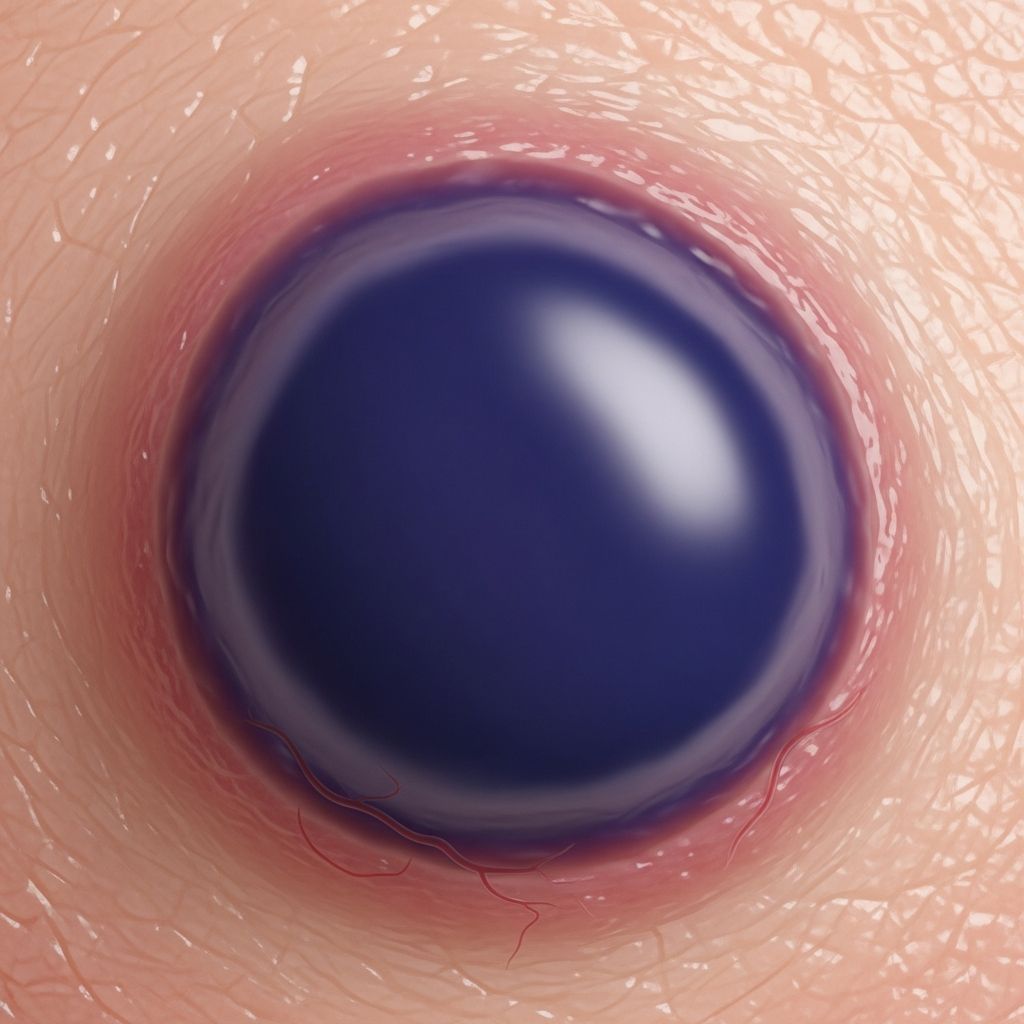
Venous lakes, also known as lip angiomas, represent a prevalent benign vascular condition characterized by dilated venules within the skin. These lesions typically manifest as soft, bluish or purple macules or papules, most commonly on the lower lip’s vermilion border or mucosal surface. This image gallery provides an authoritative visual reference for identifying venous lakes, aiding dermatologists, general practitioners, and medical students in accurate diagnosis and management. Understanding these lesions is crucial, as they are frequently encountered in middle-aged and older adults and can mimic more serious conditions like melanoma or basal cell carcinoma.
What is a Venous Lake?
A
venous lake
is a common, harmless vascular dilatation presenting as a soft, compressible blue or purple papule or macule, typically measuring 0.2–1 cm in diameter. It arises from a dilated venule in the upper dermis and is filled with slow-flowing venous blood, giving it a characteristic dark blue to purple hue. While asymptomatic in most cases, these lesions can become prominent due to cosmetic concerns or minor trauma leading to bleeding.Histologically, a venous lake consists of a single dilated vascular space lined by a thin endothelial layer, often surrounded by fibrous tissue. The lesion’s compressibility distinguishes it from solid nodules, as pressure causes the blood to blanch and disappear temporarily, confirming its vascular nature.
Demographics
Venous lakes predominantly affect
middle-aged to elderly individuals
, with a peak incidence in those over 50 years. They occur equally across races and show a slight male predominance, possibly due to cumulative sun exposure on the face. Common sites include the lower lip (most frequent), ears, cheeks, nose, neck, and upper chest. Sun-damaged skin, particularly actinically weathered areas like the vermilion lip, predisposes individuals to their development.- Age: >50 years (common in 60–80-year-olds)
- Sex: Males slightly more affected
- Race: All ethnicities
- Risk factors: Chronic UV exposure, fair skin
Clinical Features
Clinically, venous lakes appear as
well-defined, soft, bluish-purple papules or plaques
that blanch completely on digital pressure or diascopy (using a glass slide). They are non-tender, non-pulsatile, and lack scaling or crusting unless traumatized. Size varies from 1–10 mm, and multiple lesions can occur simultaneously on the lips or ears.Key characteristics include:
- Soft, spongy consistency
- Dark blue to purple color due to deoxygenated blood
- Located on sun-exposed areas (lips, ears, face)
- May darken or enlarge slowly over time
- Occasional episodic bleeding after minor trauma
Venous Lake Image Gallery
This curated collection showcases high-resolution clinical photographs of venous lakes in various presentations. Images depict lesions on different skin types and anatomical sites, highlighting diagnostic features under natural light, dermoscopy, and compression.
Classic Venous Lake on Lower Lip
Description: A solitary 4 mm blue-purple papule on the vermilion border of the lower lip in a 65-year-old man. The lesion blanches fully on glass slide compression, revealing underlying normal mucosa. Note the well-circumscribed borders and lack of induration.
Multiple Venous Lakes on Ear
Description: Two adjacent compressible purple nodules on the helix of the ear in sun-damaged skin. These lesions are typical in elderly patients with prolonged UV exposure history.
Related Stories



Large Venous Lake on Upper Lip
Description: A 1 cm plaque-like venous lake spanning the upper lip mucosa, appearing darker due to stagnation. No associated inflammation or ulceration.
Dermoscopy of Venous Lake
Under dermoscopy, venous lakes exhibit a
homogenous bluish structureless area
with irregular but non-branching vessels. Compression reveals clearance of color, differentiating from pigmented lesions.| Feature | Venous Lake | Melanoma | Haemangioma |
|---|---|---|---|
| Color | Homogenous blue/purple | Multicomponent asymmetry | Reddish with lacunae |
| Compression | Blanches completely | No change | Partial blanch |
| Vessels | Irregular dilated | Atypical network | Branching |
| Pigment | Absent | Present (brown/black) | Absent |
Diagnosis
Diagnosis is primarily
clinical
, relying on characteristic appearance and blanching test. Dermoscopy enhances specificity, showing a structureless blue-violet field without pigment networks or dots. Biopsy is reserved for atypical cases, revealing dilated subepidermal venules with thrombosis or fibrosis in chronic lesions. Immunohistochemistry (CD31, CD34 positive endothelium) confirms vascular origin if needed.Differential Diagnosis
Venous lakes must be distinguished from malignant or premalignant lesions, particularly on the lip. Key differentials include:
- Melanoma: Pigmented, asymmetrical, non-blanching
- Basal cell carcinoma: Pearly rolled borders, telangiectasia, ulceration
- Squamous cell carcinoma: Indurated, keratotic, may bleed
- Haemangioma: Brighter red, multiple small vessels
- Pyogenic granuloma: Rapid growth, collarette scale, friable
- Metastatic adenocarcinoma: Firm purple nodule (rare)
Suspicious features warrant excision biopsy: rapid growth, induration, asymmetry, irregular borders, color variation, or diameter >6 mm.
Treatment
Venous lakes are
benign and asymptomatic
, requiring no intervention unless cosmetically bothersome or recurrently bleeding. Treatment options focus on vascular destruction:- Laser therapy: Pulsed dye laser (585–595 nm) or Nd:YAG (1064 nm) targets haemoglobin, causing coagulation. Multiple sessions may be needed; minimal scarring.
- Electrocautery/hyfrecation: Effective for small lesions; quick office procedure.
- Cryotherapy: Liquid nitrogen freezes the lesion; risk of hypopigmentation.
- Sclerotherapy: Injection of sclerosant (e.g., sodium tetradecyl sulfate) collapses the vessel.
- Surgical excision: Reserved for large or diagnostic uncertainty cases; linear scar likely.
Post-treatment, expect crusting for 7–10 days. Recurrence is uncommon but possible in untreated adjacent venules.
Frequently Asked Questions (FAQs)
Q: Are venous lakes cancerous?
A: No, venous lakes are entirely benign vascular dilatations with no malignant potential. They do not progress to cancer.
Q: Can venous lakes be prevented?
A: Limiting sun exposure with lip balms containing SPF and hats may reduce development on UV-exposed sites.
Q: Is treatment painful?
A: Local anaesthesia minimizes discomfort. Lasers and cautery cause brief stinging; post-procedure soreness resolves quickly.
Q: Do venous lakes bleed easily?
A: They can bleed profusely if traumatized due to poor vascular support, but this is uncommon without injury.
Q: When should I see a dermatologist?
A: Consult if the lesion changes rapidly, becomes painful, ulcerates, or resembles skin cancer features (ABCDE rule).
Related Vascular Conditions
Venous lakes belong to the spectrum of cutaneous vascular abnormalities, including telangiectasias, angiomas, and haemangiomas. For further reading on blood vessel disorders, explore DermNet’s vascular skin problems section.
References
- Venous Lake — DermNet NZ (Dr Amanda Oakley). 2017-12. https://dermnetnz.org/topics/venous-lake
- Venous Lake Image — DermNet NZ. Accessed 2026. https://dermnetnz.org/imagedetail/9561-venous-lake
- Venous Lake Images — DermNet NZ. 2011. https://dermnetnz.org/topics/venous-lake-images
- Vascular Skin Problems — DermNet NZ. 2003. https://dermnetnz.org/topics/vascular-skin-problems
- Dermatology Differential Diagnosis — Primary Care Dermatology Society / ProductiveMedic. Accessed 2026. https://productivemedic.com/clinical-presentation/dermatology/
- Vascular Proliferations and Abnormalities — DermNet NZ (A/Prof Amanda Oakley). 2016-02. https://dermnetnz.org/topics/vascular-proliferations-and-abnormalities-of-blood-vessels
Similar Articles








Read full bio of medha deb