Venous Malformation Guide: Symptoms, Causes & Treatment
Comprehensive guide to venous malformations: causes, symptoms, diagnosis, and multidisciplinary treatment options for optimal management.
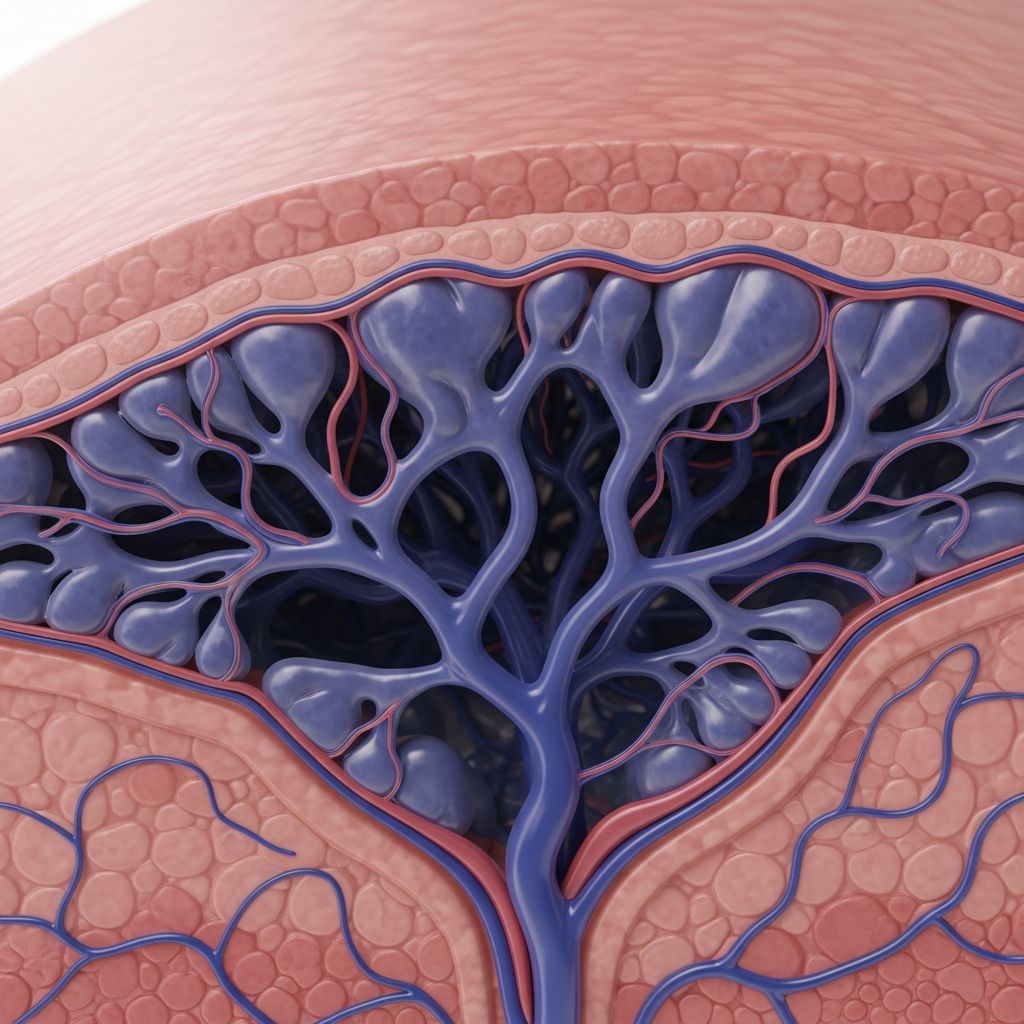
Venous malformation (VM), also known as venous angioma, phlebectasia, or varix, represents the most common vascular malformation comprising ectatic, tortuous veins with thin walls and sparse smooth muscle. These slow-flow lesions arise from errors in vascular development during embryogenesis, persisting as congenital anomalies present at birth, though often undetected until later in life.
What is venous malformation?
Venous malformations constitute approximately 55% of all vascular malformations, distinguished by their low-flow nature involving malformed venous channels without arterial involvement. Unlike high-flow lesions such as arteriovenous malformations, VMs feature stagnant blood flow prone to thrombosis and phleboliths formation.
Histologically, VMs display dilated, irregular venous ectasias lined by flat endothelium, separated by scant fibrous stroma, lacking the organized structure of normal veins. They may involve dermis, subcutaneous tissue, muscle, or viscera, with sizes ranging from pinpoint lesions to extensive involvement occupying entire limbs or body segments.
Classification distinguishes truncal VMs (along named venous axes) from diffuse forms. Localised lesions present as soft, compressible bluish nodules, while extensive VMs cause limb hypertrophy, functional impairment, and cosmetic disfigurement.
Who gets venous malformation?
Venous malformations manifest across all age groups without gender predilection, though symptoms often intensify during puberty, pregnancy, or trauma due to hormonal influences and increased venous pressure. Familial inheritance occurs in 15% of cases, linked to mutations in TIE2/TEK (extratruncal VMs) or PIK3CA genes activating PI3K/AKT/mTOR pathway.
- Sporadic VMs: Account for 85% of cases, arising from somatic mosaicism.
- Inherited syndromes: Glomuvenous malformation (glomangioma; glomulin gene), cutaneomucosal VM (RASA1/FAM192A), and blue rubber bleb naevus syndrome (TEF mutations).
Extracutaneous involvement affects 40% of patients, targeting muscles (85%), bone (16%), joints, or viscera like gastrointestinal tract causing chronic bleeding.
What causes venous malformation?
Venous malformations originate from developmental arrest between the 4th–8th gestational weeks, when angioblasts fail to remodel into mature veins. Genetic studies identify activating mutations in endothelial cell signalling pathways:
| Gene | Mutation Effect | Clinical Features |
|---|---|---|
| TEK/TIE2 | Constitutive activation of angiopoietin receptor | Multiple truncal VMs, multifocal |
| PIK3CA | PI3K/AKT/mTOR hyperactivation | Diffuse, infiltrative VMs responsive to sirolimus |
| GLMN | Loss-of-function | Glomuvenous malformations (cobblestone papules) |
| RASA1 | RasGAP dysfunction | Capillary-venous malformations ± AVMs |
Somatic mosaicism explains localised lesions, while germline mutations produce hereditary patterns.
What are the clinical features of venous malformation?
Venous malformations appear as soft, bluish-purple, compressible plaques or nodules, increasing in size with dependency, Valsalva, or crying due to venous stasis. Key features include:
- Cutaneous: Blanchable blue macules to spongy swellings; phleboliths palpable as hard nodules.
- Mucosal: Lip/cheek involvement causing macrocheilia, speech impairment.
- Muscular: Pain on exertion, contractures, atrophy from recurrent thrombosis.
- Skeletal: Cortical hyperostosis, elongated bones leading to leg-length discrepancy.
- Symptomatic: Aching pain (80%), swelling, chronic venous insufficiency, coagulopathy (localised intravascular coagulopathy; LIC).
Complications encompass superficial thrombophlebitis, haemorrhage (rare without trauma), infection, and airway compromise in cervicofacial VMs.
Related Stories



Diagnosis of venous malformation
Diagnosis integrates clinical examination with imaging to delineate extent and exclude differentials like haemangiomas or lymphatic malformations.
- Physical exam: Compressible, non-pulsatile lesion enlarging with dependency/Valsalva; murmur rare.
- Ultrasound: First-line; shows spongiform anechoic channels with slow flow on Doppler.
- MRI (gold standard): T2-hyperintense multi-cystic lesion (‘bag of worms’), flow voids absent; delineates deep extent.
- CT: Phleboliths as calcifications; useful for bone involvement.
- Genetic testing: Targeted sequencing for PIK3CA/TEK in extensive or familial cases.
Biopsy rarely indicated, revealing malformed veins; avoided due to bleeding risk.
What is the treatment of venous malformation?
Management stratifies by symptoms, location, and extent, favouring multidisciplinary input from vascular surgeons, interventional radiologists, dermatologists, and haematologists.
Conservative measures
- Graduated compression garments reduce swelling and LIC in extremity VMs.
- Low-dose aspirin (81mg daily) prevents thrombosis.
- Anticoagulation for acute thrombophlebitis; avoid in stable cases.
Medical therapy
- Sirolimus: mTOR inhibitor for PIK3CA-mutated/proliferative VMs; 0.1–0.2mg/kg/day yields 50–80% size reduction.
- Sclerotherapy adjunct: Reduces lesion bulk pre-operatively.
Interventional treatments
Sclerotherapy (first-line): Percutaneous injection of sclerosants (ethanol 95%, bleomycin, sodium tetradecyl sulfate) under imaging guidance causes endothelial destruction and fibrosis. Sessions spaced 4–6 weeks; 70–90% symptom improvement, recurrence 20–30%.
- Advantages: Minimally invasive, outpatient.
- Complications: Skin necrosis (5%), nerve injury, DVT (1%).
Endovascular embolization: Coils/glue deployment occludes draining veins; combined with sclerotherapy for complex VMs.
Laser therapy: Percutaneous/endovenous laser ablates superficial components; Nd:YAG/PDL for dermal discolouration.
Surgical management
- Excision: Curative for localised, superficial VMs; marginal excision prevents recurrence.
- Resection: Extensive VMs require staged debulking post-sclerotherapy to minimise bleeding.
- Prognosis: Complete removal essential; residual channels regrow.
Special considerations
- Head/neck: Prioritise functional restoration over cosmesis.
- Intraosseous: Curettage ± bone graft.
- Visceral: Endoscopic resection for GI bleeding; sirolimus systemic.
Complications of venous malformation
- Thrombotic: Phlebolithiasis, superficial thrombophlebitis, pulmonary embolism (rare).
- Haemorrhagic: Spontaneous rupture <1%; post-trauma.
- Functional: Joint stiffness, muscle fibrosis, consumptive coagulopathy in massive VMs.
- Neoplastic: Rare angiosarcoma transformation (<1%).
Prevention of venous malformation
Non-preventable as congenital; genetic counselling recommended for familial cases. Prenatal MRI detects extensive VMs.
Outlook for venous malformation
Asymptomatic VMs require observation only. Symptomatic lesions achieve 80% symptom control with multimodal therapy, though recurrence mandates lifelong surveillance. Sirolimus offers durable responses in genetic subsets. Multidisciplinary clinics optimise outcomes, reducing morbidity by 60% vs. single-modality approaches.
Frequently asked questions about venous malformation
What is the difference between venous malformation and haemangioma?
VMs are congenital malformations with stable growth paralleling the child; haemangiomas are benign neoplasms proliferating postnatally then involuting.
Do venous malformations grow?
VMs expand proportionally with body growth, exacerbated by trauma/hormones; PIK3CA-mutated forms may progress.
Can venous malformations be cured?
Localised VMs permit curative excision; extensive forms require repeated interventions for control.
Is sclerotherapy painful for venous malformation?
Performed under sedation/anaesthesia; post-procedure swelling/cramping managed with analgesics.
Are venous malformations cancerous?
No; exceptionally rare malignant transformation reported.
References
- Venous Malformation – Diagnosis & Treatment — Mount Sinai Health System. 2024. https://www.mountsinai.org/locations/cerebrovascular-center/conditions/vascular-malformations/venous
- Venous Malformations — Cincinnati Children’s Hospital Medical Center. 2025. https://www.cincinnatichildrens.org/health/v/venous-malformations
- Intracranial venous malformations – Diagnosis and treatment — Mayo Clinic. 2024-01-15. https://www.mayoclinic.org/diseases-conditions/intracranial-venous-malformations/diagnosis-treatment/drc-20353337
- Venous Malformation — Cleveland Clinic. 2025. https://my.clevelandclinic.org/health/diseases/23409-vascular-malformations
- Venous Malformations | Nemours KidsHealth — Nemours Children’s Health. 2024. https://kidshealth.org/en/parents/venous-malformations.html
- Venous Malformation – Interventional Neuroradiologist — Athos Patsalides MD. 2024. https://www.athospatsalidesmd.com/venous-malformation-interventional-neuroradiologist-new-york-ny.html
Similar Articles








Read full bio of Sneha Tete