Verruca Vulgaris Pathology: Expert Dermatopathology Insights
Detailed histopathology of common warts caused by HPV infection, including key diagnostic features and differentials.
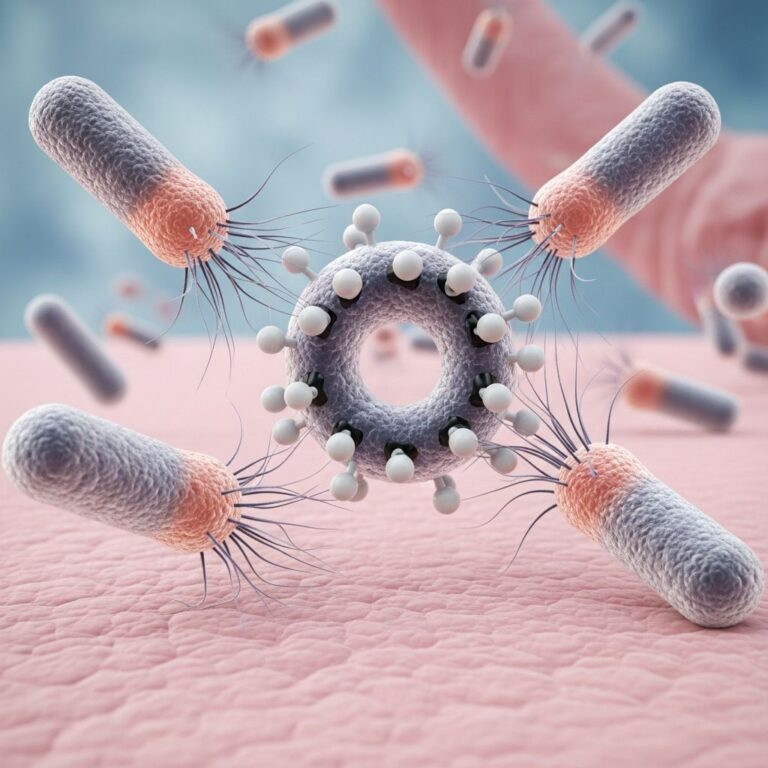
Verruca vulgaris, also known as the common wart, represents one of the most frequent benign skin lesions encountered in dermatological practice. This keratotic proliferation arises from infection with specific human papillomavirus (HPV) types, primarily HPV-2 and HPV-4, though other subtypes like HPV-1, -27, and -57 can also be implicated. Unlike mucosal warts associated with high-risk oncogenic HPVs (e.g., types 16, 18), cutaneous verrucae are typically low-risk and self-limiting, resolving spontaneously in 60-80% of immunocompetent individuals within 1-2 years.
Pathologically, verruca vulgaris exhibits distinctive epidermal changes driven by HPV’s tropism for keratinocytes. The virus replicates in the upper epidermis, inducing hyperplasia and cytopathic effects that are diagnostic on histopathology. Understanding these features is crucial for accurate diagnosis, especially in atypical presentations or immunocompromised patients where malignant transformation risk increases. This article delves into the clinical context, microscopic hallmarks, special studies, and key differential diagnoses, mirroring the structure of authoritative dermatopathology resources.
Introduction
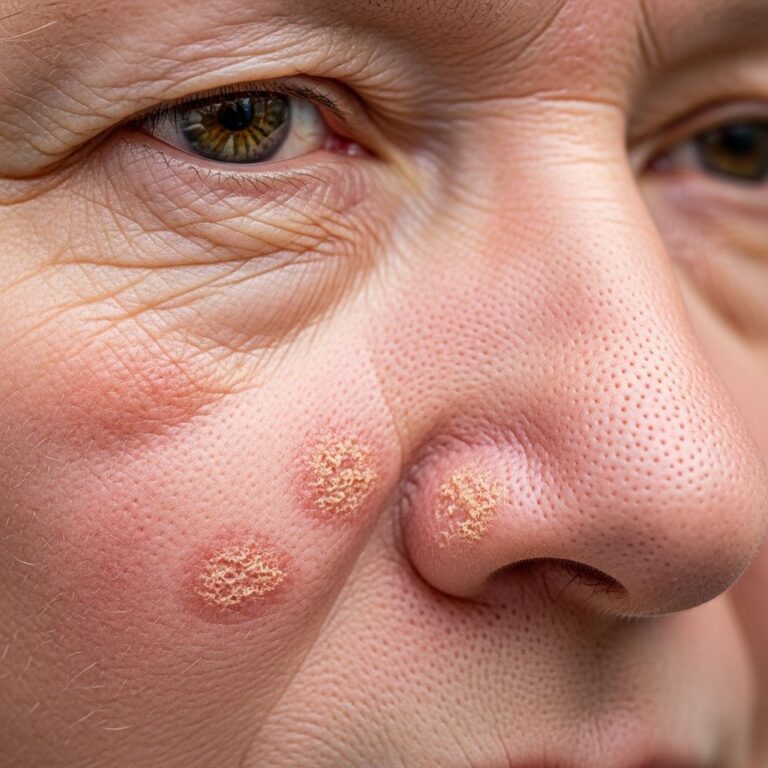
Verruca vulgaris manifests as a rough, hyperkeratotic papule or plaque, often described as having a ‘cauliflower-like’ surface due to its papillomatous architecture. Common sites include the hands (especially dorsal fingers and periungual areas), knees, and elbows, reflecting sites of minor trauma that facilitate viral entry through disrupted skin barriers. Transmission occurs via direct skin-to-skin contact or fomites, with autoinoculation explaining multifocal lesions. Children and young adults are disproportionately affected, with prevalence peaking at 4-5% in school-aged populations.
Clinically, lesions measure 2-10 mm, displaying a verrucous surface with punctate black dots representing thrombosed dermal papillary capillaries— a hallmark visible on paring or dermoscopy. While benign, persistent warts in immunosuppressed individuals (e.g., post-transplant patients) may evolve into verrucous carcinoma, a well-differentiated squamous cell carcinoma with local invasiveness but low metastatic potential. Histopathology remains the gold standard for confirmation, particularly when clinical distinction from mimics like seborrhoeic keratosis or squamous proliferations is challenging.
Histopathology
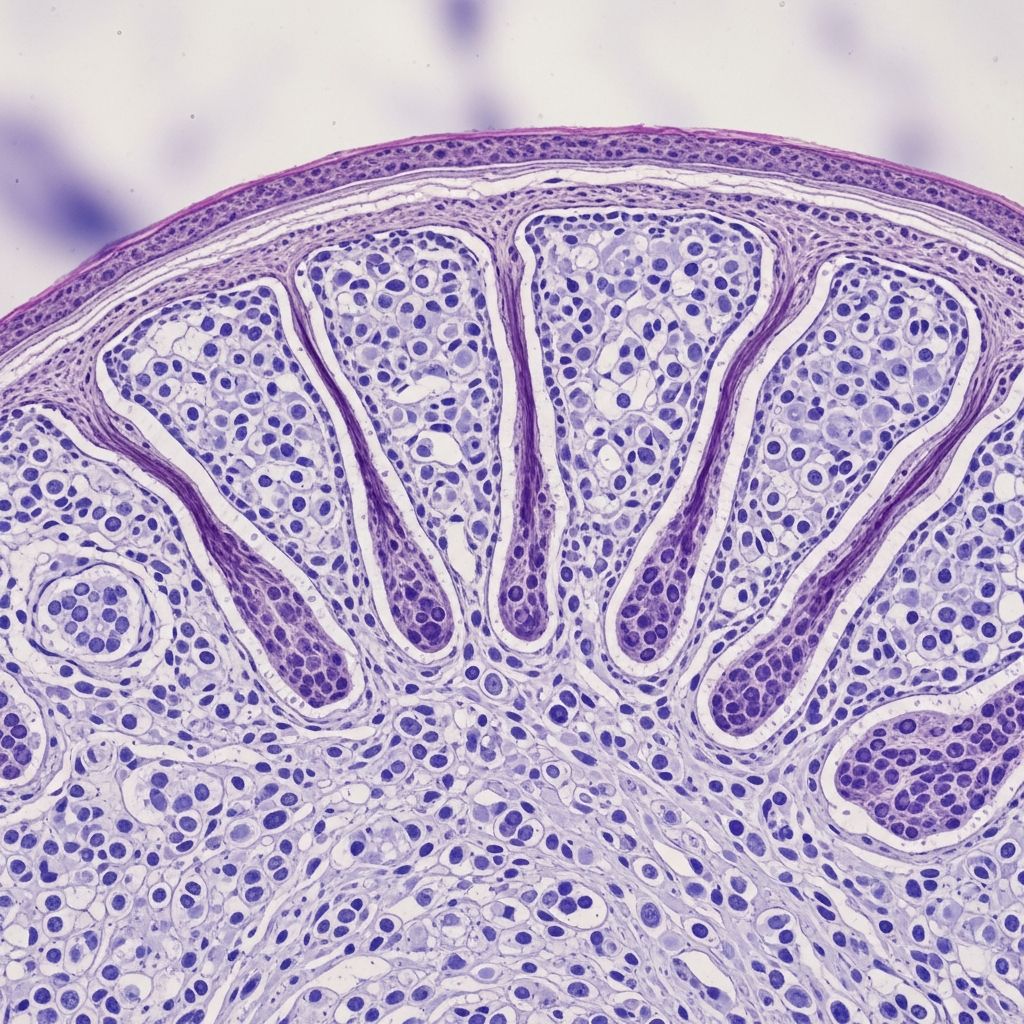
Low-power examination reveals a markedly papillomatous epidermis with elongated rete ridges extending downward in a church-spire or digitated pattern. This acanthosis (epidermal thickening) and papillomatosis create the gross verrucous appearance. The surface shows compact orthokeratosis interspersed with tiers of parakeratosis—horizontal layers of retained nuclei in the stratum corneum, a direct result of HPV-induced keratinocyte dysregulation.
Deeper in the epidermis, hypergranulosis (thickened granular layer) is prominent, often two to three times normal thickness. Within this layer and upper spinous zone, koilocytes—pathognomonic vacuolated keratinocytes—appear with perinuclear halos surrounding pyknotic, shrunken nuclei. These reflect viral cytopathic effects from HPV L1 capsid protein expression. Dermal papillae are elongated and vascular, frequently containing tortuous capillaries; entrapped red blood cells in parakeratotic tiers corroborate the clinical black dots.
- Key low-power features: Papillomatosis, acanthosis, hypergranulosis, parakeratotic tiers.
- Mid-power hallmarks: Koilocytes, coarse keratohyalin granules, vacuolization.
- High-power details: Binucleate cells, wrinkled nuclei, occasional mitoses in basal layers.
In acral (palmar/plantar) variants, large eosinophilic (pink) or basophilic inclusions may dominate the upper epidermis, representing aggregated viral particles. These are larger than molluscum bodies and site-specific. The dermis typically shows mild vascular ectasia without significant inflammation unless regressing, when a lichenoid lymphocytic infiltrate emerges.
Related Stories



Viropathic effect
The viropathic effect of HPV is the sine qua non for diagnosis. Koilocytes, first described by Koss and Durfee in 1956, feature clear perinuclear halos (koilocytosis), raisinoid nuclei, and amphophilic cytoplasm. Coarse, clumped keratohyalin granules adjoin these changes, contrasting normal fine granules. In productive infections, eosinophilic inclusions (HPV virions) cluster suprabasally, while basophilic forms occur in granular layers.
Electron microscopy (rarely used) confirms 50-60 nm icosahedral virions in nuclei. Regression phases show apoptosis, dyskeratosis, and CD4+ T-cell infiltrates targeting HPV antigens. In immunosuppressed cases, blunted viropathic effects mimic hyperplastic lesions, necessitating clinical correlation.
| Site | Epidermal Changes | Inclusions | Other |
|---|---|---|---|
| Acral (hands/feet) | Marked papillomatosis, deep acanthosis | Large pink/basophilic inclusions | Thrombosed capillaries prominent |
| Non-acral | Mild-moderate papillomatosis | Small basophilic granules | Koilocytes dominant |
| Regressing | Lichenoid infiltrate | Reduced inclusions | Apoptosis, pigment incontinence |
Special stains
Routine hematoxylin-eosin (H&E) suffices for diagnosis; special stains are rarely needed. Periodic acid-Schiff (PAS) highlights thickened basement membrane but lacks specificity. Immunohistochemistry for p16 or Ki-67 shows basal proliferation but overlaps with reactive processes. HPV genotyping via PCR targets E6/E7 oncogenes or L1 capsid, typing subtypes (e.g., HPV-2 PCR-positive in 70% cases). In situ hybridization (ISH) localizes HPV DNA in koilocytes, useful for research or equivocal biopsies.
Direct immunofluorescence is negative, distinguishing from autoimmune blistering diseases.
Differential diagnosis
Histologic mimics abound; clinicopathologic correlation is essential.
- Seborrhoeic keratosis: Lacks papillomatosis, koilocytes; shows horn cysts, pseudohorn nests. Older verrucae may ‘burn out’ viropathic effects, termed ‘verrucal keratosis’ by some.
- Molluscum contagiosum: Henderson-Patterson bodies (large homogeneous inclusions) vs. verruca’s heterogeneous granules. Molluscum favors non-acral sites.
- Plantar fibroma/poroma: Endophytic growth, ductal differentiation absent in warts.
- Squamous cell carcinoma/verrucous carcinoma: Atypia, invasion, lack of koilocytes. Risk elevated in chronic immunosuppression.
- Condyloma acuminatum: More exophytic, genital tropism, different HPV types.
| Entity | Distinguishing Features from Verruca | Clinical Clue |
|---|---|---|
| Seborrhoeic keratosis | Horn cysts, no koilocytes/parakeratosis | Stuck-on appearance, elderly |
| Molluscum | Large uniform inclusions, no papillomatosis | Umbilicated, pearly |
| Verrucous carcinoma | Atypia, bulbous rete, no viropathic effect | Large, fixed, plantar |
| Poroma | Ductal lumina, uniform basaloid cells | Vascular, pink |
Frequently Asked Questions (FAQs)
Q: What is the most pathognomonic feature of verruca vulgaris?
A: Koilocytes with perinuclear halos and hypergranulosis are diagnostic.
Q: Can verruca vulgaris turn cancerous?
A: Rarely; verrucous carcinoma arises in <1% chronic cases, especially immunosuppressed or plantar sites.
Q: Is biopsy always needed for diagnosis?
A: No, clinical/dermoscopy suffices; biopsy for atypical, persistent, or high-risk patients.
Q: How does verruca plana differ histologically?
A: Flat warts show mild acanthosis, hypergranulosis, koilocytes without marked papillomatosis.
Q: Role of PCR in routine practice?
A: Limited to research/typing; H&E diagnostic in >95%.
Clinical Relevance and Management Insights
Beyond pathology, verrucae inform broader HPV biology. Over 100 HPV types exist, with cutaneous low-risk (alpha/beta genera) vs. mucosal high-risk (alpha genera like 16/18). Epidermodysplasia verruciformis (EV) exemplifies beta-HPV oncogenicity (types 5,8), causing pityriasis-like lesions progressing to SCC in 30-70%. Treatment—cryotherapy, salicylic acid, or laser—targets hyperkeratosis, but histopathology guides post-treatment confirmation.
In organ transplant recipients, multifocal warts warrant surveillance; HPV vaccination (Gardasil) covers some cutaneous types indirectly. Emerging therapies like intralesional immunotherapy (e.g., Candida antigen) leverage T-cell responses observed in regressing lesions.
Pathologists must scan entire sections at high power for subtle koilocytes, as sampling errors occur in 10-15% superficial biopsies. Digital pathology and AI-assisted koilocyte detection show promise for efficiency.
References
- Wart – StatPearls — Levitt J, et al. National Center for Biotechnology Information (NCBI). 2023-08-08. https://www.ncbi.nlm.nih.gov/books/NBK431047/
- Verruca vulgaris (common wart) pathology — DermNet NZ. 2013 (updated). https://dermnetnz.org/topics/verruca-vulgaris-pathology
- Introduction to dermatopathology — DermNet NZ. Updated 2023. https://dermnetnz.org/topics/introduction-to-dermatopathology
- Verruca plana pathology — DermNet NZ. Updated 2023. https://dermnetnz.org/topics/verruca-plana-pathology
- Viral skin infections. Warts – CME — DermNet NZ. Updated 2024. https://dermnetnz.org/cme/viral-infections/viral-warts-cme
- Warts, verrucas, human papillomavirus infection — DermNet NZ. Updated 2024. https://dermnetnz.org/topics/viral-wart
Similar Articles








Read full bio of Sneha Tete