Viral Warts: Complete Guide to Causes, Symptoms, and Treatments
Comprehensive guide to viral warts: causes, types, diagnosis, treatments, and management strategies for HPV-induced skin lesions.
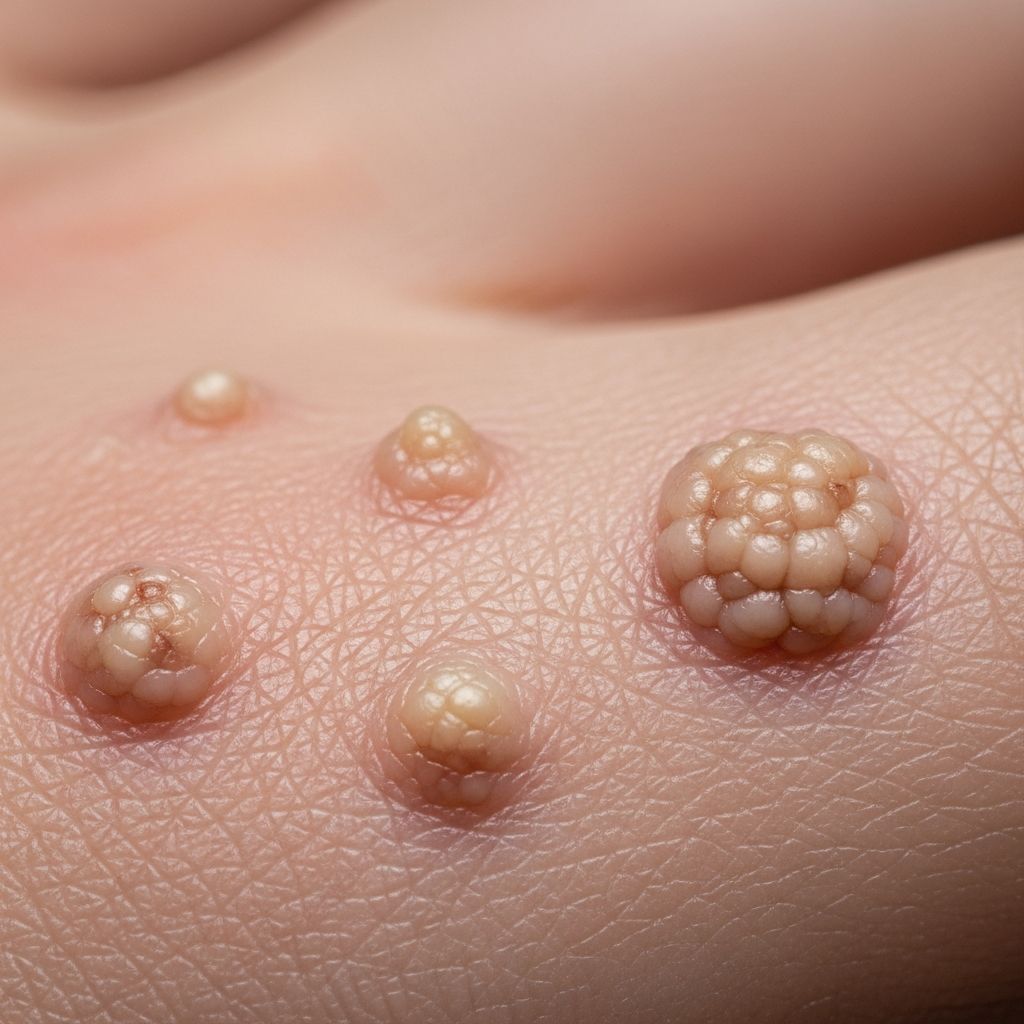
Viral warts are benign epidermal proliferations caused by human papillomavirus (HPV) infection, classified as cutaneous or mucosal based on site and HPV type. Cutaneous warts, also known as verrucae or papillomata, present variably depending on the HPV strain and location.
Demographics
Viral warts affect approximately 7–12% of the general population, with higher prevalence in children and adolescents. They are particularly common in school-aged children (10–20% prevalence), peaking around age 12–16 years, and are less frequent in adults. Immunosuppressed individuals, such as organ transplant recipients, HIV patients, and those on immunosuppressive therapy, experience higher rates and persistence due to impaired cell-mediated immunity.
- Peak incidence in children aged 12–16 years
- Prevalence up to 20–30% in schoolchildren
- Increased risk in immunocompromised patients
- More persistent in smokers and adults
Causes
Viral warts result from infection with HPV, a double-stranded DNA virus from the Papillomaviridae family. Over 150 HPV types exist, but cutaneous warts are primarily caused by types 1, 2, 4, 27, 57 (verruca vulgaris), HPV-1 (myrmecia), HPV-2 (mosaic warts), and HPV-3, 10 (plane warts). Infection occurs via direct skin-to-skin contact or autoinoculation, entering through microtrauma in the basal epidermis. This triggers keratinocyte proliferation, hyperkeratosis, and virion production. The incubation period ranges from 1–20 months, averaging 2–6 months.
Transmission is facilitated by close contact in moist environments like pools or gyms. Autoinoculation can lead to pseudo-Koebnerization, where scratching spreads virus linearly. HPV thrives in damaged or macerated skin, explaining higher rates on hands, feet, and shaved areas.
Clinical Features
Warts exhibit diverse morphologies based on site, type, and host factors. Common features include surface hyperkeratosis, thrombosed capillaries (peppercorn spots), and disruption of normal skin lines.
Common Wart (Verruca Vulgaris)
Typically on hands, fingers, knees, elbows; rough, dome-shaped hyperkeratotic papules (3–10 mm) with black peppercorn dots (thrombosed capillaries). May coalesce into plaques.
Plantar Warts (Verruca Plantaris)
On soles, pressure points; painful, endophytic with hyperkeratotic collar. Myrmecia (HPV-1): deep, tender with yellow callus; mosaic warts (HPV-2): superficial clusters, less painful.
Plane Warts (Verruca Plana)
Multiple small (1–5 mm), flat-topped, skin-colored papules on face, hands, shins. Often linear from shaving (beard area, legs). Caused by HPV-3, 10.
Filiform Warts
Thread-like projections on face (eyelids, lips, neck).
Other Types
- Butcher’s warts: on hands of meat handlers (HPV-7)
- Subungual warts: under nails, painful
- Epidermodysplasia verruciformis: rare genetic disorder with pityriasis versicolor-like lesions progressing to SCC (HPV-5,8)
- Plantar epidermoid cysts: HPV-60
Images typically show hyperkeratotic lesions with disrupted skin markings and punctate hemorrhages.
Complications
Most warts are asymptomatic, but complications include pain (plantar warts), bleeding, secondary bacterial infection, and koebnerization. Malignant transformation is rare but occurs in epidermodysplasia verruciformis (up to 50% SCC risk) and immunosuppressed patients with high-risk HPV (e.g., types 5,8). Recurrence is common (20–30%) due to persistent basal layer infection.
- Pain and disability from plantar warts
- Cosmetic distress
- Auto-inoculation spreading
- Rare squamous cell carcinoma in predisposed individuals
Diagnosis
Primarily clinical, based on characteristic morphology: hyperkeratosis, black dots, disrupted skin lines. Dermoscopy reveals dotted vessels, mosaic patterns, and hemorrhage spots, distinguishing from calluses or corns.
Biopsy rarely needed but shows acanthosis, papillomatosis, hypergranulosis, koilocytes (pathognomonic), and viral inclusions. PCR identifies HPV type if malignancy suspected.
Related Stories



| Feature | Wart | Differential (e.g., Callus) |
|---|---|---|
| Skin lines | Interrupted | Continuous |
| Pain on pressure | Lateral/side | Direct |
| Dermoscopy | Dotted vessels | Absent |
Differential Diagnoses
- Seborrheic keratosis: stuck-on appearance, no vessels on dermoscopy
- Corns/calluses: regular skin lines, no black dots
- Molluscum contagiosum: central umbilication
- Squamous cell carcinoma: irregular, indurated
- Amyloidosis, porokeratosis, lichen planus
Treatment
No treatment eradicates HPV; therapies remove infected epidermis, relying on immunity. Persistence is key; 50% of childhood warts resolve spontaneously in 6–12 months, 90% in 2 years. Adults and immunosuppressed have lower rates.
Topical Therapies (First-Line)
- Salicylic Acid: 17–40% in plaster/paint; daily after soaking/paring. 50–70% clearance in 12 weeks. Safe for home use.
- Podophyllin, 5-FU, Tretinoin: for plane warts.
- Imiquimod: stimulates immunity, for recalcitrant/genital.
Physical Destruction
- Cryotherapy: Liquid nitrogen every 1–2 weeks; 70% success after 3–4 sessions. Causes blistering.
- Curettage/Electrocautery: for small lesions.
- Laser (CO2, pulsed dye): vascular targeting.
Immunotherapy
- Intralesional: Candida antigen, bleomycin (painful, 70–90% efficacy).
- Topical: DCP, imiquimod.
- Systemic: Cimetidine, retinoids (off-label).
Watchful Waiting
Recommended for asymptomatic warts, especially in children.
| Treatment | Efficacy | Side Effects |
|---|---|---|
| Salicylic acid | 50–70% | Irritation |
| Cryotherapy | 70% | Pain, blistering |
| Immunotherapy | 70–90% | Injection pain |
Outcome
Spontaneous resolution: 65–78% within 2 years. Persistence higher in adults (up to 30% at 5 years), smokers, and immunosuppressed. Type-specific immunity develops; recurrence 20–50%. No scarring usually, but treatments may cause hypopigmentation.
Prevention: Avoid barefoot in public areas, treat trauma, hand hygiene. HPV vaccines (Gardasil) prevent high-risk genital types but not cutaneous.
Frequently Asked Questions (FAQs)
Q: Are viral warts contagious?
A: Yes, via direct contact or autoinoculation; avoid sharing towels or picking warts.
Q: How long do warts last without treatment?
A: 50% resolve in 6 months, 90% in 2 years in children; longer in adults.
Q: Is salicylic acid safe for children?
A: Yes, first-line; apply carefully, avoid face/genitals.
Q: Can warts turn cancerous?
A: Rare, mainly in epidermodysplasia verruciformis or immunosuppressed.
Q: What’s the best treatment for plantar warts?
A: Salicylic acid or cryotherapy; paring essential.
References
- Warts, verrucas, human papillomavirus infection — DermNet NZ. 2023. https://dermnetnz.org/topics/viral-wart
- Wart – StatPearls — NCBI Bookshelf, NIH. 2023-09-04. https://www.ncbi.nlm.nih.gov/books/NBK431047/
- Warts | Better Health Channel — Better Health Channel, Victoria Government. 2023. https://www.betterhealth.vic.gov.au/health/conditionsandtreatments/warts
- Warts: How To Identify, Causes, Types, Treatment & Prevention — Cleveland Clinic. 2023-05-01. https://my.clevelandclinic.org/health/diseases/15045-warts
- Common warts – Symptoms and causes — Mayo Clinic. 2023. https://www.mayoclinic.org/diseases-conditions/common-warts/symptoms-causes/syc-20371125
Similar Articles








Read full bio of Sneha Tete