Vision Loss Facts: Scale, Causes, Prevention
Uncover critical statistics on vision impairment affecting millions worldwide, its rising trends, and actionable steps for prevention and policy advocacy.
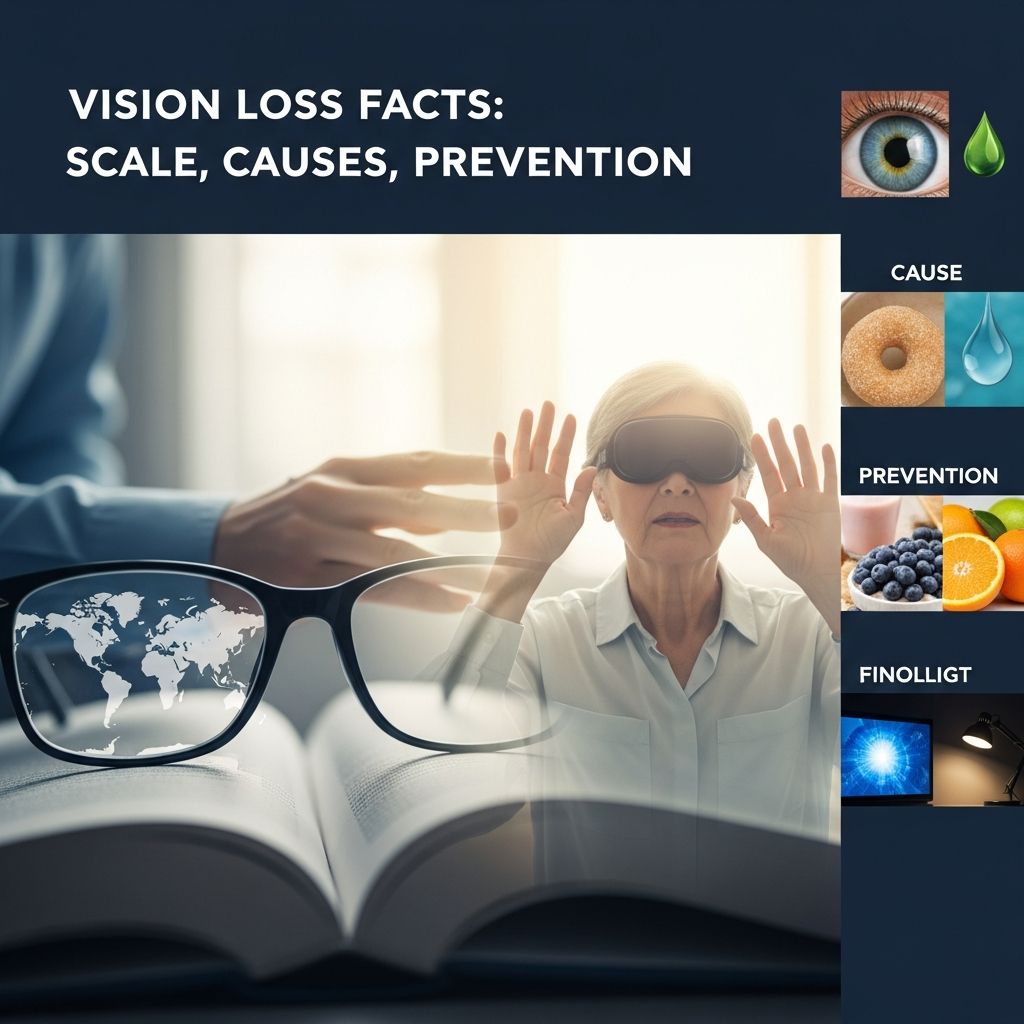
Vision impairment affects millions, with over 7 million Americans experiencing vision loss and 1 million legally blind as of recent estimates. Globally, at least 2.2 billion people live with some form of vision impairment, over 1 billion of which is preventable or untreated.
The Current Scope of Vision Impairment in the United States
In the United States, vision loss represents a significant public health challenge. Data from 2017 modeled estimates indicate that more than 7 million individuals had vision loss defined as best-corrected visual acuity of 20/40 or worse in their better-seeing eye, while approximately 1 million met the criteria for blindness at 20/200 or worse. These figures break down further by demographics, highlighting disparities.
| Category | Vision Loss (20/40 or worse) | Blindness (20/200 or worse) |
|---|---|---|
| Overall | 7,053,006 | 1,097,853 |
| Female | 4,141,824 | 640,278 |
| Male | 2,911,182 | 457,575 |
Age plays a critical role, with prevalence surging in older groups. Over 1.6 million affected individuals are under 40, but the burden intensifies after 65.
| Age Group | Vision Loss | Blindness |
|---|---|---|
| 0-17 Years | 601,972 | 45,520 |
| 18-39 Years | 1,021,796 | 101,115 |
| 40-64 Years | 1,258,536 | 150,003 |
| 65-84 Years | 2,876,846 | 454,587 |
| 85+ Years | 1,293,856 | 346,627 |
Recent surveys from 2023 reveal that 51.9 million U.S. adults aged 18+ report some seeing difficulty, with 3.7 million facing severe challenges. Among them, 35.1 million are working-age (18-64) and 13.4 million are 65+.
Global Dimensions of Blindness and Vision Loss
Worldwide, the problem dwarfs national figures. The World Health Organization reports at least 2.2 billion people with near or distance vision impairment, including 1 billion cases where interventions could have prevented or addressed the issue. A 2020 analysis estimated 1.1 billion with untreated impairment, projected to reach 1.8 billion by 2050 without increased investment, 90% in low- and middle-income countries (LMICs).
Breaking it down, 596 million had untreated distance vision issues like cataracts or glaucoma in 2020, with 43 million blind from these. Additionally, 510 million lacked glasses for near vision. Projections for 2050 foresee 895 million with distance impairment (61 million blind) and 866 million with unaddressed presbyopia.
Cataracts dominate as the leading cause, responsible for nearly 45% of global blindness in 2026, impacting 15.2 million people and 39% of moderate-to-severe impairment (78.8 million). Prevalence escalates with age: 3.9% in 55-64 year-olds to 92.6% in those 80+.
Trends and Projections: A Growing Crisis
From 1990 to 2021, global blindness and moderate-to-severe vision impairment rates remained stable despite population growth and aging, thanks to prevention efforts reducing disability years lived (YLD). However, challenges persist, notably in East Asia where refractive errors like myopia are rising due to urbanization and near-work.
By 2050, U.S. rates could double from aging and chronic diseases like diabetes. Globally, the 1.7-1.8 billion projection underscores urgency, with economic losses from working-age impairment reaching $411 billion in 2020 alone (0.3% of global GDP), highest in east and south Asia.
Risk Factors and Vulnerable Populations
- Age: Primary driver, with exponential increases post-65.
- Gender: Women face higher rates (108-112 per 100 men for blindness/moderate loss), linked to socioeconomic barriers.
- Geography: LMICs, rural areas, sub-Saharan Africa, and Asia bear 90% burden; workforce shortages (1 ophthalmologist per million in parts of Africa vs. 76 per million in high-income countries).
- Chronic Conditions: Diabetes, glaucoma, myopia fueling rises.
- Socioeconomic: Ethnic minorities, low-income groups disproportionately affected.
Economic and Social Consequences
Vision loss erodes quality of life, causing reduced employment, education, social isolation, and shorter lifespans. The $411 billion annual productivity loss in 2020 highlights its GDP drag. In the U.S., it ranks top 10 disabilities, straining healthcare.
Related Stories



Prevention Strategies and Interventions
Over 90% of cases are preventable via cost-effective measures: screenings, glasses, surgeries. Key approaches include:
- Regular eye exams, especially for at-risk groups.
- Glaucoma telehealth/AI screening in rural areas.
- Addressing uncorrected refractive errors (glasses for 510+ million).
- Cataract surgery, proven effective.
- Diabetes management to curb retinopathy.
Public health systems like the U.S. Vision and Eye Health Surveillance System (VEHSS) track data and barriers.
Policy Challenges: Funding Cuts and Advocacy
U.S. Congress cut Vision Health Initiative (VHI) funding by one-third for FY26 (from $6.5M to $4.5M), impacting surveillance, grants, and community programs despite rising needs. Advocates push for FY27 restoration to sustain progress against doubling rates.
FAQs on Vision Loss
What is the difference between vision loss and blindness?
Vision loss is acuity 20/40 or worse; blindness is 20/200 or worse in the better eye.
How many people globally have preventable vision impairment?
Over 1 billion, mostly from uncorrected refractive errors, cataracts, and glaucoma.
Will vision loss rates increase?
Yes, projected to double by 2050 due to aging and diabetes.
Who is most at risk?
Older adults, women, LMIC residents, and those with chronic diseases.
How can I protect my vision?
Get annual exams, manage health conditions, wear protective eyewear, and ensure refractive correction.
Steps to Take for Better Eye Health
- Schedule comprehensive dilated eye exams yearly after 40 or sooner if at risk.
- Control blood sugar, blood pressure for diabetes/hypertension patients.
- Wear UV-protective sunglasses outdoors.
- Follow the 20-20-20 rule for screen users: every 20 minutes, view 20 feet away for 20 seconds.
- Advocate for eye health funding and access in your community.
References
- VEHSS Modeled Estimates: Vision Loss and Blindness — Centers for Disease Control and Prevention (CDC). 2017. https://www.cdc.gov/vision-health-data/prevalence-estimates/vision-loss-prevalence.html
- Congress Cuts Vision and Eye Health Funding by One-Third — Prevent Blindness. 2026. https://preventblindness.org/congress-cuts-2026-vision-funding/
- The Lancet Global Health: Vision loss could be treated in one billion people worldwide — Michigan Medicine / The Lancet Global Health. 2023. https://www.michiganmedicine.org/news-release/lancet-global-health-vision-loss-could-be-treated-one-billion-people-worldwide
- Cataract Statistics Worldwide For 2025 — Eye Health Central. 2026. https://www.contactlensesplus.com/education/cataract-stats
- Study: Global Vision Loss Trends Show Progress — Eyewire News / British Journal of Ophthalmology. 2025. https://eyewire.news/news/study-global-vision-loss-trends-show-progress-in-some-areas-but-persisting-challenges-in-east-asia
- Facts and Figures on Adults with Vision Loss — American Foundation for the Blind (AFB). 2023. https://afb.org/research-and-initiatives/statistics/adults-vision-loss-nhis
- Blindness and visual impairment — World Health Organization (WHO). 2023. https://www.who.int/news-room/fact-sheets/detail/blindness-and-visual-impairment
Similar Articles








Read full bio of medha deb