Vitamin D: Daily vs Weekly Supplementation Guide for 2025
Discover if taking vitamin D daily or weekly is more effective for optimal health and deficiency correction.
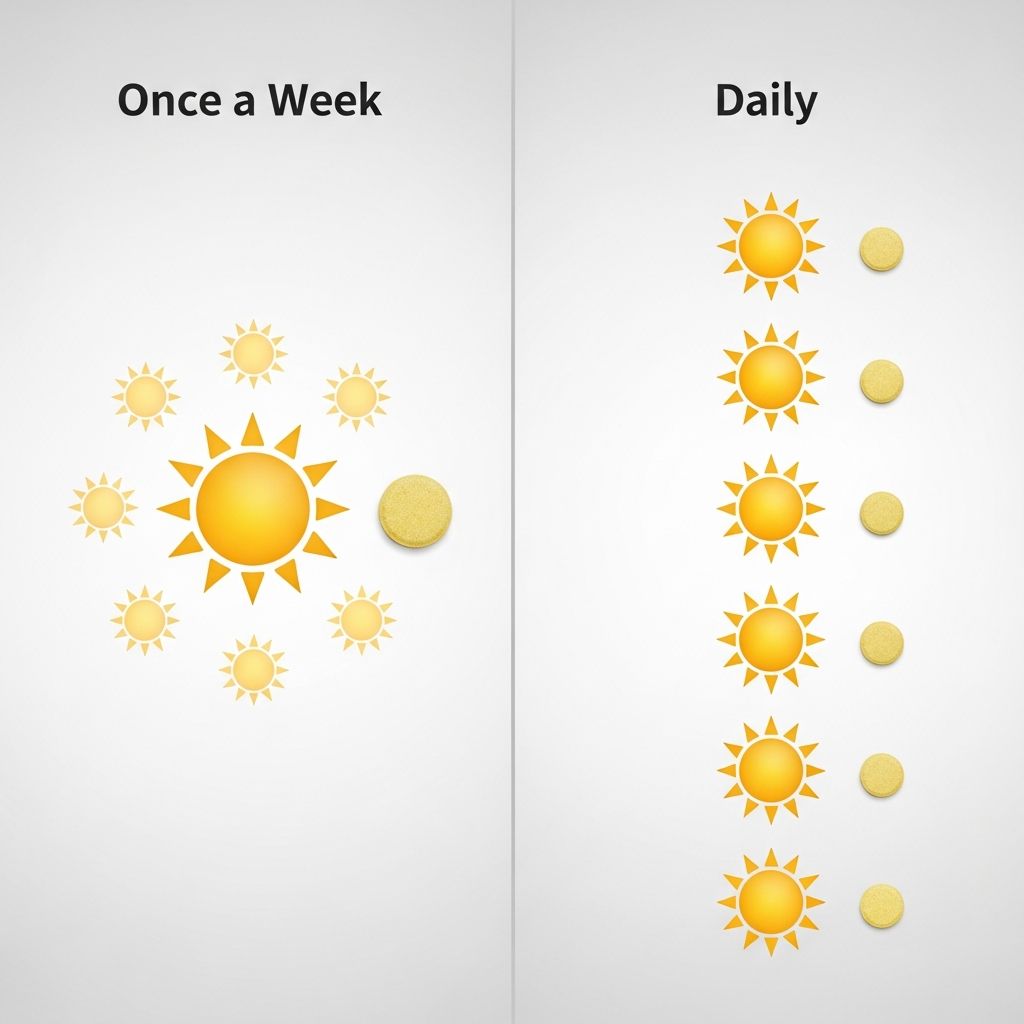
Vitamin D supplementation can be administered daily or weekly with comparable efficacy in elevating serum 25-hydroxyvitamin D [25(OH)D] levels when cumulative doses are equivalent, though daily dosing may offer slight advantages in consistency for certain populations.
What Is Vitamin D and Why Do You Need It?
Vitamin D, often called the “sunshine vitamin,” is essential for calcium absorption, bone health, immune function, and muscle performance. The body synthesizes it through skin exposure to UVB rays, but factors like limited sunlight, indoor lifestyles, aging, darker skin tones, and obesity often lead to deficiency. Nearly 40% of Americans have insufficient levels below 20 ng/mL, increasing risks for osteoporosis, fractures, infections, and chronic diseases.
Deficiency is defined as serum 25(OH)D below 20 ng/mL (insufficiency 20-30 ng/mL; optimal >30 ng/mL per Endocrine Society). Supplementation bridges gaps, especially in winter or northern latitudes where UVB is scarce. Forms include D2 (ergocalciferol from plants) and D3 (cholecalciferol from animal sources/lichen), with D3 generally more effective at raising and sustaining 25(OH)D.
Daily vs. Weekly Vitamin D: How Do They Compare?
Clinical trials show both daily and weekly regimens effectively boost 25(OH)D, but pharmacokinetics differ. Daily dosing provides steady absorption, mimicking natural production, while weekly high-dose boluses cause peaks followed by gradual declines due to vitamin D’s 25-day half-life.
A randomized trial in elderly hip fracture patients (n=48) compared 1,500 IU daily, 10,500 IU weekly, or 45,000 IU monthly. After 2 months, mean 25(OH)D levels were similar: 33.2 ng/mL (daily), 29.2 ng/mL (weekly), 37.1 ng/mL (monthly), with no significant differences. Monthly dosing spiked 25(OH)D and 1,25(OH)2D immediately post-dose, but levels equilibrated over time.
In nursing home residents (n=188, baseline deficiency >98% <50 nmol/L), 600 IU daily outperformed 4,200 IU weekly and 18,000 IU monthly after 4 months: increases of 47.2 nmol/L (daily), 40.7 nmol/L (weekly), 27.6 nmol/L (monthly). Daily reduced PTH more effectively and kept <10% below 50 nmol/L vs. 35% monthly.
| Regimen | Cumulative Dose Equivalent | 25(OH)D Increase (4 months) | % <50 nmol/L |
|---|---|---|---|
| Daily (600 IU) | ~24,000 IU/4 mo | 47.2 nmol/L | ~10% |
| Weekly (4,200 IU) | ~67,200 IU/4 mo | 40.7 nmol/L | ~10% |
| Monthly (18,000 IU) | 72,000 IU/4 mo | 27.6 nmol/L | 35% |
A 2023 network meta-analysis (116 RCTs, n=11,376) found no significant differences between daily and intermittent (weekly/monthly) supplementation at equal cumulative doses/durations. Daily ranked slightly higher (SUCRA), but CIs overlapped zero. Weekly 600,000 IU over 3 months (~6,666 IU/day equiv.) yielded the largest increase (63 nmol/L).
Weekly vs. daily showed no significant difference in repleting deficiency, though many studies had bias risks. Daily may restore levels more efficiently than boluses in deficient patients.
Research-Backed Pros and Cons
- Daily Pros: Steady levels, better absorption regularity, superior PTH suppression, higher nursing staff preference (72%) for fewer errors.
- Daily Cons: Adherence challenges (daily pills), inconvenience for some.
- Weekly Pros: Convenience, high compliance (93-100%), similar long-term efficacy, rapid initial boost.
- Weekly Cons: Transient peaks may stress system briefly; less effective monthly.
What Do the Experts Say?
Endocrine Society recommends 1,500-2,000 IU daily for adults, up to 10,000 IU short-term for deficiency. IOM suggests 600-800 IU daily. For maintenance, weekly equivalents (e.g., 10,000-50,000 IU) are endorsed if adherence improves. Harvard Nutrition Source notes daily/weekly reduces respiratory infections, strongest in deficient individuals.
Related Stories



Frontiers in Nutrition recommends 60,000 IU monthly (~2,000 IU/day equiv.) for >75 nmol/L due to convenience. Choose based on lifestyle: daily for precision, weekly for simplicity.
Safety and Side Effects
Both regimens are safe below 4,000 IU/day or 50,000 IU/week equivalents. Toxicity (>150 ng/mL) risks hypercalcemia, but rare. Monitor levels in obesity, malabsorption, or high doses. No significant differences in adverse events between frequencies.
Who Might Benefit More from Daily vs. Weekly?
- Daily Best For: Nursing homes, poor weekly compliance, PTH-sensitive (e.g., osteoporosis), precise control needed.
- Weekly Best For: Busy lifestyles, travel, high adherence to infrequent dosing, cost-saving bulk packs.
How to Choose the Right Vitamin D Supplement
Opt for D3 over D2. Pair with fat for absorption. Test baseline 25(OH)D. Start 2,000 IU daily or 50,000 IU weekly for deficiency; retest in 3 months. Consult MD for >4,000 IU/day.
FAQs
Is weekly vitamin D as effective as daily?
Yes, for equivalent cumulative doses, both raise 25(OH)D similarly long-term, though daily may edge out in steady-state efficacy.
What’s the best vitamin D dose?
1,500-2,000 IU daily or 10,000-50,000 IU weekly for most adults; adjust per blood levels.
Can you overdose on vitamin D?
Uncommon below upper limits; monitor to avoid hypercalcemia.
How soon do levels rise?
Weeks with daily; peaks faster with weekly boluses.
Should I take vitamin D with food?
Yes, fat enhances absorption.
References
- Comparison of Daily, Weekly, and Monthly Vitamin D3 in Ethanol… — The Journal of Clinical Endocrinology & Metabolism. 2008-09-01. https://academic.oup.com/jcem/article-abstract/93/9/3430/2596811
- Efficacy of different doses and time intervals of oral vitamin D… — PMC / NCBI. 2008. https://pmc.ncbi.nlm.nih.gov/articles/PMC2277446/
- Efficacy of intermittent versus daily vitamin D supplementation on… — Frontiers in Nutrition. 2023. https://www.frontiersin.org/journals/nutrition/articles/10.3389/fnut.2023.1168115/full
- Efficacy of weekly versus daily cholecalciferol for repleting serum… — Basic & Clinical Pharmacology & Toxicology. 2023. https://onlinelibrary.wiley.com/doi/full/10.1111/bcpt.14092
- Vitamin D supplementation: better daily or by bolus? — Vitamin D Journal. 2021. https://www.vitamind-journal.it/en/wp-content/uploads/2021/04/03_Adami_EN-1.pdf
- Vitamin D – The Nutrition Source — Harvard T.H. Chan School of Public Health. Updated 2023. https://nutritionsource.hsph.harvard.edu/vitamin-d/
Similar Articles








Read full bio of medha deb