Vitreomacular Traction Syndrome: 6 Symptoms, 4 Treatments
Discover the causes, symptoms, diagnosis, and advanced treatments for vitreomacular traction syndrome, a common age-related eye condition affecting central vision.
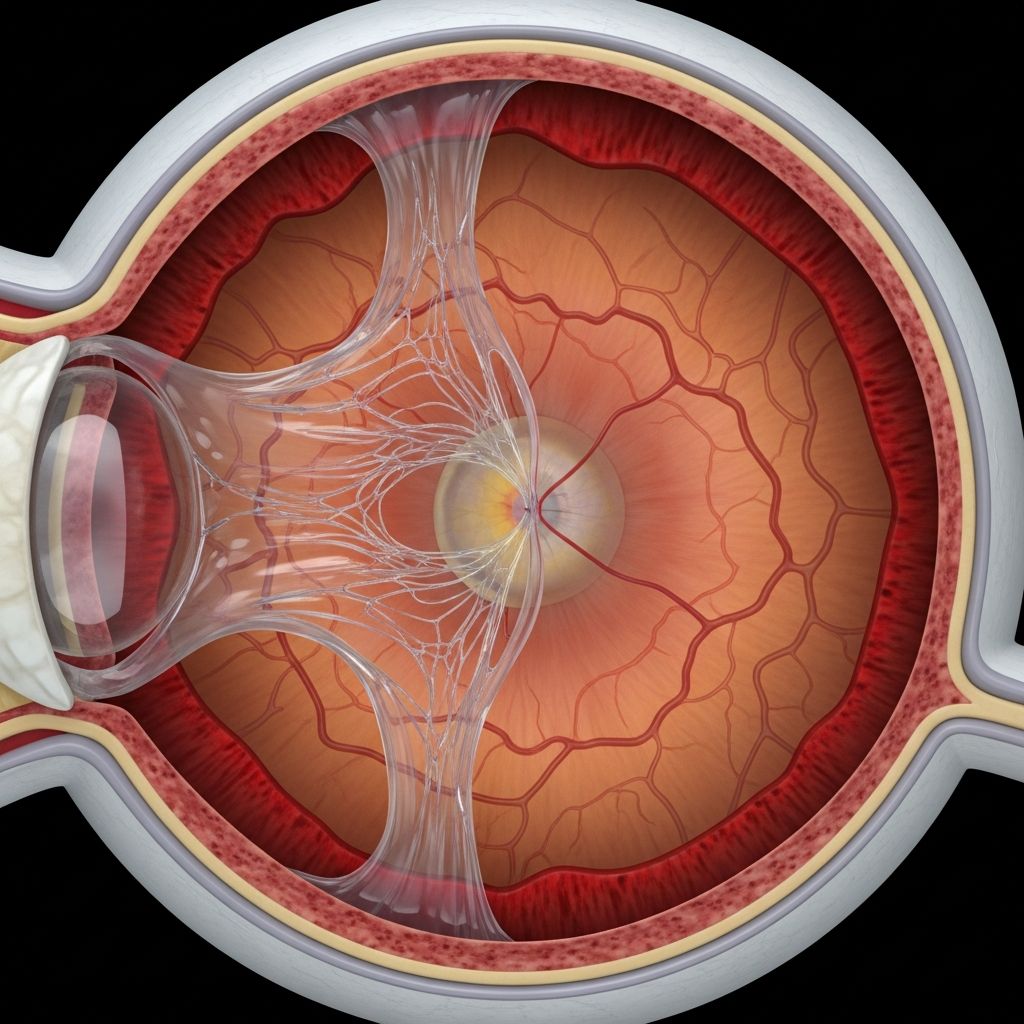
Vitreomacular traction syndrome (VMT) represents a significant ocular condition where the vitreous humor exerts abnormal pulling forces on the macula, the retina’s central region responsible for sharp vision. This leads to structural distortions and potential vision impairment, primarily in older adults as part of the natural aging process of the eye.
The Anatomy of the Eye Involved in VMT
The eye’s interior is filled with the vitreous, a gel-like substance that occupies about two-thirds of the eyeball’s volume. Composed mainly of water, collagen, and hyaluronic acid, this transparent material maintains the eye’s shape and supports the retina. The retina, a thin neural layer at the back of the eye, converts light into electrical signals for the brain. The macula, located at the retina’s center, enables detailed central vision essential for reading, driving, and recognizing faces.
As people age, the vitreous undergoes syneresis, a liquefaction process forming fluid pockets that cause the gel to shrink and contract. Normally, this results in posterior vitreous detachment (PVD), where the vitreous separates cleanly from the retina. However, in VMT, persistent adhesions anchor the vitreous to the macula, generating tractional forces that deform retinal layers.
How Vitreomacular Traction Develops
VMT arises from an incomplete PVD, particularly anomalous ones linked to premature vitreous liquefaction without sufficient weakening of vitreoretinal interfaces. Strong adhesions, mediated by extracellular matrix components, resist detachment, allowing static and dynamic traction to distort the macula. This can induce retinal folds, cystoid spaces, schisis, or even detachment.
Factors influencing VMT include the adhesion’s size: focal attachments (narrower than 1500 microns) concentrate forces, promoting severe changes like macular holes or edema, while broader ones distribute stress more evenly. Common triggers encompass age-related vitreous degeneration, prior surgeries (e.g., cataract extraction), inflammation, trauma, high myopia, or conditions like diabetic retinopathy.
Stages of Progression
- Vitreomacular Adhesion (VMA): Initial phase with partial detachment but no significant traction; often asymptomatic.
- Early VMT: Traction begins, causing subtle macular elevation or cysts.
- Advanced VMT: Persistent pull leads to foveal deformation, holes, or epiretinal membranes.
- Resolution or Complication: Spontaneous release improves vision, or progression to full detachment or irreversible damage occurs.
Recognizing the Signs and Symptoms
Patients with VMT often report insidious onset of visual disturbances centered on central vision. Key symptoms include:
- Reduced visual acuity, making fine details blurry.
- Metamorphopsia: Straight lines appearing wavy or distorted.
- Micropsia: Objects seeming smaller than actual size.
- Photopsia: Brief flashes of light.
- Central scotomas: Blind spots or greyed areas in vision.
- Loss of contrast or color sensitivity.
Notably, symptom severity may not correlate with anatomical changes; some with extensive traction retain good acuity, while others experience acute loss from subretinal fluid.
Risk Factors and Who Is Affected
VMT predominantly affects individuals over 50, with prevalence rising with age due to vitreous changes. Women may be at slightly higher risk, possibly linked to hormonal factors or smaller eye sizes in hyperopes. Comorbidities amplifying risk include:
Related Stories



| Risk Factor | Description |
|---|---|
| Age >50 | Primary driver via vitreous syneresis. |
| High Myopia | Elongated eyes increase traction likelihood. |
| Diabetic Retinopathy | Vascular changes weaken retinal stability. |
| Post-Surgical Eyes | Cataract or other procedures alter vitreous dynamics. |
| Inflammation/Trauma | Scar tissue promotes adhesions. |
Diagnostic Approaches for Accurate Detection
Diagnosis begins with a comprehensive dilated eye exam, assessing visual acuity and fundus appearance. Gold-standard imaging is optical coherence tomography (OCT), providing cross-sectional retinal views to measure adhesion width, traction extent, and complications like cysts or holes. Fluorescein angiography may evaluate leakage in edema cases, while ultrasound aids if media opacity obscures views.
OCT classifies VMT as focal (<1500 μm) or broad, guiding prognosis—focal types pose higher complication risks.
Treatment Strategies: From Watchful Waiting to Intervention
Management depends on symptoms, duration, and traction severity. Options include:
- Observation: For asymptomatic or mild cases, as 10-20% resolve spontaneously within months.
- Pharmacologic Therapy: Ocriplasmin (Jetrea), a protease enzyme injection, enzymatically cleaves adhesions; effective in select focal VMT, avoiding surgery (FDA-approved based on pivotal trials).
- Surgical Vitrectomy: Pars plana vitrectomy (PPV) with membrane peeling removes vitreous and relieves traction; high success for vision-threatening cases, though risks include cataracts, retinal tears.
- Emerging Therapies: Anti-VEGF for associated edema or ongoing research into adhesion-specific agents.
Post-treatment monitoring is crucial, with many gaining vision improvement.
Potential Complications and Long-Term Outlook
Untreated VMT risks macular hole formation (up to 10-15% in focal cases), tractional retinal detachment, or epiretinal membrane development, all worsening prognosis. Early intervention often yields better outcomes, with surgery restoring acuity in 60-80% of cases. Regular follow-ups mitigate progression.
Prevention and Lifestyle Recommendations
While aging is inevitable, controlling diabetes, avoiding eye trauma, and prompt treatment of inflammations reduce risks. Annual dilated exams for those over 50 aid early detection. Protective eyewear and healthy diets rich in antioxidants (leafy greens, fish) support retinal health.
Frequently Asked Questions (FAQs)
What causes sudden vision changes in VMT?
Sudden worsening often stems from cystoid edema or subfoveal detachment due to intensified traction.
Is VMT the same as macular hole?
No; VMT can precede holes but is the tractional precursor.
How effective is ocriplasmin?
It resolves adhesions in about 26% of cases per trials, with fewer complications than surgery.
Can VMT recur after treatment?
Rare post-vitrectomy, but possible if new adhesions form.
Does VMT affect both eyes?
Often unilateral initially, but bilateral risk exists over time.
Understanding VMT empowers timely intervention, preserving quality vision. Consult a retina specialist for personalized care.
References
- Vitreomacular Traction Syndrome — Gira Yersoz Eye Hospital. 2023. https://www.girayersoz.com.tr/en/vitreomacular-traction-syndrome/
- Vitreomacular Traction Syndrome — National Center for Biotechnology Information (PMC). 2012-10-15. https://pmc.ncbi.nlm.nih.gov/articles/PMC3520473/
- Vitreomacular Traction: Causes, Symptoms, and Treatment — Good Eyes. 2024. https://www.goodeyes.com/retina/vitreomacular-traction/
- Vitreomacular Traction — Sapphire Eye Care. 2023. https://sapphire-eyecare.co.uk/wp-content/uploads/Vitreo-Traction.pdf
- Vitreomacular Traction Syndrome – Patients — American Society of Retina Specialists. 2024. https://www.asrs.org/patients/retinal-diseases/12/vitreomacular-traction-syndrome
Similar Articles








Read full bio of Sneha Tete