Vocal Cords: 3 Essential Functions, Disorders, And Care
Understand how your vocal cords work and maintain voice health.
Understanding Your Vocal Cords: A Complete Guide
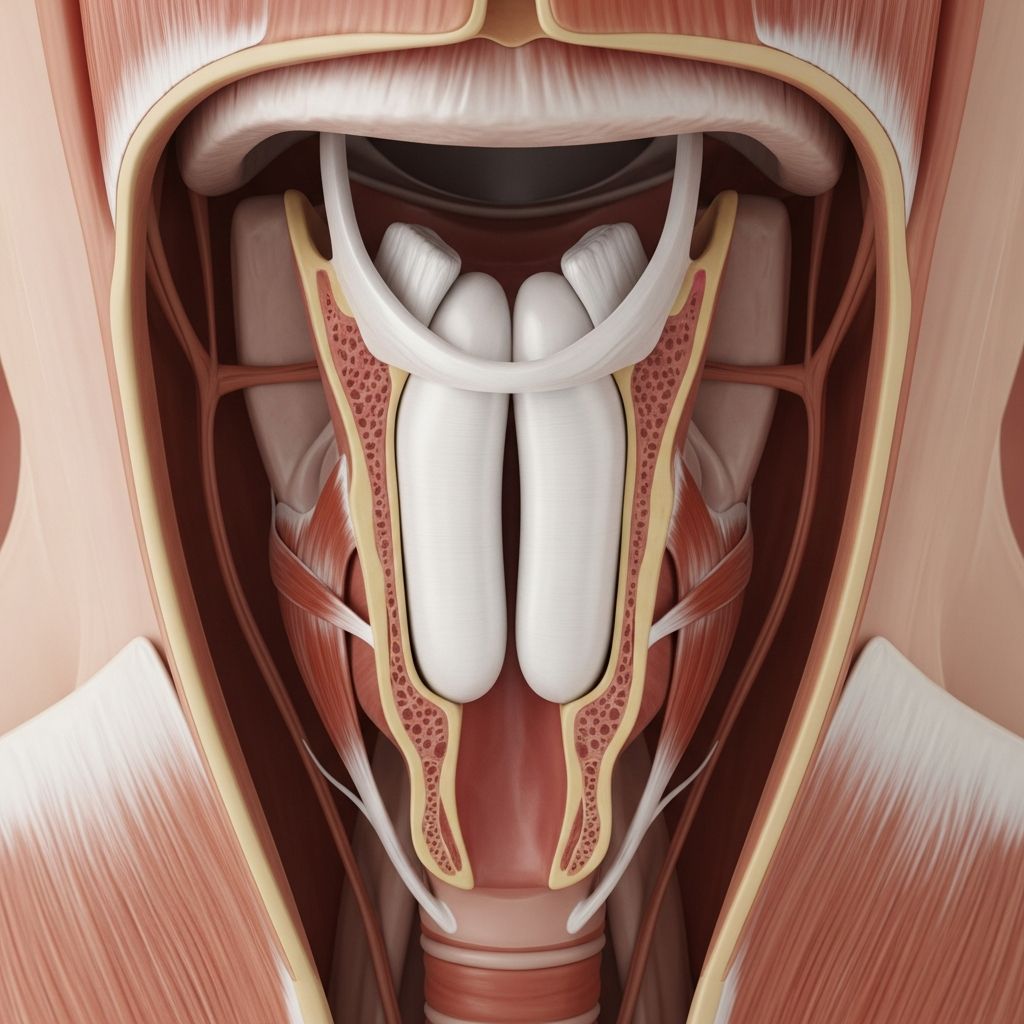
Your vocal cords are two bands of muscle inside your voice box, known medically as the larynx, located at the top of your windpipe (trachea). These remarkable structures play essential roles in three critical functions: breathing, protecting your airway, and producing sound for speech and singing. Understanding how your vocal cords work can help you maintain voice health and recognize when something might be wrong.
Vocal Cord Anatomy: The Building Blocks of Your Voice
The Laryngeal Structure
Your larynx is a hollow tube made up of specialized cartilages, muscles, ligaments, and membranes that work together in perfect coordination. The laryngeal skeleton consists of three unpaired cartilages and three paired cartilages. The largest of these is the thyroid cartilage, which houses your vocal folds and is commonly known as the “Adam’s apple.” From an anterior view, the vocal folds sit approximately midway between the inferior thyroid cartilage margin and the laryngeal prominence.
The Vocal Folds: Your Voice’s Engine
Your true vocal folds, also called vocal cords, are highly specialized anatomic structures responsible for phonation. These structures consist of three specialized anatomic layers covering the thyroarytenoid muscle (also called the vocalis muscle): squamous epithelium, superficial lamina propria, intermediate lamina propria, and deep lamina propria. The intermediate and deep lamina propria together make up the vocal ligament, which is crucial for voice quality.
Above your true vocal folds sit the “false” vocal folds, also called vestibular folds or vestibular membrane. These false folds are separated from your true vocal folds by the laryngeal ventricle. While they don’t directly produce sound, they play a supporting role in voice production and airway protection.
The Glottis: The Voice Production Center
The glottis is the middle region inside your larynx that contains your vocal cords. It includes two primary structures: your vocal cords and the opening between them, called the rima glottidis. If you were to look directly down on your glottis, it may remind you of a cat’s eye, with the rima glottidis resembling the spindle-like pupil and the vocal cords forming the symmetrical left and right sides.
How Your Vocal Cords Function
The Three Essential Functions
Your vocal cords perform three vital functions that require remarkable coordination:
Respiration
When you breathe, your vocal folds open via action by the posterior cricoarytenoid muscle, the only laryngeal abductor muscle. This allows air to pass freely through your windpipe to your lungs. During expiration, the laryngeal adductor muscles work to pull the vocal folds partially toward the midline and modulate expiratory airflow.
Airway Protection
When you swallow, your vocal cords close to prevent food, fluids, and saliva from entering your windpipe and lungs. This protective mechanism is essential for safe swallowing and is one of the most critical functions of your vocal cords.
Phonation (Voice Production)
During phonation, your vocal folds posture so that they sit in the midline, allowing the folds to vibrate against each other and creating vocalization. The mucosal surface of the folds must line up straight and smooth to create a mucosal wave. The vibration of the epithelial layer over the gelatinous layer of the superficial lamina propria produces smooth, clear phonation.
Related Stories



The Muscles That Control Your Voice
Several muscles work together to control your vocal cord movement. The muscles responsible for closing or adducting the vocal folds are the thyroarytenoid, lateral cricoarytenoid, and interarytenoid muscles. These muscles pull your vocal cords together, allowing them to vibrate and produce sound. The posterior cricoarytenoid muscle is responsible for opening or abducting the folds. All these muscles are innervated by the recurrent laryngeal nerve.
Pitch and Voice Quality
The frequency and pitch of your voice may be altered by contraction of the laryngeal muscles at different ratios, causing changes in length and position of the vibrating portion of the vocal folds themselves. Although the size and weight of your vocal cords are primarily responsible for your pitch, how you position them plays a role, too. These muscles can become more tense or relaxed for different styles of speaking and singing.
Common Vocal Cord Conditions
Vocal Cord Paralysis
Vocal cord paralysis happens when you cannot control the muscles that move one or both vocal cords. Nerve damage prevents the muscles inside your vocal cords from opening and closing properly. Vocal cords that cannot close may leave a space for food, fluids, and saliva to enter your windpipe and lungs. This can result in problems with breathing, swallowing, and speaking.
Vocal Cord Dysfunction (Inducible Laryngeal Obstruction)
Vocal cord dysfunction occurs when your vocal folds do not open and close properly during breathing or speaking. While your vocal cords should open widely when you breathe, those with this condition may experience inappropriate narrowing of the vocal cords, leading to breathing difficulties, particularly during exercise or when exposed to irritants.
Reinke Edema
Reinke edema, also referred to as polypoid corditis, involves swelling of the true vocal folds owing to accumulation of fluid within the potential space between the superficial lamina propria and the vocal ligaments (also called the Reinke space). The fluid accumulation is due to subepithelial hypervascularity, leading to vascular permeability and the disruption of collagen deposition. This condition typically results in a lower, hoarser voice.
Presbylarynx (Age-Related Changes)
Presbylarynx involves atrophy of the true vocal folds secondary to the natural physiologic aging process. As muscles and mucus-producing cells atrophy, the true vocal folds bow and prevent complete glottic closure. This leads to glottic insufficiency, where air escapes during attempted closure, and increases the surface viscosity of the mucus. These changes result in a hoarse, breathy, weak, or strained voice.
Vocal Cord Lesions, Nodules, and Polyps
Your vocal cords are susceptible to developing various benign lesions that can change your voice. Vocal cord nodules, sometimes called singer’s or screamer’s nodes, can form if you’re repeatedly misusing or overusing your voice. These callus-like growths develop in the midpoint of your vocal cords, where they experience the most vibration during voice use. Often, nodules develop on both vocal cords. Polyps and cysts are other types of lesions that can develop on vocal cords and affect voice quality.
Voice Disorders: When Multiple Factors Combine
Voice disorders may involve more than one category of dysfunction. For example, you could have a vocal fold paralysis—when one vocal cord doesn’t move the way it should (neurological). In response, the other vocal cord may overcompensate for the paralyzed one, causing you to develop tension in your throat (functional). Or excessive tension (functional) in the throat could lead to the development of vocal fold nodules (organic).
Signs That Your Vocal Cords Need Attention
Hoarseness is one of the most common signs that your vocal cords may not be functioning optimally. Any disruption of the vocal cord layers by tumor, fibrous nodules, cyst, scar, or muscle atrophy may result in hoarseness. Irregularities of the mucosa may cause abnormal vibration, leading to dysphonia (difficulty speaking). Other signs that warrant medical attention include:
- Persistent hoarseness lasting more than two weeks
- Difficulty swallowing or pain when swallowing
- Breathing difficulties, particularly during physical activity
- Loss of vocal range or voice fatigue
- Weakness in your voice or difficulty being heard
- Sensation of a lump in your throat
Caring for Your Vocal Cords
Maintaining vocal cord health involves being mindful of how you use your voice and protecting your larynx from harm. Avoid chronic voice misuse or overuse, such as shouting or screaming. Stay hydrated, as your vocal cords require proper moisture to vibrate smoothly. Avoid smoking and secondhand smoke exposure, as these irritate the delicate tissues of your larynx. If you use your voice professionally—as a singer, teacher, or public speaker—consider voice training to learn proper technique and reduce strain.
When to Seek Medical Care
If you experience persistent hoarseness, difficulty swallowing, or breathing problems, it’s important to consult a healthcare provider. Healthcare providers treat vocal cord conditions with voice therapy and, when necessary, surgery. A laryngologist, an ear, nose, and throat specialist, can examine your vocal cords using specialized imaging techniques to determine the underlying cause of your symptoms and recommend appropriate treatment.
Frequently Asked Questions (FAQs)
Q: What exactly are vocal cords made of?
A: Your vocal cords are bands of muscle covered by multiple layers of tissue, including squamous epithelium and lamina propria layers that allow them to vibrate smoothly when you speak or sing.
Q: Why do some people have deeper voices than others?
A: Voice pitch is primarily determined by the size and weight of your vocal cords. Larger, heavier vocal cords vibrate more slowly, producing lower frequencies, while smaller, lighter vocal cords vibrate faster, producing higher frequencies. Hormone levels during puberty can also affect vocal cord size.
Q: Can vocal cord damage be permanent?
A: Some vocal cord damage can be temporary and reversible with proper treatment and voice rest, while other damage, such as severe scarring or nerve damage, may be permanent. Early intervention often leads to better outcomes.
Q: How long does it take vocal cords to heal?
A: The healing timeline depends on the type and severity of injury. Minor inflammation may resolve within days to weeks with voice rest, while more significant damage may take several weeks to months or may require surgical intervention.
Q: Is it safe to use my voice when I have laryngitis?
A: When you have laryngitis, it’s best to rest your voice as much as possible. Continuing to use your voice when your vocal cords are inflamed can prolong the condition and potentially cause further damage.
References
- Hoarseness: When to observe and when to refer — Cleveland Clinical Journal of Medicine, Ohio State University. 2022. https://www.ccjm.org/content/90/8/475
- Vocal Cord Paralysis: Causes, Symptoms & Treatment — Cleveland Clinic. 2024. https://my.clevelandclinic.org/health/diseases/17624-vocal-cord-paralysis
- Glottis: Function, Anatomy & Definition — Cleveland Clinic. 2024. https://my.clevelandclinic.org/health/body/glottis
- Vocal Cord Dysfunction (Inducible Laryngeal Obstruction) — Cleveland Clinic. 2024. https://my.clevelandclinic.org/health/diseases/17623-vocal-cord-dysfunction
- Vocal Cord Nodules: Causes, Symptoms & Treatment — Cleveland Clinic. 2024. https://my.clevelandclinic.org/health/diseases/15424-vocal-cord-lesions-nodules-polyps-and-cysts
- Larynx (Voice Box): Anatomy & Function — Cleveland Clinic. 2024. https://my.clevelandclinic.org/health/body/21872-larynx
- Voice Disorders: Types, Causes & Treatment — Cleveland Clinic. 2024. https://my.clevelandclinic.org/health/diseases/23339-voice-disorders
Similar Articles








Read full bio of medha deb