Vocal Fry: Causes, Risks, And 5 Proven Ways To Reduce It
Understand vocal fry: its creaky sound, causes, health effects, and tips to reduce it for clearer speech.
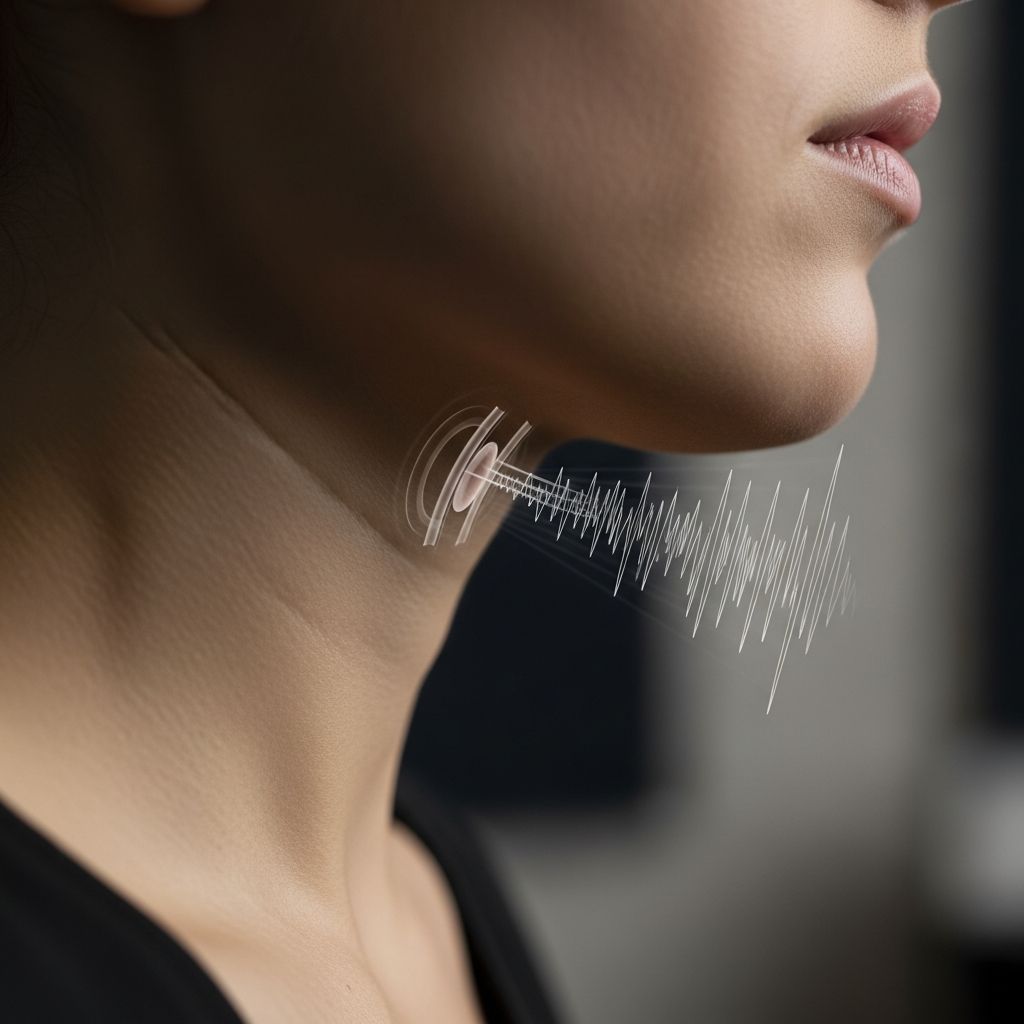
Vocal fry is a low, creaky vocal register produced by loose, irregular vibrations of the vocal folds, often resembling the sound of frying bacon.
What Does Vocal Fry Sound Like?
Vocal fry produces a distinctive low-frequency, rattling or popping noise at the bottom of one’s vocal range, characterized by short, staccato pulses and a relaxed, creaky quality.
- Low frequency: Typically 18-65 Hz, far below normal modal voice.
- Creaky quality: Irregular vocal fold vibrations create a crackling effect.
- Staccato bursts: Brief pulses from loose fold closure.
- Relaxed tone: Lacks projection, sounding informal and subdued.
How Is Vocal Fry Produced?
Vocal fry occurs when vocal folds shorten, slacken, and vibrate irregularly, allowing slow air escape that produces low-frequency pulses, differing from the steady vibrations of normal speech.
Examples of Vocal Fry
Celebrities like Kim Kardashian and Scarlett Johansson popularized vocal fry in media, often using it for stylistic emphasis at sentence ends, though it’s a natural phonational register present across genders and cultures.
Is Vocal Fry Bad for You?
Vocal fry is generally not harmful when used sporadically or correctly, as it’s a normal register, but persistent habitual use may lead to vocal fatigue, muscle tension, or reduced voice quality.
- Sporadic fry serves communicative roles, like syntactic marking.
- Persistent fry risks fatigue or strain, especially in professionals.
- No evidence of permanent cord damage with moderation.
Why Do People Use Vocal Fry?
People employ vocal fry for emphasis, informality, or as a linguistic marker at phrase ends; it’s physiological normalcy, not pathology, and appears equally in young men and women.
Does Vocal Fry Affect How You’re Perceived?
Studies show women using vocal fry may be rated less competent or authoritative in professional settings, though recent research debunks gender bias myths, noting equal prevalence.
| Perception Factor | Impact of Vocal Fry | Source |
|---|---|---|
| Competence | May reduce ratings, especially for women | |
| Authority | Perceived as less reliable | |
| Gender Prevalence | Equal in young adults |
How to Get Rid of Vocal Fry
Eliminate vocal fry through hydration, posture improvement, breath support exercises, and speech therapy focusing on modal voice transitions.
- Hydrate: Drink water to lubricate folds.
- Posture check: Stand tall for better airflow.
- Breathing exercises: Diaphragmatic breaths to engage modal register.
- Vocal warm-ups: Humming or lip trills to relax tension.
- Professional help: Speech-language pathologist for retraining.
When to See a Doctor About Vocal Fry
Consult an ENT or speech pathologist if vocal fry persists with hoarseness, pain, fatigue, or sudden onset, as it may signal injury or disorder.
Frequently Asked Questions
Is vocal fry bad for your vocal cords?
No, moderate use is safe and normal; persistent strain may cause fatigue but not permanent damage.
Why do young women use vocal fry?
Related Stories



It’s stylistic or habitual, not gender-specific; recent studies show equal use in young men and women.
Can vocal fry be fixed?
Yes, with exercises, hydration, and therapy to strengthen modal voice.
Does vocal fry make you sound less professional?
It can reduce perceived authority, particularly for women in job settings.
Is vocal fry a sign of vocal damage?
Usually not, but accompanied symptoms warrant evaluation.
This comprehensive guide expands on vocal fry’s mechanics, drawing from physiological explanations to practical remedies. Vocal fry, while polarizing, is a natural vocal mode with minimal risks when managed. Understanding its production—loose vocal fold vibrations yielding 18-65 Hz creaks—helps demystify it. Culturally, it’s amplified by media figures, yet acoustic analysis confirms its normalcy across demographics.
Health-wise, sporadic fry aids communication, like phrase-final emphasis, without harm. However, chronic reliance builds muscle memory favoring low registers, complicating shifts to projected speech and risking fatigue. For voice professionals, this perception gap is critical: listeners often equate fry with lower competence. Countering it involves holistic vocal hygiene—hydration prevents dryness exacerbating creakiness, while posture optimizes airflow.
Exercises like sustained humming ascend from fry to modal voice train flexibility. Speech therapy employs fry therapeutically to release tension before building resonance. Acoustically, fry’s pulses lack modal voice’s steady harmonics, explaining its informal vibe. Gender myths persist despite evidence: Australian studies found no female skew.
In clinics, persistent fry ratings above moderate levels (per 4-point scales) flag issues, but most cases are mild. Prevention emphasizes awareness—record speech to self-audit fry prevalence. For singers, fry eases into chest register safely if relaxed. Overall, informed use enhances expressivity without jeopardy.
Delving deeper, phonetic research positions fry as one of three registers: falsetto, modal, and pulse/fry. Hollien’s 1960s work normalized it beyond pathology. Perceptually rough, its low pitch suits emphasis, yet excess muffles clarity. Therapeutic applications include voice rehab, where controlled fry loosens hyperfunction.
Socially, 2014 labor studies linked female fry to hireability dips, prompting awareness. Yet, evolutionarily, creaky voice signals relaxation universally. Reduction protocols succeed via progressive resistance: start with gentle sirens gliding pitches. Monitor progress acoustically if possible, targeting fundamental frequency rise.
For parents noting teen fry, reassure—it’s developmental, resolvable with modeling clear speech. Professionals benefit from apps tracking vocal load. Ultimately, vocal fry underscores voice’s adaptability; mastery balances registers for optimal health and impact.
References
- What Is Vocal Fry And How To Get Rid Of It? — Vesper RX. 2023. https://vesperrx.com/vocal-fry/
- What is Vocal Fry? Understanding Its Impact on Your Voice — Voices.com. 2023. https://www.voices.com/blog/vocal-fry/
- Factors associated with vocal fry among college students — PMC – NIH. 2018-09-06. https://pmc.ncbi.nlm.nih.gov/articles/PMC6123225/
- Vocal Fry and How to Use It in Your Voice — Ramsey Voice. 2023. https://ramseyvoice.com/vocal-fry/
- Vocal Fry in Women: The Impact on Vocal Health… and Career? — Center for Vocal Health. 2023. https://www.centerforvocalhealth.com/tips-from-the-doc/vocal-fry-in-women-impact-on-career-and-vocal-health
- Vocal fry: What is it and why does it still polarise listeners? — Pursuit by University of Melbourne. 2023. https://pursuit.unimelb.edu.au/articles/vocal-fry-what-is-it-and-why-does-it-still-polarise-listeners
- Myth busted: vocal fry isn’t just a ‘girl thing’ — Macquarie University Lighthouse. 2025-10. https://lighthouse.mq.edu.au/article/october-2025/myth-busted-vocal-fry-isnt-just-a-girl-thing
Similar Articles








Read full bio of medha deb