Vulval Intraepithelial Neoplasia: Causes, Symptoms & Treatment
Understanding VIN: A comprehensive guide to precancerous vulval skin lesions and effective treatment options.
Understanding Vulval Intraepithelial Neoplasia (VIN)
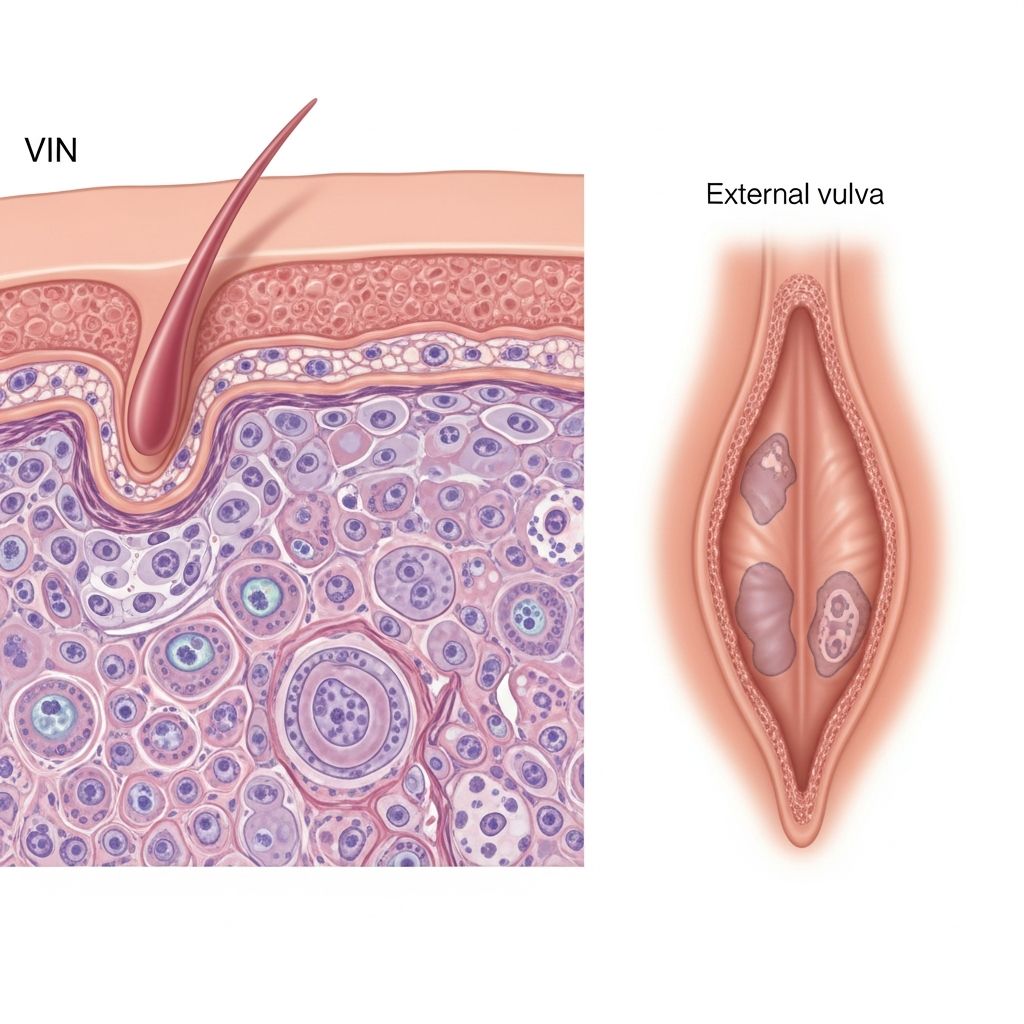
Vulval intraepithelial neoplasia (VIN) is a precancerous skin condition that affects the vulva, the outer part of the female genital area surrounding the vaginal opening. Also known as vulval dysplasia, VIN represents a type of squamous cell carcinoma in situ that can develop on any part of the vulva. Understanding this condition is essential for early detection and prevention of progression to invasive vulval cancer. VIN is classified into two distinct types with different biological behaviors and risk profiles, each requiring different management approaches.
Types of Vulval Intraepithelial Neoplasia
VIN is classified into two main types based on etiology and clinical presentation:
Usual-Type VIN (uVIN/HSIL)
Usual-type VIN, also referred to as vulval high-grade squamous intraepithelial lesion (HSIL), is strongly associated with human papillomavirus (HPV) infection. This represents the more common form of VIN and accounts for the majority of diagnosed cases. High-risk HPV strains, particularly types 16, 18, and 33, are predominantly implicated in uVIN development. Most individuals diagnosed with uVIN carry HPV-16 infection. The condition typically affects younger to middle-aged women and may present with multiple lesions at different sites on the vulva.
Differentiated VIN (dVIN)
Differentiated VIN is not associated with HPV infection and is considerably less common, accounting for approximately 5% of all VIN cases. Instead, dVIN is closely associated with chronic inflammatory skin conditions, particularly lichen sclerosus and erosive lichen planus. Lichen sclerosus causes inflammation and characteristic white, scaly patches on the vulva. Importantly, differentiated VIN carries a significantly higher risk of malignant progression, with up to 85% of untreated cases advancing to squamous cell carcinoma if left unmanaged.
Symptoms and Clinical Presentation
VIN presents with variable symptoms, and notably, some women may be entirely asymptomatic, with the condition discovered incidentally during routine gynecological examination. Among symptomatic women, the following manifestations are common:
- Vulval itching – Ranging from mild to severe, often the most frequently reported symptom
- Vulval burning or pain – Described as burning sensations, soreness, or tingling in the vulval area
- Skin color changes – Visible alterations in pigmentation, appearing white, grey, pink, red, or dark brown
- Skin thickening or new growths – Raised or thickened areas that may resemble warts
- Cracks or ulcerations – Breaking of the skin surface with potential bleeding
- Dyspareunia – Discomfort or pain during sexual intercourse
The lesions may appear as flat or slightly raised plaques with irregular borders and can occur at multiple sites across the vulva. Most commonly, lesions appear on the hair-bearing labia majora or non-hair-bearing labia minora and posterior fourchette. Up to one in five patients may experience no symptoms at all.
Causes and Risk Factors
HPV Infection
Human papillomavirus (HPV) is the primary causative agent for usual-type VIN. HPV is a sexually transmitted infection transmitted through skin-to-skin contact, meaning various forms of sexual contact beyond intercourse can spread the virus. The high-risk strains associated with VIN development carry significantly higher malignancy potential compared to low-risk HPV types, which typically cause benign warts.
Related Stories



Inflammatory Skin Conditions
Differentiated VIN develops in the context of chronic inflammatory vulval diseases, with lichen sclerosus being the most commonly associated condition. Lichen sclerosus causes inflammation, hypopigmentation, and skin atrophy, creating an environment conducive to malignant transformation.
Additional Risk Factors
Various factors may increase VIN development risk, including immunosuppression, smoking, history of abnormal cervical cytology, and previous vulval dermatological conditions. Age of presentation varies depending on VIN type, with uVIN affecting younger and middle-aged women, while dVIN typically occurs in older women.
Diagnosis and Assessment
Clinical Examination
Healthcare providers begin with a detailed physical examination and comprehensive symptom assessment. The vulva is carefully inspected for suspicious growths, discoloration, or irregular plaques. Any visible skin changes warrant further investigation.
Colposcopy
Colposcopy uses a specialized magnified visual instrument called a colposcope to examine the vulva and vagina with enhanced magnification and illumination. This procedure helps identify the extent and appearance of lesions that may not be visible to the naked eye. Vulvoscopy, a similar examination technique using special light and magnification, is used to evaluate suspected VIN lesions.
Tissue Biopsy
A biopsy remains the definitive diagnostic test for VIN. During this procedure, a small tissue sample is removed from suspicious-looking areas and examined microscopically by a pathologist to confirm the presence of precancerous or abnormal epithelial cells. The biopsy also determines the histological type of VIN and screens for any invasive cancer that may already be present.
Treatment Options
Treatment approaches vary based on VIN type, symptom severity, patient preferences, and individual risk factors. The primary goal is to remove or destroy precancerous cells while preserving vulval sensation and function.
Surgical Excision
Surgical removal of affected tissue remains a standard treatment approach, particularly for localized lesions. Wide local excision allows for complete histological examination of margins and removes visible disease. This approach is typically recommended for differentiated VIN due to its higher malignancy risk.
Laser Ablation
Laser treatment, or laser ablation, uses focused light energy to destroy abnormal cells and allow normal skin regeneration. Most patients require only one treatment session. However, laser treatment can cause specific side effects, including hair loss around the vulva and changes in skin pigmentation in treated areas. This approach is less frequently offered than other treatment modalities.
Topical Imiquimod Cream
Imiquimod is a topical immunomodulatory agent that stimulates the immune system to destroy abnormal cells. It is applied directly to affected areas and works by encouraging the body’s natural immune response. During treatment, vulval skin typically becomes inflamed, and some patients may experience flu-like symptoms including body aches, mild fever, and general malaise. Paracetamol can help manage these symptoms. The most common side effect is vulval skin inflammation manifesting as redness, soreness, itching, weeping, peeling, or cracking skin.
Symptom Management
For patients who do not undergo curative treatment or alongside treatment, symptom management is important. Local anesthetic creams can relieve soreness, while regular moisturizers help maintain skin integrity and reduce irritation. These approaches provide comfort without addressing the underlying condition.
Follow-Up and Monitoring
Regular follow-up appointments are essential for all VIN patients, particularly those managed conservatively. Surveillance ensures that lesions are resolving and monitors for recurrence or progression. For low-grade lesions (LSIL) associated with low-risk HPV types, close observation may be appropriate until lesions resolve spontaneously. Additionally, a group of younger women with multifocal uVIN/HSIL may experience spontaneous disease resolution within one year, particularly when lesions are papular and pigmented. If lesions persist beyond this timeframe, treatment is warranted.
Cancer Risk and Prognosis
The most significant concern with untreated VIN is the potential for malignant transformation to invasive squamous cell carcinoma. Differentiated VIN carries substantially higher cancer risk than usual-type VIN, with up to 85% of untreated dVIN cases progressing to cancer. The timeline for progression varies depending on VIN type, patient factors, and treatment compliance. Early intervention significantly reduces the risk of progression to invasive cancer, making timely diagnosis and appropriate treatment critical for preventing malignancy.
Hereditary Considerations
Currently, there is no evidence that VIN is hereditary or runs in families. While HPV infection itself is sexually transmitted and may cluster in families due to shared exposures, VIN development is not genetically inherited. Recommendations for family screening are not routinely indicated based solely on a relative’s VIN diagnosis.
Post-Treatment Skin Care
Following any VIN treatment, meticulous vulval skin care is essential for optimal healing and comfort. Healthcare providers offer specific guidance on caring for the sensitive vulval region during recovery. Patients should avoid irritants, maintain gentle hygiene practices, and use recommended moisturizers. Regular follow-up appointments monitor healing progress and ensure appropriate recovery.
Frequently Asked Questions
Q: Can VIN resolve on its own without treatment?
A: Some lesions, particularly multifocal uVIN/HSIL in younger women with pigmented papular lesions, may spontaneously resolve within one year. However, if lesions persist beyond this timeframe, treatment is recommended. Differentiated VIN requires active treatment due to its high malignancy risk.
Q: Is VIN always caused by HPV?
A: No. Usual-type VIN (uVIN/HSIL) is strongly associated with HPV infection. However, differentiated VIN is not HPV-related and instead develops in the context of inflammatory skin conditions like lichen sclerosus. This distinction is important for determining appropriate treatment strategies.
Q: What is the risk of VIN progressing to cancer?
A: Untreated differentiated VIN carries a significantly higher cancer risk, with up to 85% progressing to squamous cell carcinoma. Usual-type VIN progression rates are lower but still notable. Early treatment substantially reduces malignancy risk, making prompt diagnosis and intervention crucial.
Q: How long does VIN treatment take?
A: Treatment duration varies by modality. Laser ablation typically requires only one treatment session. Topical imiquimod therapy may require several weeks of application. Surgical excision is a single procedure, though recovery and follow-up monitoring extend over weeks to months.
Q: Can I transmit HPV to partners if I have uVIN?
A: Individuals with HPV-related uVIN may transmit the virus to sexual partners through skin-to-skin contact. However, infection does not inevitably lead to VIN development in partners. Safe sexual practices may reduce transmission risk.
Q: What symptoms warrant immediate medical attention?
A: Seek prompt evaluation for unexplained vulval itching, burning, pain, visible skin changes, color alterations, new growths, ulcerations, or any symptoms persisting beyond two weeks. Early medical assessment is essential for accurate diagnosis and timely intervention.
References
- Vulval intraepithelial neoplasia (VIN) — DermNet. Accessed January 2026. https://dermnetnz.org/topics/vulval-intraepithelial-neoplasia
- Vulvar Intraepithelial Neoplasia: Causes, Symptoms & Treatment — Cleveland Clinic. Updated 2025. https://my.clevelandclinic.org/health/diseases/vulvar-intraepithelial-neoplasia
- Vulval intraepithelial neoplasia (VIN) — Cancer Research UK. Accessed January 2026. https://www.cancerresearchuk.org/about-cancer/vulval-cancer/vulval-intraepithelial-neoplasia
- Vulvar Dysplasia Symptoms & Diagnosis — Columbia University Irving Medical Center. Accessed January 2026. https://www.cancer.columbia.edu/cancer-types-care/types/vulvar-cancer/vulvar-dysplasia
- Vulval Intraepithelial Neoplasia Patient Information Leaflet — Skin Health Info. November 2024. https://www.skinhealthinfo.org.uk/wp-content/uploads/2024/11/Vulval-intraepithelial-neoplasia-PIL-Nov-2024.pdf
Similar Articles








Read full bio of Sneha Tete