Warts And Verrucas: 5 Types, Causes, Prevention, And Treatments
Comprehensive guide to understanding, treating, and preventing warts and verrucas caused by HPV virus.
Warts and verrucas are small, rough lumps on the skin caused by the human papillomavirus (HPV). They are harmless but can be painful, itchy, or embarrassing, often resolving without treatment in 2 years.
What are warts and verrucas?
Warts are small, rough lumps that develop on the skin due to infection with the human papillomavirus (HPV), which triggers a reaction in skin cells. Verrucas are a specific type of wart appearing on the soles of the feet, often flattened by pressure and containing black dots from clotted blood vessels. They range from 1 mm to over 1 cm in size and can appear singly or in clusters.
HPV has over 100 strains, with types 1, 2, 4, 27, and 57 commonly causing cutaneous warts. The virus enters through tiny cuts or abrasions, incubating from one month to over a year before visible growths form.
Types of warts and verrucas
- Common warts: Rough, raised lumps, typically on hands or fingers, with a cauliflower-like surface.
- Plantar warts (verrucas): On soles of feet, painful when walked on, with black dots and hardened skin.
- Flat warts: Smaller, smoother, slightly raised; common on face, legs, or arms.
- Filiform warts: Long, thread-like projections, often on face or neck.
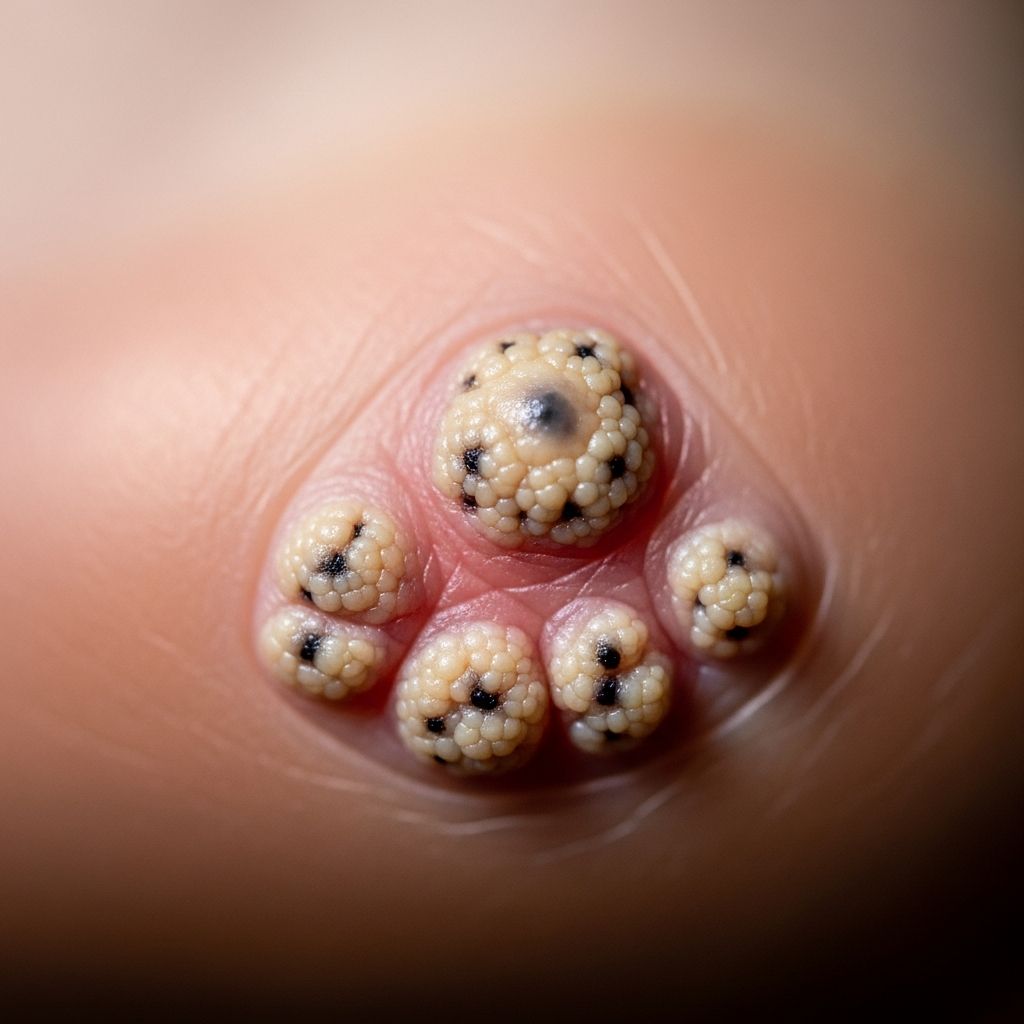
- Mosaic warts: Clusters of verrucas forming a mosaic pattern on feet.
These variations depend on HPV strain and location, with verrucas particularly common in pressure areas like heels.
How common are warts and verrucas?
Warts affect most people at some point, especially children and young adults. They are highly prevalent in communal settings like schools and pools. Studies show half resolve in one year and two-thirds in two years without treatment, faster in children.
Are warts and verrucas harmful?
Generally no; they are benign and do not cause serious health issues. However, verrucas can be painful, mimicking a needle underfoot, and may itch or bleed if irritated. In rare cases with immunosuppression, they persist or spread. They pose cosmetic concerns or discomfort during activities like swimming.
Are warts and verrucas contagious?
Yes, highly contagious via direct skin-to-skin contact or contaminated surfaces like pool floors or towels. Risk increases with wet, damaged skin. Close contact transmits the virus directly; indirect spread occurs in moist environments.
How to stop warts and verrucas spreading
- Wash hands thoroughly after touching warts or verrucas.
- Avoid picking, scratching, or biting them.
- Do not share towels, socks, shoes, or razors.
- Cover warts with plasters, especially in pools or gyms.
- Wear flip-flops in public showers, pools, and changing rooms.
- Keep skin dry and intact; moisturize to prevent cracks.
These measures reduce transmission risk significantly.
What is the treatment for warts and verrucas?
Treatment is optional as 65-70% resolve spontaneously within 2 years. Treat if painful, spreading, or bothersome. First-line: salicylic acid (over-the-counter, 12.5-27% strength). Apply daily after soaking and paring dead skin with a pumice or emery board. Use for up to 12 weeks; success rate 50-70% at 3 months.
Step-by-step salicylic acid application:
- Soak wart in warm water 10-20 mins.
- Gently file excess skin (discard file).
- Apply acid, avoiding healthy skin; cover with plaster.
- Repeat daily; stop if irritated.
Verrucas may need stronger preparations like Occlusal® (up to 6 weeks) or Bazooka™.
Other treatment options
If salicylic acid fails:
- Cryotherapy: Liquid nitrogen freezing every 2-4 weeks; 70% success after 3-4 sessions, painful with blistering.
- Strong acids: Glutaraldehyde (Glutarol®) or formaldehyde (Veracur®), painted on daily.
- Duct tape occlusion: Cover for 6 days, then file and repeat; adjunct to acids.
- GP treatments: Electrosurgery, curettage, laser, or immunotherapy for resistant cases.
Related Stories



| Treatment | Success Rate | Duration | Side Effects |
|---|---|---|---|
| Salicylic Acid | 50-70% at 3 months | Up to 12 weeks | Skin irritation |
| Cryotherapy | 70% after 3 sessions | 2-4 weeks intervals | Pain, blisters |
| Duct Tape | Variable, adjunct | 6 days cycles | Skin irritation |
Immunosuppressed patients or facial warts require professional care.
Can you swim with warts and verrucas?
Yes, but cover with waterproof plasters to prevent spread. Avoid bare feet on pool floors; use flip-flops. Many pools require covering.
When to seek medical advice
- Wart changes: bleeding, hair growth, color/shape alteration.
- Severe pain or emotional distress.
- No improvement after 12 weeks self-treatment.
- Weakened immunity (e.g., diabetes, chemotherapy, HIV).
- Poor circulation or numerous warts.
- Child under 4 or facial/periungual warts.
See GP for referral to dermatology if needed.
Frequently Asked Questions (FAQs)
Q: Do warts go away on their own?
A: Yes, about two-thirds clear within 2 years, especially in children.
Q: Are verrucas dangerous?
A: No, but painful; pinch test confirms (pain like squeezing a spot).
Q: Can I cut off a wart?
A: No, risks infection/bleeding; seek professional removal.
Q: How long does salicylic acid take?
A: Up to 12 weeks; persist unless irritated.
Q: Are home remedies effective?
A: Limited evidence; duct tape or vinegar unproven vs. standard treatments.
Prevention Tips
Beyond hygiene, boost immunity via healthy diet/sleep. Avoid walking barefoot in public wet areas.
This guide empowers self-management while highlighting when professional input is essential, ensuring safe resolution of these common afflictions.
References
- Warts and Verrucas — Welsh Medicines Advice Service. 2023-07-20. https://www.wmic.wales.nhs.uk/wp-content/uploads/2023/07/CAS-PIL-Warts-and-Verrucas-v3-20.07.23.pdf
- Warts and Verrucas: Causes and Treatment — Patient.info. Recent. https://patient.info/skin-conditions/warts-and-verrucas-leaflet
- Verrucas — Gateshead Health NHS Foundation Trust. 2023-09. https://www.gatesheadhealth.nhs.uk/wp-content/uploads/2023/09/Verrucas.pdf
- Verrucae — Patient.info (Doctor). Recent. https://patient.info/doctor/dermatology/verrucae
- Warts and verrucas — NHS. Recent. https://www.nhs.uk/conditions/warts-and-verrucas/
- Warts and Verrucas – Self-treatment — PCDS. Recent. https://www.pcds.org.uk/files/gallery/PCDS-PIL-Warts-and-Verrucas.pdf
Similar Articles








Read full bio of Sneha Tete