What Does Skin Cancer Look Like: Key Signs To Spot Early
Recognize skin cancer early with photos and descriptions of basal cell, squamous cell, melanoma, and more across skin tones.
Skin cancer is the most common cancer in the United States, affecting millions annually, with nonmelanoma types like basal cell carcinoma (BCC) and squamous cell carcinoma (SCC) being prevalent, alongside the more dangerous melanoma. Early detection through self-examination is crucial, as most cases are curable when found early. This article provides detailed descriptions and characteristics of various skin cancers, including photos referenced from credible sources, to help you recognize potential signs on any skin tone.
Skin Cancer Overview
Skin cancer develops primarily from ultraviolet (UV) exposure from the sun or tanning beds, appearing on sun-exposed areas like the face, scalp, neck, ears, and hands. It manifests in diverse forms, sizes, and colors, making identification challenging without knowledge of key warning signs. Regular monthly skin checks are recommended: look for anything
new, changing, or unusual
, even if it doesn’t match typical images. Factors like skin tone influence appearance—darker skin may show less pigmentation, while lighter skin often displays pink or red lesions.- Key Risk Factors: Fair skin, history of sunburns, family history, weakened immune system, and excessive UV exposure.
- Prevention Tips: Use broad-spectrum SPF 30+ sunscreen daily, wear protective clothing, avoid peak sun hours, and skip tanning beds.
Nonmelanoma Skin Cancers
Nonmelanoma skin cancers, including BCC and SCC, are the most common and usually slow-growing but can invade nearby tissues if untreated. They account for the majority of cases and are highly treatable with early intervention like Mohs surgery.
Basal Cell Carcinoma (BCC)
BCC, the most frequent skin cancer, often appears as a pink or skin-colored bump that enlarges slowly, sometimes bleeding or becoming tender. It can look translucent and shiny with visible blood vessels, or waxy and scar-like in morphoeic types. Pigmented BCC may show brown, blue, or gray areas resembling warts or melanoma.
- Early BCC: Small, pearly nodule with rolled edges.
- Advanced BCC: Ulcerated sore or crusty patch that doesn’t heal.
- On Diverse Skin Tones: Pinkish on light skin; darker or less noticeable on brown or Black skin.
A case study highlights a BCC on the face that grew deeply, requiring Mohs surgery followed by reconstruction for optimal cosmetic results.
Squamous Cell Carcinoma (SCC)
SCC presents as a firm, red nodule or flat lesion that may bleed, scab, or ulcerate, often on sun-exposed areas like the scalp or ears. It can resemble a non-healing wound or thickened, scaly patch.
- Early SCC: Red, scaly spot or sore.
- Late-Stage SCC: Large, ulcerated tumor.
- On Various Skin Tones: Reddish on fair skin; hyperpigmented on darker tones.
In one example, a large SCC on an elderly patient necessitated extensive surgery and radiation, but early treatment could have simplified care.
Precancerous Lesions
Actinic Keratosis (AK)
AKs are rough, scaly precancerous spots from sun damage, appearing as small, dry patches that feel like sandpaper. They are common on the face, scalp, ears, and hands, with potential to progress to SCC if untreated.
Related Stories



- Appearance: Red, tan, or pink; may itch or sting.
- Risk: Up to 10% develop into cancer; treat with cryotherapy or topical medications.
Monthly checks help spot AKs early, preventing progression.
Melanoma
Melanoma, though less common, is deadlier due to its potential to spread. It often arises from existing moles or as new growths, looking different on various skin tones—including pink or amelanotic (non-pigmented) types.
Use the
ABCDE rule
from the American Academy of Dermatology to evaluate spots:- A: Asymmetry – One half unlike the other.
- B: Border – Irregular, jagged, or notched edges.
- C: Color – Varied shades: tan, brown, black, red, white, blue.
- D: Diameter – Larger than 6mm (pencil eraser size).
- E: Evolving – Changing in size, shape, color, or symptoms.
Early Melanoma: Small, asymmetrical lesion with uneven borders.
Late-Stage: Larger, ulcerated, or multicolored.
On Black/Brown skin, it may appear on palms, soles, or under nails.
Rare Skin Cancers
Rare types include:
- Merkel Cell Carcinoma: Rapid-growing, red or violet nodule.
- Acral Lentiginous Melanoma (ALM): On palms/soles, irregular pigmentation.
- Kaposi’s Sarcoma: Purple patches, often in immunocompromised individuals.
- Others: Cutaneous lymphoma, DFSP, microcystic adnexal carcinoma, sebaceous carcinoma, undifferentiated pleomorphic sarcoma, extramammary Paget’s disease.
These require specialist evaluation due to rarity and aggressive nature.
Skin Cancer Image Gallery Summary
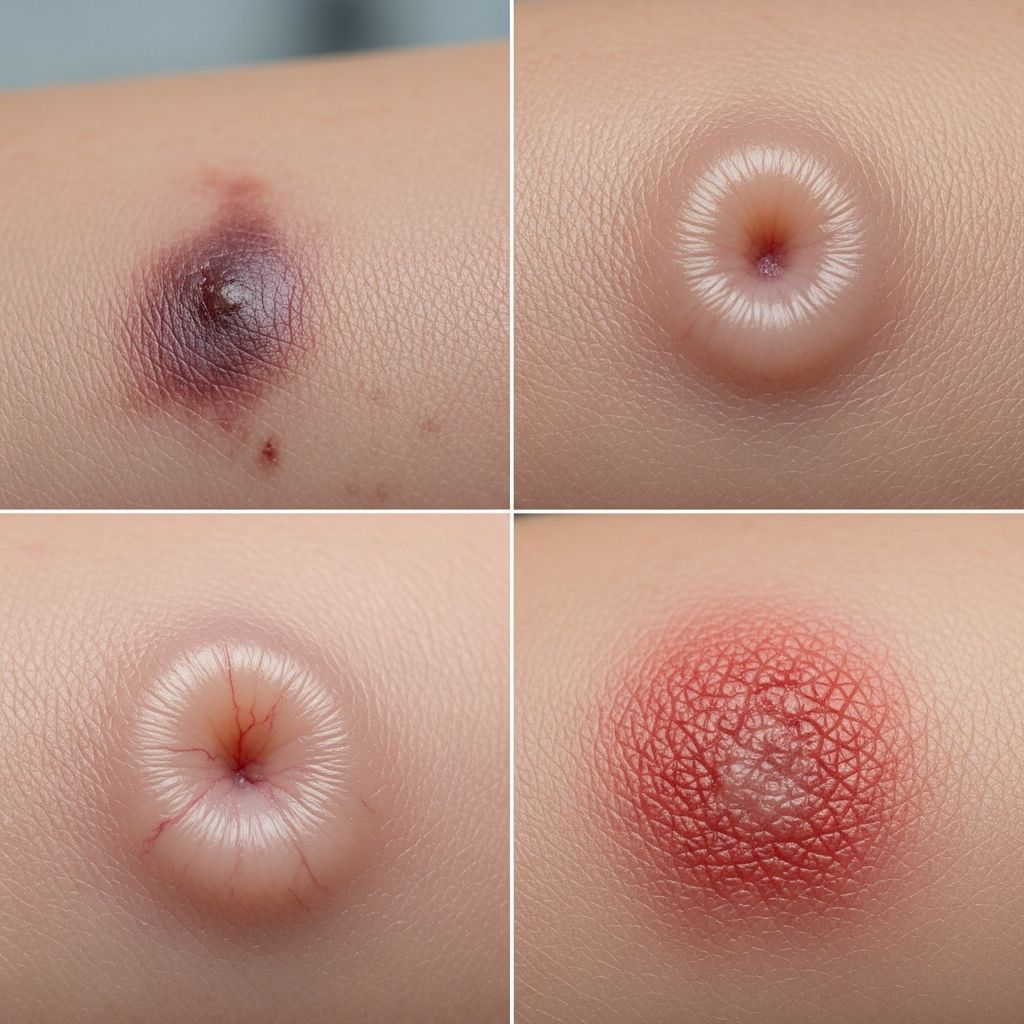
Images from galleries show BCC as pearly bumps, SCC as scaly sores, melanoma via ABCDE traits, and AKs as rough patches. Note: Cancers vary greatly; consult a dermatologist for any concerning spot.
| Type | Common Appearance | Location | Skin Tones Variation |
|---|---|---|---|
| BCC | Pink bump, shiny, ulcerated | Face, neck | Pink to pigmented |
| SCC | Red nodule, scaly sore | Scalp, ears | Red to dark |
| Melanoma | Asymmetrical, multicolored | Anywhere | Tan to pink/amela. |
| AK | Rough, scaly patch | Sun-exposed | Red/tan |
Frequently Asked Questions (FAQs)
What are the first signs of skin cancer?
New, changing, or unusual spots: sores that don’t heal, asymmetrical moles, or rough patches.
How does skin cancer look on Black skin?
Often less pigmented; melanoma on palms/soles, BCC/SCC as dark or hyperpigmented lesions.
Is all skin cancer deadly?
No—most nonmelanoma types are curable early; melanoma is riskier if advanced.
When to see a dermatologist?
Immediately for ABCDE changes, bleeding, or non-healing sores.
Can skin cancer be prevented?
Yes—daily sunscreen, shade, and UV-protective clothing reduce risk significantly.
Self-Examination Tips
Examine skin monthly using a mirror or partner: check scalp, between fingers/toes, soles, and back. Use the ABCDE guide and note changes. Early detection saves lives—most skin cancers are treatable with surgery like Mohs.
References
- Skin Cancer Pictures | What Does Skin Cancer Look Like? — Skin Cancer Foundation. Accessed 2026. https://www.skincancer.org/skin-cancer-information/skin-cancer-pictures/
- Photos of skin cancer — Cancer Research UK. 2022-12-19. https://www.cancerresearchuk.org/about-cancer/skin-cancer/symptoms/photos
- Mayo Clinic Minute – The most common types of skin cancer — Mayo Clinic. 2024-05-28. https://www.youtube.com/watch?v=d57yn6wPCDs
- Melanoma pictures to help identify skin cancer — Mayo Clinic. Accessed 2026. https://www.mayoclinic.org/diseases-conditions/melanoma/in-depth/melanoma/art-20546856
- Skin Cancer Images | What Does Skin Cancer Look Like? — American Cancer Society. Accessed 2026. https://www.cancer.org/cancer/types/skin-cancer/skin-cancer-image-gallery.html
Similar Articles








Read full bio of medha deb