EKG: What It Is And 4 Test Types Explained
Understand the EKG test: its purpose, procedure, results, and role in diagnosing heart conditions effectively.
An
electrocardiogram (EKG or ECG)
is a noninvasive test that records the electrical signals in your heart to evaluate its rhythm and function. This quick, painless procedure helps healthcare providers diagnose various heart conditions by capturing the heart’s electrical activity as waveform patterns.What Does EKG Stand For?
EKG stands for
electrocardiogram
, a test that measures the electrical impulses generated by the heart with each beat. These impulses travel through the heart muscle, causing it to contract and pump blood. The term “EKG” derives from the German spelling “Elektrokardiogramm,” while “ECG” is the English equivalent; both refer to the same test.What Is an EKG Used For?
An EKG is primarily used to assess heart rate, rhythm, and electrical activity to identify abnormalities. Providers order it for symptoms like chest pain, shortness of breath, dizziness, or irregular heartbeats, or as a routine check for heart disease risk, pacemaker function, or pre-surgery evaluation.
- Detecting
arrhythmias
(irregular heartbeats like atrial fibrillation). - Diagnosing
heart attacks
(current or past) by spotting damaged heart tissue patterns. - Evaluating
coronary artery disease
, heart failure, or valve issues. - Monitoring treatment effectiveness, such as pacemakers or medications.
Common symptoms prompting an EKG include pounding or fluttering heartbeat, fast pulse, lightheadedness, unexplained fatigue, reduced exercise tolerance, and chest tightness.
How Does an EKG Work?
The heart’s natural pacemaker, the sinoatrial (SA) node, generates electrical impulses that spread through the atria and ventricles, causing contractions. Electrodes on the skin detect these tiny signals, which a machine amplifies and converts into waves on graph paper or a screen.
Key
EKG components
include:- P wave: Atrial depolarization (contraction).
- QRS complex: Ventricular depolarization (main pumping action).
- T wave: Ventricular repolarization (recovery phase).
Intervals like PR (atrial to ventricular conduction) and QT (ventricular activity duration) help assess timing.
Types of EKG Tests
Standard EKGs capture 10 seconds of activity, but extended monitoring uses other devices for intermittent issues:
| Type | Description | Duration |
|---|---|---|
| Resting EKG | Basic test in a clinic with 12 leads. | 10 seconds |
| Stress EKG | During exercise to check under stress. | Minutes |
| Ambulatory (Holter) | Portable for continuous monitoring. | 24-48 hours |
| Event Monitor | Records when symptoms occur. | Weeks |
These variations ensure comprehensive rhythm evaluation beyond brief snapshots.
How Is an EKG Performed?
Before the Test
No special preparation is needed. Avoid lotions or oils on skin for better electrode adhesion. Inform your provider of pacemakers or pregnancy.
During the Test
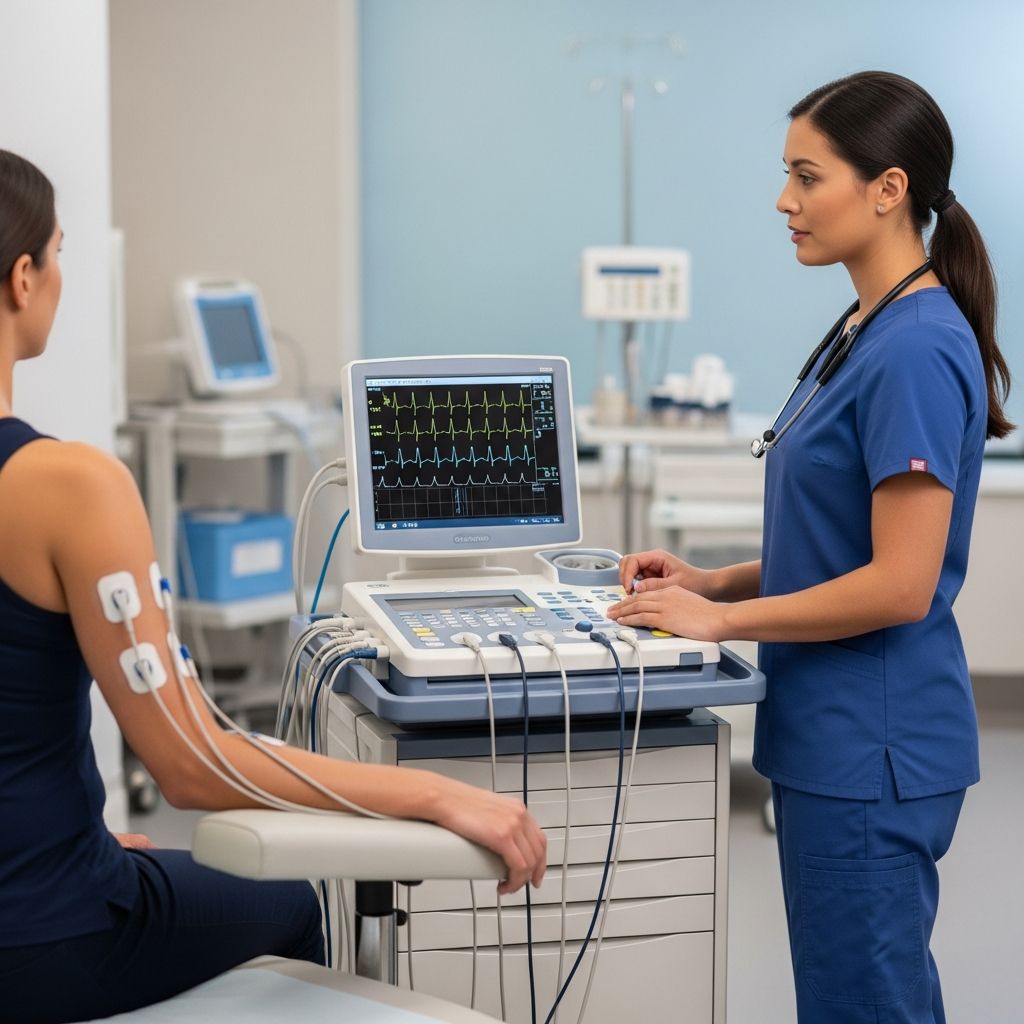
You lie still on an exam table. A technician applies 12 sticky electrodes (patches) to your chest, arms, and legs, connected by wires to a machine. Stay relaxed, breathe normally, but avoid talking or moving, as it can distort results. The test takes 5-10 minutes.
Electrodes detect signals without sending electricity into your body; a computer generates the waveform instantly.
After the Test
Electrodes are removed, and you resume normal activities immediately unless urgent issues arise. Mild skin redness from patches may occur but fades quickly.
Related Stories



Reading an EKG
Providers analyze rate (beats per minute), rhythm regularity, wave morphology, and intervals. Normal findings show consistent P-QRS-T patterns at 60-100 bpm.
Abnormal results** may indicate:
- **Tachycardia** (>100 bpm) or
bradycardia
(<60 bpm). - **Arrhythmias**: Irregular P waves or QRS, e.g., AFib lacks distinct P waves.
- **Ischemia/Infraction**: ST elevation/depression, T inversions, or Q waves signaling damage.
- **Conduction blocks**: Prolonged PR or wide QRS.
- **Enlarged chambers**: Altered wave amplitudes.
Results print as a strip with leads (I, II, III, aVR, aVL, aVF, V1-V6) for multi-angle views.
EKG Results
Normal: Regular rhythm, proper rate, distinct waves. Abnormal patterns pinpoint issues like blocked arteries or structural defects. Urgent findings (e.g., active heart attack) prompt immediate discussion; routine tests may take days.
Follow-up might include echocardiograms, stress tests, or blood work for confirmation.
Risks of an EKG
EKG is low-risk with no radiation or pain. Rare issues: skin irritation or allergic reaction to electrodes. It’s safe for all ages, including pregnant individuals.
When to Do an EKG
Seek an EKG for new or worsening symptoms: chest pain, palpitations, syncope, dyspnea, or fatigue. Routine for high-risk groups (hypertension, diabetes) or surgery prep.
FAQ
Is an EKG painful?
No, it’s painless; electrodes simply stick to skin.
How long does an EKG take?
About 5-10 minutes.
Can an EKG detect heart attacks?
Yes, current or prior via specific wave changes.
What’s the difference between EKG and ECG?
None; interchangeable terms.
Do I need to fast for an EKG?
No preparation required.
Can I drive after an EKG?
Yes, unless advised otherwise.
Key Takeaways
- EKG is essential for diagnosing arrhythmias, heart attacks, and more.
- Quick, safe test using electrodes to graph heart electricity.
- Normal: Regular waves at 60-100 bpm.
- Abnormalities guide further tests or treatments.
References
- Electrocardiogram (EKG or ECG): Test & Results — Cleveland Clinic. 2023-10-25. https://my.clevelandclinic.org/health/diagnostics/16953-electrocardiogram-ekg
- EKG for Heart Problems: Only the First Step — Orlando Health. 2023. https://www.orlandohealth.com/content-hub/ekg-for-heart-problems-only-the-first-step/
- Electrocardiogram (ECG or EKG) — Mayo Clinic. 2024-01-10. https://www.mayoclinic.org/tests-procedures/ekg/about/pac-20384983
- Electrocardiogram (EKG) Components and Intervals — Alberta Health Services. 2023. https://myhealth.alberta.ca/Health/pages/conditions.aspx?hwid=zm2308
- Electrocardiogram (EKG) — American Heart Association. 2023-11-01. https://www.heart.org/en/health-topics/heart-attack/diagnosing-a-heart-attack/electrocardiogram
- Electrocardiogram — StatPearls, NCBI Bookshelf. 2023-07-17. https://www.ncbi.nlm.nih.gov/books/NBK549803/
Similar Articles








Read full bio of Sneha Tete