What is Intelligence? Understanding Mind and Cognition
Explore the science of intelligence: definitions, types, measurement, and what makes us cognitively unique.
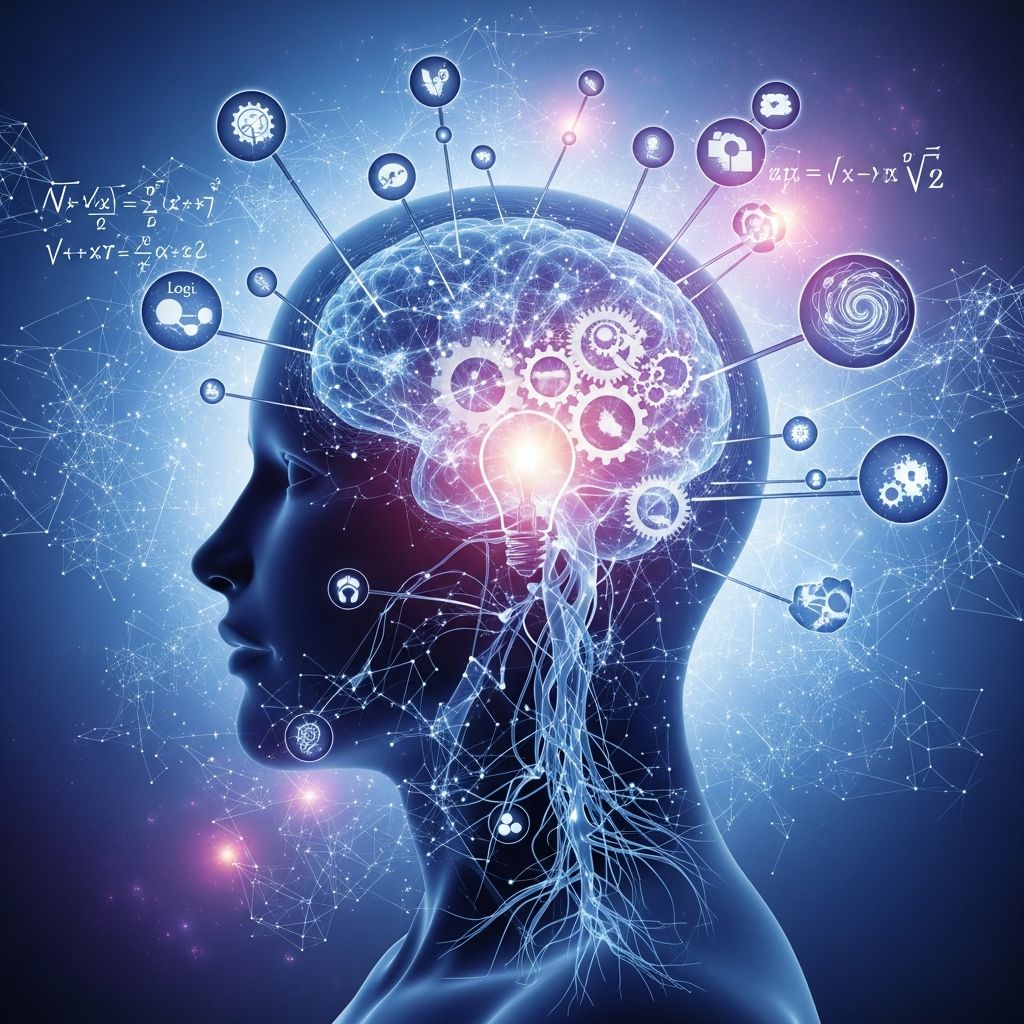
What is Intelligence? A Comprehensive Guide
Intelligence is one of the most fundamental yet complex concepts in psychology and neuroscience. While we often use the term casually in everyday conversation, defining intelligence precisely has challenged researchers and scientists for decades. Intelligence encompasses far more than a single ability or score on a standardized test—it represents the broad cognitive capacity that enables humans to learn, reason, solve problems, and adapt to their environment. Understanding what intelligence truly is requires examining its multiple dimensions, how scientists measure it, and what recent research reveals about the brain mechanisms underlying cognitive abilities.
Defining Intelligence
Intelligence can be defined as the capacity to acquire knowledge, apply reasoning, solve problems, recognize patterns, and adapt to new situations. It is the mental ability to comprehend ideas, understand relationships between concepts, and use information effectively to achieve goals. Rather than a single trait, intelligence is multifaceted and includes various cognitive processes such as attention, memory, processing speed, and executive function. The most widely accepted definition in psychology emphasizes that intelligence is the ability to learn from experience, recognize patterns, understand complex ideas, reason abstractly, and apply knowledge to new problems. This definition acknowledges that intelligence is not static but can be developed and improved through education, practice, and experience.
Types and Components of Intelligence
Modern psychology recognizes that intelligence is not monolithic but consists of multiple components. Different theoretical frameworks have proposed various models of intelligence, each emphasizing different aspects of cognitive ability.
General Intelligence (g Factor)
The concept of general intelligence, often called the “g factor,” was proposed by psychologist Charles Spearman in the early 20th century. This theory suggests that there is an underlying general cognitive ability that influences performance across different intellectual tasks. People who score well on one type of cognitive task tend to perform well on others, supporting the notion of a general intelligence factor. However, while the g factor explains some variance in cognitive performance, it does not account for all differences in mental abilities across individuals.
Multiple Intelligences Theory
Howard Gardner’s theory of multiple intelligences proposes that intelligence is not a single entity but rather a collection of distinct cognitive capabilities. Gardner initially identified seven types of intelligence: linguistic, logical-mathematical, spatial, bodily-kinesthetic, musical, interpersonal, and intrapersonal. Later, he added naturalistic intelligence and suggested other potential forms. This framework recognizes that individuals may excel in certain types of intelligence while being less proficient in others. For example, a musician might have exceptional musical intelligence but not necessarily superior logical-mathematical intelligence. This perspective has important implications for education and career development, as it suggests that traditional measures of intelligence may not capture all forms of cognitive ability.
Emotional Intelligence
Emotional intelligence (EI) refers to the ability to perceive, understand, manage, and utilize emotions effectively. This includes self-awareness, self-regulation, motivation, empathy, and social skills. Individuals with high emotional intelligence can recognize their own emotions and those of others, use this information to guide thinking and behavior, and manage interpersonal relationships effectively. Emotional intelligence plays a crucial role in personal success, professional effectiveness, and mental health. Research suggests that emotional intelligence may be equally or even more important than traditional measures of cognitive ability in predicting life success and well-being.
Fluid and Crystallized Intelligence
Another important distinction is between fluid intelligence and crystallized intelligence. Fluid intelligence refers to the ability to reason abstractly, solve novel problems, and think flexibly without relying on prior knowledge. It involves processing speed and working memory and is crucial for handling new situations and challenges. Crystallized intelligence, by contrast, refers to knowledge accumulated through experience and education. It represents the ability to apply learned skills and information to solve problems. These two types of intelligence show different trajectories across the lifespan—fluid intelligence tends to peak in early adulthood and decline with age, while crystallized intelligence often continues to improve throughout life as people accumulate knowledge and experience.
Related Stories



Measuring Intelligence
Intelligence testing has a long history in psychology and education. The most widely used measures are intelligence quotient (IQ) tests, which attempt to quantify cognitive ability numerically.
IQ Tests and Standardized Measures
Intelligence quotient tests are standardized assessments designed to measure cognitive abilities and compare an individual’s performance to population norms. Common IQ tests include the Wechsler Adult Intelligence Scale (WAIS), the Stanford-Binet Intelligence Scale, and the Raven Progressive Matrices. These tests typically assess various cognitive domains including verbal comprehension, perceptual reasoning, working memory, and processing speed. An IQ score of 100 represents the average, with a standard deviation of 15 points in most modern tests. Scores between 85 and 115 are considered average, while scores above 130 may indicate giftedness, and scores below 70 may suggest intellectual disability.
Limitations of Traditional IQ Testing
While IQ tests remain widely used in educational and clinical settings, they have significant limitations. These tests may not capture all forms of intelligence, particularly creative thinking, practical problem-solving, and social intelligence. Cultural bias in testing has also been documented, with some populations performing differently due to differences in educational background, language proficiency, or familiarity with test formats rather than differences in underlying cognitive ability. Additionally, IQ tests measure performance at a single point in time and may not reflect an individual’s full potential or capability for growth and learning.
Contemporary Assessment Approaches
Modern approaches to assessing intelligence have expanded beyond traditional IQ testing to include measures of adaptive functioning, achievement, and real-world problem-solving abilities. Dynamic assessment approaches evaluate how individuals learn and improve with instruction and support, providing a more process-oriented view of intelligence. Portfolio assessment and performance-based evaluations allow for demonstration of knowledge and skills in authentic contexts. Neuropsychological testing can provide detailed information about specific cognitive strengths and weaknesses. These contemporary methods recognize that intelligence is multifaceted and that traditional standardized tests may not fully capture an individual’s cognitive capabilities.
Brain Mechanisms and Neurobiology of Intelligence
Advances in neuroscience have revealed important insights into the biological basis of intelligence. Brain imaging studies, genetic research, and investigations of neural processing have contributed to understanding how intelligence emerges from brain structure and function.
Brain Structure and Intelligence
Research has identified correlations between certain brain characteristics and intelligence measures. Brain size shows a modest positive correlation with IQ, although the relationship is complex and influenced by factors such as body size and sex. More importantly, the quality of neural connectivity—how efficiently different brain regions communicate—appears to be strongly related to cognitive abilities. The prefrontal cortex, which is involved in executive function, planning, and working memory, is particularly important for intelligence. The parietal cortex contributes to reasoning and spatial abilities, while temporal regions support language and memory. White matter integrity, which reflects the quality of connections between brain regions, shows consistent positive associations with intelligence across studies.
Genetic and Environmental Factors
Intelligence is influenced by both genetic and environmental factors. Twin and adoption studies suggest that approximately 50% of the variation in intelligence among individuals is attributable to genetic differences, with the remaining variation influenced by environmental factors. However, the relative contributions of genes and environment vary across the lifespan and differ across populations. Early childhood experiences, educational opportunities, nutrition, socioeconomic status, and family environment all significantly influence cognitive development. Importantly, the heritability of intelligence does not mean that intelligence is fixed or unchangeable—environmental interventions and educational programs can substantially improve cognitive abilities, particularly during critical developmental periods.
Neural Efficiency and Processing
Highly intelligent individuals show greater neural efficiency, meaning they accomplish cognitive tasks while using less neural resources than others. Brain imaging studies reveal that people with higher IQ scores often show less activation in certain brain regions during cognitive tasks, suggesting more efficient information processing. Additionally, processing speed—the rate at which the brain can process information—is consistently positively correlated with intelligence measures. Reaction time tasks, which measure how quickly individuals can respond to stimuli, show moderate correlations with IQ, suggesting that faster neural processing contributes to higher cognitive abilities.
Intelligence Across the Lifespan
Intelligence is not static but changes throughout development. Understanding how cognitive abilities evolve across the lifespan is crucial for appreciating the dynamic nature of intelligence.
Childhood Development
During childhood, intelligence develops rapidly as the brain matures and children acquire knowledge and skills. Infants show early signs of cognitive ability through their capacity to perceive patterns, learn associations, and remember information. Jean Piaget’s theory of cognitive development describes qualitative changes in thinking abilities across childhood stages, from sensorimotor thinking in infancy to formal operational reasoning in adolescence. During childhood, IQ scores become increasingly stable and predictive of future academic performance, particularly after age 7. However, significant individual differences exist, and cognitive abilities continue to develop and change throughout childhood and into adolescence.
Adulthood and Aging
In adulthood, different aspects of intelligence show different developmental trajectories. Fluid intelligence, which depends on processing speed and working memory, generally peaks in the late teens or early twenties and gradually declines with advancing age. Crystallized intelligence, by contrast, continues to increase throughout adulthood as people accumulate knowledge and experience, often reaching a plateau in later life but remaining relatively stable. This suggests that while some aspects of cognitive ability decline with age, others actually improve. Older adults often demonstrate superior performance on tasks requiring knowledge, vocabulary, and judgment compared to younger individuals, while showing slower processing speed and reduced working memory capacity.
Factors Influencing Intelligence
Numerous factors influence the development and expression of intelligence beyond genetics:
– Education: Quality education significantly enhances cognitive abilities and provides tools for intellectual development- Socioeconomic Status: Access to resources, educational opportunities, and stimulating environments correlates with intelligence measures- Nutrition: Adequate nutrition, particularly during critical developmental periods, supports brain development and cognitive function- Sleep: Quality sleep is essential for memory consolidation, cognitive processing, and maintaining mental acuity- Physical Activity: Regular exercise improves brain health, cognitive function, and academic performance- Cognitive Stimulation: Engaging in challenging mental activities, learning new skills, and problem-solving enhances cognitive abilities- Social Interaction: Social engagement and meaningful relationships contribute to cognitive health and psychological well-being- Motivation and Effort: Persistence, motivation, and engagement in learning significantly influence how intelligence is expressed and developed
Practical Applications of Intelligence Understanding
Education
Understanding intelligence has profound implications for educational practice. Recognizing that intelligence is multifaceted suggests that educational systems should nurture diverse abilities rather than focusing narrowly on academic skills measured by standardized tests. Differentiated instruction that accommodates different learning styles and cognitive strengths can help all students reach their potential. Growth mindset approaches that emphasize that abilities can be developed through effort and practice have been shown to improve motivation and academic achievement.
Career Development
Insights from intelligence research inform career counseling and human resource management. Understanding an individual’s cognitive strengths and weaknesses can guide educational and occupational choices. Recognizing multiple forms of intelligence helps people find careers that align with their particular abilities, whether those involve analytical reasoning, creative thinking, interpersonal skills, or practical problem-solving. This approach acknowledges that success in various fields requires different combinations of cognitive abilities.
Mental Health and Clinical Assessment
Intelligence assessment plays an important role in clinical psychology and psychiatry. Intellectual disability is defined partly based on IQ scores and adaptive functioning. Neuropsychological assessment helps identify cognitive impairments associated with brain injury, neurodegenerative diseases, or psychiatric conditions. Understanding cognitive strengths and weaknesses can inform treatment planning and help individuals develop compensatory strategies for cognitive challenges.
Frequently Asked Questions About Intelligence
Q: Is intelligence fixed or can it change?
A: Intelligence is not entirely fixed. While genetic factors contribute significantly to cognitive abilities, intelligence can be developed and improved through education, practice, and environmental enrichment. The brain’s neuroplasticity—its ability to reorganize and form new neural connections—supports continued intellectual growth throughout life. Fixed mindset beliefs that intelligence cannot change can actually limit achievement, while growth mindset approaches emphasizing that abilities can improve through effort tend to enhance motivation and performance.
Q: Is IQ the only measure of intelligence?
A: No. While IQ tests are widely used standardized measures of certain cognitive abilities, they capture only some aspects of intelligence. IQ tests do not measure creativity, practical problem-solving, emotional intelligence, social skills, or wisdom. Many psychologists argue that intelligence is much broader than what traditional IQ tests measure, and that success in life depends on multiple forms of abilities beyond what these tests assess.
Q: Are there cultural differences in intelligence?
A: Research shows that observed differences in IQ scores between cultural groups are primarily attributable to differences in educational opportunities, socioeconomic status, test bias, and environmental factors rather than fundamental differences in cognitive ability. When these environmental factors are controlled for, many observed differences diminish or disappear. Intelligence testing must account for cultural context to avoid biased assessment.
Q: How does emotional intelligence differ from cognitive intelligence?
A: Cognitive intelligence refers to reasoning, problem-solving, and abstract thinking abilities measured by IQ tests. Emotional intelligence refers to the ability to perceive, understand, and manage emotions—both one’s own and others’. While these are different constructs, research suggests that both contribute importantly to success in personal relationships, career achievement, and overall life satisfaction.
Q: Can intelligence be improved through training?
A: Yes, certain cognitive abilities can be improved through specific training. Working memory capacity, processing speed, and reasoning can be enhanced through targeted cognitive exercises. Additionally, acquiring knowledge, developing skills, and engaging in mentally challenging activities contribute to improved performance on intelligence tasks. However, the extent to which training generalizes to untrained cognitive domains remains a subject of ongoing research.
Conclusion
Intelligence is a complex, multifaceted construct that extends far beyond a single number or score. It encompasses diverse cognitive abilities including reasoning, learning, memory, problem-solving, emotional understanding, and practical adaptation. While IQ tests provide useful standardized measures of certain cognitive abilities, they represent only one aspect of human intellectual capacity. Contemporary understanding recognizes that intelligence is influenced by both genetic and environmental factors, varies across individuals and cultures, and continues to develop throughout the lifespan. As neuroscience advances and our understanding of intelligence deepens, educational and professional practices increasingly recognize and value the multiple forms that intelligence can take. Rather than viewing intelligence as a fixed trait that determines destiny, modern psychology emphasizes that cognitive abilities can be developed and improved through education, practice, and environmental enrichment, offering hope that all individuals can grow intellectually and reach their potential.
References
- Big Data, Artificial Intelligence, and the Promise of Precision Medicine — Johns Hopkins Applied Physics Laboratory & Johns Hopkins Medicine. 2021. https://secwww.jhuapl.edu/techdigest/content/techdigest/pdf/V35-N04/35-04-Ravitz.pdf
- Strategic Applications of Artificial Intelligence in Healthcare — Peer-reviewed research. 2021. https://pdfs.semanticscholar.org/74a6/5096b27cd522a1d0847affdb3d2e8dc58450.pdf
- Autonomous Artificial Intelligence for Diabetic Eye Disease — Johns Hopkins Medicine & Nature. 2024. https://www.nature.com/articles/s41746-024-01197-3
- Medicine, Science, and the Humanities — Johns Hopkins University School of Arts & Sciences. 2024. https://e-catalogue.jhu.edu/arts-sciences/full-time-residential-programs/degree-programs/medicine-science-humanities/
Similar Articles








Read full bio of Sneha Tete