Where Does Our Food Come From? Farm-To-Plate Guide
Uncover the complete journey of food from farm and sea to your table, exploring production, distribution, and sustainable practices.
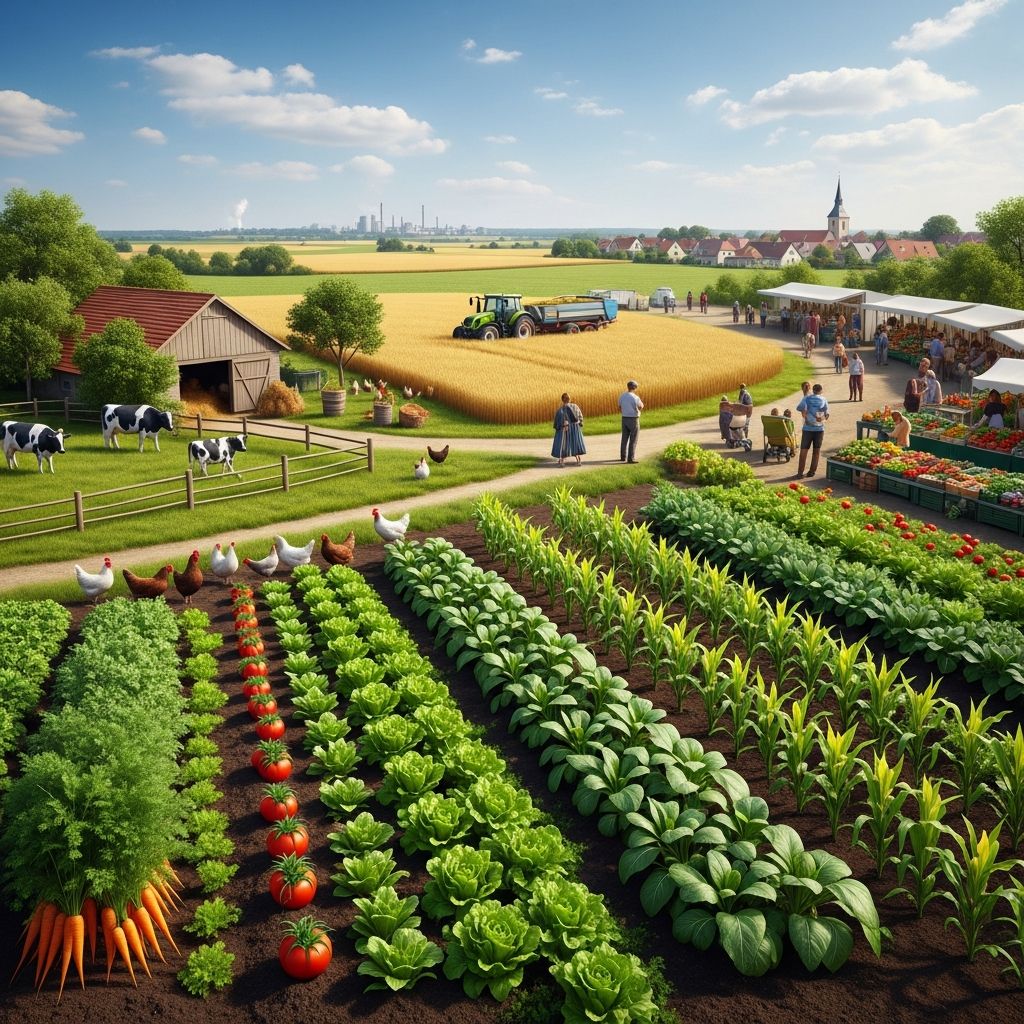
Every bite we take connects us to a vast, intricate global food system that spans farms, oceans, factories, and transportation networks. Understanding where our food originates empowers consumers to make informed choices that support health, sustainability, and food security. This article explores the journey of various food types—from plants grown in soil to animals raised on pastures and fish harvested from seas—while highlighting the roles of processing, distribution, and sustainable practices essential for feeding a growing world population projected to reach 9.8 billion by 2050.
Plant Foods: Fruits, Vegetables and Grains
Plant-based foods form the foundation of human diets worldwide, providing essential nutrients like vitamins, fiber, and carbohydrates. Most fruits, vegetables, and grains begin their journey in agricultural fields, orchards, or greenhouses.
**Fruits and Vegetables:** These are grown in diverse climates tailored to specific crops. Tomatoes, peppers, and cucumbers thrive in warm regions, while root vegetables like carrots and potatoes prefer cooler soils. In the U.S., California produces over 90% of the nation’s fresh fruits and vegetables due to its ideal Mediterranean climate. Farmers plant seeds or seedlings, nurture them with water, fertilizers, and pest control, then harvest at peak ripeness. Post-harvest, produce is sorted, washed, and often hydrocooled to extend shelf life before packing into crates or bins.
**Grains:** Wheat, corn, rice, and oats are staple grains cultivated on vast farmlands. Corn and soybeans dominate U.S. Midwest fields, while rice paddies flourish in Asia’s humid tropics. Harvesting involves mechanized combines that separate grains from stalks. Grains are dried to prevent mold, stored in silos, and transported to mills for processing into flour, cereals, or animal feed.
- Key growing regions: California for specialty crops, Midwest for grains, Florida for citrus.
- Sustainable practices: Crop rotation, cover cropping, and integrated pest management reduce soil erosion and chemical use.
- Challenges: Climate variability, water scarcity, and pests threaten yields, necessitating resilient varieties.
Animal Foods: Meat, Poultry, Dairy and Eggs
Animal products supply high-quality protein, fats, and micronutrients but require significant resources like feed, water, and land. Livestock farming varies from small family operations to large industrial facilities.
**Meat (Beef, Pork, Lamb):** Cattle graze on pastures or are finished in feedlots with grain diets. Pigs are raised in barns with controlled environments, and sheep roam open ranges. Animals are raised to slaughter weight—typically 18-24 months for beef—then transported to processing plants where they are humanely slaughtered, inspected, and fabricated into cuts.
**Poultry:** Chickens and turkeys are broilers raised in climate-controlled houses for 6-8 weeks. Eggs come from layer hens in caged, enriched, or free-range systems. Processing involves stunning, defeathering, evisceration, and portioning.
**Dairy and Eggs:** Dairy cows are milked twice daily on farms, with milk pasteurized and homogenized before packaging. Eggs are collected, candled for quality, washed, and graded.
- Trends: Grass-fed beef and pasture-raised poultry appeal to sustainability-conscious consumers.
- Environmental impact: Livestock contributes to 14.5% of global greenhouse gases, prompting methane-reduction strategies.
Seafood
Seafood offers omega-3 fatty acids and lean protein, sourced from oceans, rivers, and aquaculture farms. Wild-caught fish dominate, but farmed salmon and shrimp are rising.
Commercial fishing fleets use trawlers, longlines, and purse seines to harvest tuna, salmon, cod, and shrimp. Sustainable practices like bycatch reduction and quotas prevent overfishing. Aquaculture grows fish in net pens or ponds, with tilapia and catfish common inland. Post-harvest, seafood is iced, gutted, and filleted on vessels or shoreside plants, then frozen or chilled for transport.
Related Stories



- Certifications: MSC (Marine Stewardship Council) labels ensure sustainable wild fisheries.
- Challenges: Overfishing depletes stocks; aquaculture can pollute waters if unmanaged.
Processing and Manufacturing
Raw commodities transform into consumer-ready products through processing. Primary processing cleans, cuts, and preserves (e.g., canning vegetables, milling grains). Secondary manufacturing creates value-added items like bread, yogurt, or ready-meals.
Facilities adhere to strict food safety standards like HACCP (Hazard Analysis Critical Control Points). Packaging prevents contamination and extends shelf life using modified atmosphere techniques. In the U.S., food processing employs millions and adds economic value, turning $200 billion in farm products into $1.5 trillion retail sales.
| Processing Type | Examples | Purpose |
|---|---|---|
| Pasteurization | Milk, juice | Kill pathogens |
| Fermentation | Yogurt, cheese | Enhance flavor, probiotics |
| Extrusion | Cereal, snacks | Create shapes/textures |
Distribution and Retail
A complex logistics network delivers food nationwide and globally. Wholesalers aggregate products from multiple sources, breaking bulk for retailers. Trucks, rail, ships, and planes form the ‘cold chain’ maintaining temperature control for perishables.
Grocery stores, supermarkets, and specialty markets display foods in refrigerated cases or aisles. Direct-to-consumer models like CSAs (Community Supported Agriculture) and farmers’ markets shorten supply chains, ensuring freshness and supporting local economies. E-commerce and meal kits add convenience but increase packaging waste.
- Global trade: U.S. imports 15% of food, including bananas from Latin America and coffee from Africa.
- Sustainability: Efficient routing and electric vehicles reduce emissions.
Sustainability in Our Food System
Sustainable food systems balance economic viability, social equity, and environmental health without compromising future generations. Key pillars include:
- Environmental: Conserve water, protect biodiversity, reduce waste (one-third of food produced is lost or wasted globally).
- Economic: Fair wages, profitable farms, affordable prices.
- Social: Food security—access to nutritious food for all—addressing hunger affecting 828 million people in 2021.
Practices like regenerative agriculture restore soils, precision farming optimizes inputs via GPS/drones, and plant-forward diets lower impacts. The EAT-Lancet Commission advocates halving food waste and shifting to sustainable diets.
Frequently Asked Questions (FAQs)
How much of U.S. produce comes from California?
Over 90% of fresh fruits and vegetables, thanks to its climate and infrastructure.
What percentage of global emissions comes from food systems?
About 30%, with livestock at 14.5%; agriculture drives deforestation and water use.
How can I support sustainable food choices?
Choose seasonal/local produce, reduce meat intake, minimize waste, and look for certifications like USDA Organic or MSC.
What is the role of aquaculture in seafood supply?
It provides over 50% of seafood for human consumption, easing pressure on wild stocks but requiring eco-friendly management.
Why is food waste a sustainability issue?
It squanders resources (1,300 liters water per kg food wasted) and generates methane in landfills.
References
- What Is A Sustainable Food System? — Academy of Nutrition and Dietetics. 2023. https://www.eatright.org/food/planning/food-security-and-sustainability/what-is-a-sustainable-food-system
- Definitions: Sustainability and Food Systems — United States Department of Agriculture (USDA). 2023-01-01. https://www.usda.gov/about-usda/general-information/staff-offices/office-chief-economist/sustainability/definitions-sustainability-and-food-systems
- Sustainability — Harvard T.H. Chan School of Public Health Nutrition Source. 2024. https://nutritionsource.hsph.harvard.edu/sustainability/
- Sustainable Eating — Academy of Nutrition and Dietetics. 2023. https://www.eatright.org/food/planning/food-security-and-sustainability/sustainable-eating-1
- Food security and sustainability: can one exist without the other? — National Institutes of Health (PMC). 2023-06-01. https://pmc.ncbi.nlm.nih.gov/articles/PMC10271846/
Similar Articles








Read full bio of medha deb