Whole Person Health Determinants: NCCIH’s Framework
Defining key determinants of health across biological, behavioral, social, and environmental domains.
Understanding Whole Person Health and Its Determinants
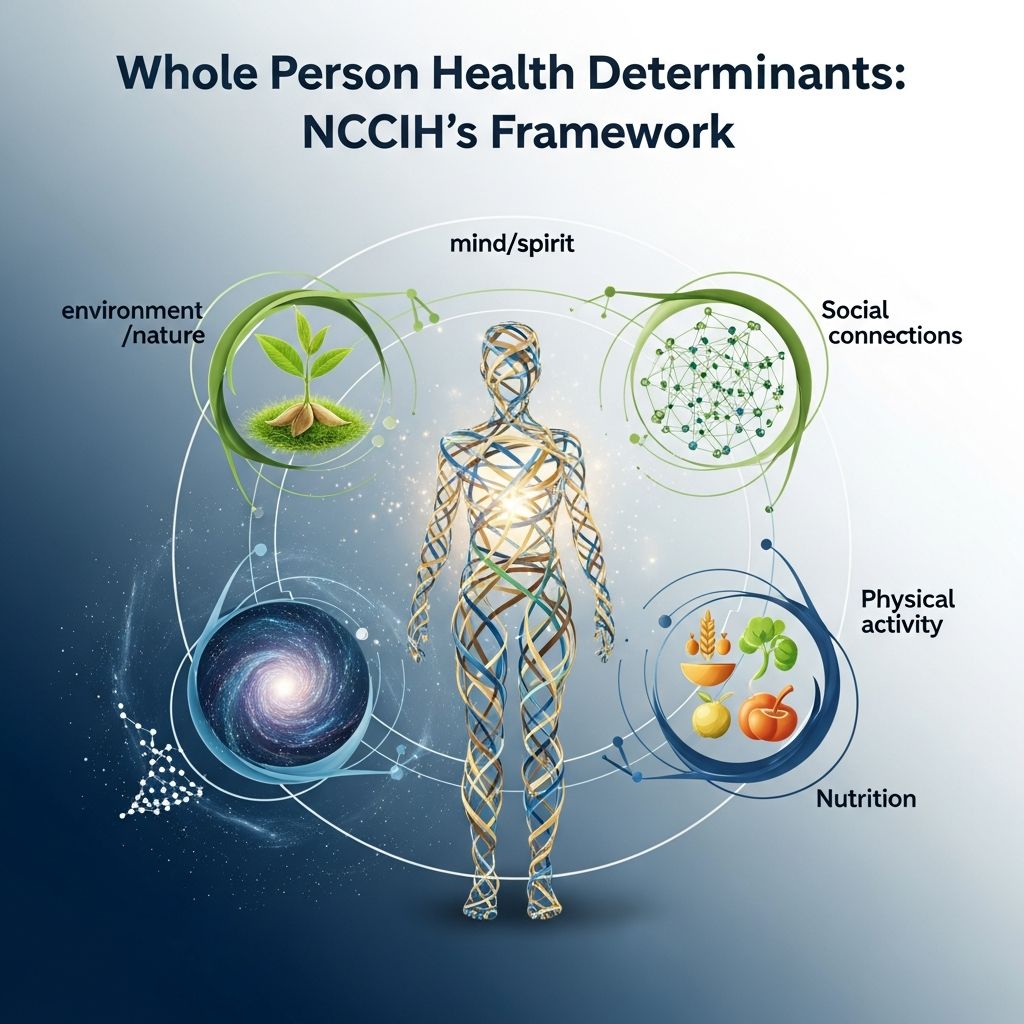
The National Center for Complementary and Integrative Health (NCCIH) has launched a comprehensive initiative to identify and define a unified set of key determinants that influence health across all dimensions of the human experience. This Request for Information (RFI) represents a significant step toward establishing a more holistic approach to health research and patient care that transcends traditional siloed approaches to disease prevention and health promotion. The initiative seeks to develop a framework that recognizes health as a multidimensional construct influenced by interconnected biological, behavioral, social, and environmental factors working in concert.
The Need for a Comprehensive Health Framework
Existing frameworks for understanding health determinants have historically been fragmented and incomplete. Most well-established frameworks focusing on social determinants of health typically include factors within the social, economic, and environmental domains such as education, employment, housing, social connectedness, food access, and access to natural environments. Conversely, other frameworks emphasize behavioral determinants including diet, physical activity, and smoking patterns. However, a critical gap has persisted in health research: no existing framework fully integrates these social, environmental, and behavioral factors together with biological determinants such as fat and muscle mass composition, blood pressure, and metabolic indices.
This fragmentation has led to an incomplete understanding of health and disease. Traditional frameworks have also been disproportionately focused on identifying risk factors for disease rather than recognizing the bidirectional relationship between health and disease. For instance, behavioral determinant frameworks rarely include stress management practices or other health-promoting behaviors that actively contribute to wellness. The reality is that health and disease exist on a continuum rather than as separate, disconnected states. Addressing determinants collectively, with emphasis on factors that promote health, can prevent multiple chronic diseases, restore health, and halt disease progression across the entire lifespan.
The Whole Person Health Research Initiative
NCCIH’s strategic plan emphasizes research on whole person health that deepens scientific understanding of connections across physiological systems and domains of human health. This approach enables researchers and clinicians to better understand how health conditions interrelate, develop interventions that address multiple problems simultaneously, and support patients through the full continuum of their health experience, including pathways to restored health. A critical component of implementing this research strategy involves defining a consistent set of determinants of whole person health that can be applied uniformly across studies and facilitate data harmonization.
Data harmonization is essential for advancing integrated health research. When different studies use different variables and definitions, synthesizing findings and conducting meta-analyses becomes increasingly difficult. By establishing a common framework of health determinants, NCCIH aims to enable researchers across institutions and disciplines to collaborate more effectively and build cumulative knowledge about what drives health and disease across populations.
Scope and Objectives of the RFI
NCCIH is actively seeking to compile a comprehensive list of major determinants of health that encompass the full spectrum of biological, behavioral, social, and environmental domains. This compilation serves a dual purpose: it can ultimately be used to identify a set of common data elements (CDEs) for use in both research settings and patient care delivery. The RFI specifically limits proposed determinants to no more than 20 to ensure the list remains sufficiently comprehensive to capture key elements of whole person health while remaining succinct enough to be manageable for eventual development and deployment of CDE-based measurement tools.
Related Stories



Potential examples of determinants include age, genetic predisposition, sleep quality, social connectedness, and environmental exposures. Where possible, proposed determinants should be listed as Medical Subject Heading (MeSH) terms to ensure consistency and interoperability across research studies and health information systems. A single determinant may span multiple domains and interact with other determinants in both causal and consequential roles.
Understanding Determinant Interactions and Complexity
Health determinants do not operate in isolation. A fundamental principle of whole person health is recognizing that determinants interact in complex, multidirectional ways. Psychological stress exemplifies this interconnectedness: it may be a consequence of socioeconomic factors, inadequate social support networks, environmental exposures, and genetic predisposition. Simultaneously, stress plays a causal role in disrupting sleep habits and can exacerbate negative outcomes in both socioeconomic circumstances and social support systems. NCCIH’s goal is to identify a concise list of major determinants that best define the health-disease continuum from a whole person perspective, acknowledging these complex interrelationships without requiring their complete mapping.
Key Domains of Whole Person Health
Biological and Physical Domain
The biological domain encompasses inherent physiological characteristics and processes including genetic predisposition, age, body composition, blood pressure, metabolic indices, immune function, and organ system health. These factors form the physical foundation of health and interact significantly with behavioral, social, and environmental factors. For instance, genetic predisposition may influence susceptibility to chronic diseases, but environmental factors and behavioral choices often determine whether genetic vulnerabilities manifest as disease.
Behavioral and Mental Domain
Behavioral determinants include lifestyle choices and psychological factors such as diet quality, physical activity levels, sleep patterns, stress management practices, substance use, and mental health status. Mental health encompasses depression, anxiety, cognitive function, and psychological resilience. These behavioral factors are both independent determinants of health and mediators through which social and environmental factors influence physical health outcomes.
Social and Relational Domain
Social determinants include social connectedness, family relationships, community engagement, social support networks, and sense of belonging. Research consistently demonstrates that strong social connections are protective against numerous chronic diseases and contribute to longevity and quality of life. Conversely, social isolation and loneliness are associated with increased mortality risk and numerous negative health outcomes comparable to traditional risk factors.
Environmental Domain
Environmental determinants encompass both natural and built environments, including air and water quality, exposure to toxins and pollutants, access to green spaces, neighborhood characteristics, housing quality, and climate factors. Environmental exposures can have immediate acute effects and long-term chronic consequences, making this domain critical for understanding population health patterns and health disparities.
Spiritual and Existential Domain
Emerging research recognizes spiritual wellbeing, sense of purpose, life meaning, and existential factors as important health determinants. Spiritual practices and beliefs influence health behaviors, stress resilience, social engagement, and overall health outcomes. This domain acknowledges that health encompasses more than physical and mental dimensions.
From Determinants to Measurement and Implementation
The development of common data elements based on identified determinants represents a practical step toward implementing whole person health research and clinical practice. Common data elements standardize how health information is collected, coded, and shared across different studies and settings. This standardization enables data harmonization—the process of making data from different sources comparable and combinable. With standardized measurement of whole person health determinants, researchers can more readily conduct meta-analyses, identify population-level patterns, and test interventions aimed at multiple determinants simultaneously.
The Whole Person Health Index (WPHI), developed collaboratively by NCCIH and the National Center for Health Statistics, represents an early implementation of this framework. The WPHI focuses on nine dimensions of whole person health: self-rated general health, quality of life, social and family connections, diet, physical activity, stress, sleep, spiritual wellbeing, and ability to manage health. This instrument is designed for use across clinical and population-based settings to facilitate the collection of consistent information on these dimensions.
Public Engagement and Stakeholder Input
NCCIH’s approach to developing this framework emphasizes collaboration and public engagement. The RFI process solicits input from researchers, clinicians, community organizations, and other stakeholders who bring diverse perspectives on what constitutes the determinants of health. Multiple organizations, including academic medical centers and community health organizations, have submitted detailed responses to the RFI, contributing their expertise to shaping the final framework. This inclusive approach recognizes that determining which health factors matter most requires input from multiple disciplines and perspectives.
Implications for Research and Clinical Practice
A unified framework for whole person health determinants has profound implications for both research and clinical practice. In research, it enables multi-institutional collaborations that would otherwise be hampered by definitional inconsistencies. In clinical practice, it provides a structured approach for assessing patients across multiple dimensions of health, moving beyond disease-focused histories to comprehensive health assessment. Healthcare providers can use such a framework to identify modifiable determinants amenable to intervention and develop personalized treatment plans that address multiple factors simultaneously.
Furthermore, this framework supports efforts to address health disparities by making visible the multiple pathways through which social, environmental, and economic inequities translate into health inequalities. By measuring determinants consistently across populations, researchers can identify where disparities originate and develop targeted interventions.
Challenges and Considerations
Developing a unified framework for whole person health determinants presents several challenges. First is the challenge of comprehensiveness versus parsimony—including enough determinants to capture the complexity of health while maintaining a list manageable enough for practical implementation. The limitation to 20 determinants represents a balance between these competing demands. Second is the challenge of measurement: translating conceptual determinants into valid, reliable, and practical measurement approaches requires rigorous psychometric evaluation. Third is ensuring that the framework remains flexible enough to accommodate new scientific discoveries about health determinants while remaining stable enough to enable data harmonization across time and studies.
Future Directions
As NCCIH continues to refine the framework for whole person health determinants, several important directions warrant attention. Research is needed to validate proposed determinants and understand their relative importance for different health outcomes and populations. Implementation science research can help identify optimal approaches for incorporating whole person health assessment into routine clinical practice. Additionally, longitudinal studies examining how changes in determinants predict health outcomes will strengthen evidence for the framework’s practical utility.
Frequently Asked Questions
Q: What is the primary purpose of NCCIH’s RFI on whole person health determinants?
A: The RFI seeks to establish a comprehensive, unified framework of health determinants that integrates biological, behavioral, social, and environmental factors for use in both research and patient care settings.
Q: How many determinants is NCCIH targeting for the final framework?
A: NCCIH is limiting the list to no more than 20 determinants to ensure comprehensiveness while maintaining manageability for developing measurement tools.
Q: Why are existing health frameworks considered incomplete?
A: Existing frameworks have been fragmented, typically focusing on either social determinants or behavioral determinants separately, without fully integrating biological and environmental factors or recognizing the bidirectional health-disease continuum.
Q: What is the relationship between health determinants and common data elements?
A: Identified determinants will be used to develop common data elements (CDEs) that standardize how health information is measured and collected across different research studies and clinical settings.
Q: How do health determinants interact with each other?
A: Determinants interact in complex, multidirectional ways. A single factor may be both a consequence of other determinants and a cause of additional health outcomes, reflecting the interconnected nature of health systems.
Q: What is the Whole Person Health Index?
A: The WPHI is a measurement instrument developed by NCCIH and the National Center for Health Statistics that assesses nine dimensions of whole person health for use in research and population health surveillance.
Q: How will NCCIH use the information submitted in response to the RFI?
A: NCCIH will analyze submissions at its discretion, potentially reflecting responses in future funding opportunity announcements and public reports, though individual feedback to respondents is not guaranteed.
References
- Request for Information (RFI): Identification of a Set of Determinants for Whole Person Health — National Center for Complementary and Integrative Health (NCCIH), National Institutes of Health. 2022-04-04. https://www.nccih.nih.gov/grants/request-for-information-rfi-identification-of-a-set-of-determinants-for-whole-person-health
- A Mixed Method Evaluation of the Whole Person Health Index — Centers for Disease Control and Prevention, National Center for Health Statistics. 2025-08. https://stacks.cdc.gov/view/cdc/232357
- Measuring Whole Person Health: A Scoping Review — Journal of Integrative and Complementary Medicine. 2024. https://www.liebertpub.com/doi/10.1089/jicm.2024.0817
- AAMC Response to NCCIH RFI on Whole Person Health Determinants — Association of American Medical Colleges. 2022-06-17. https://www.aamc.org/media/61411/download
Similar Articles








Read full bio of Sneha Tete