With Vs Against The Rule Astigmatism: Causes, Diagnosis, Care
Understand the key differences between with-the-rule and against-the-rule astigmatism, their causes, corrections, and age-related shifts for better vision care.
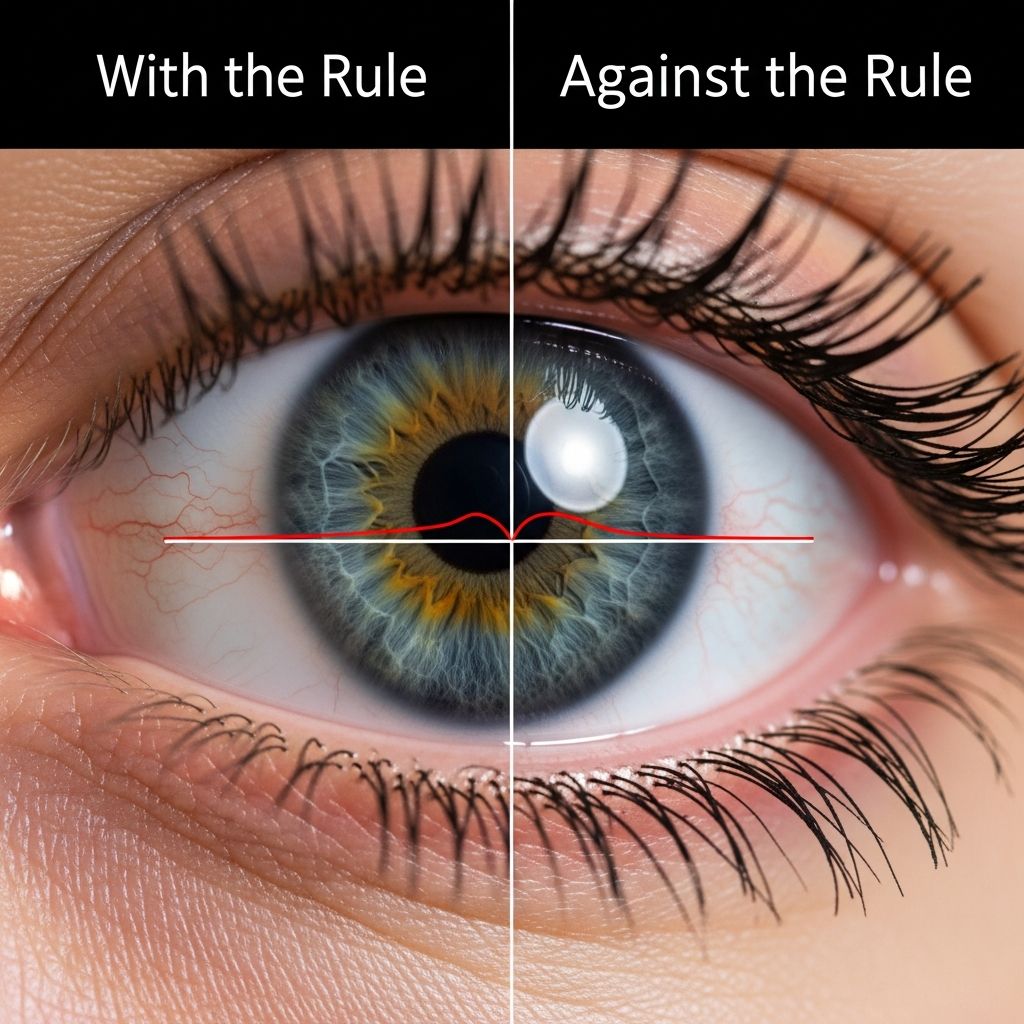
Astigmatism is a common refractive error where the eye’s cornea or lens has an irregular curvature, causing blurred vision at all distances. This condition manifests in different orientations, primarily classified as with-the-rule (WTR) and against-the-rule (ATR) astigmatism, based on the steepest meridian of the cornea. Understanding these distinctions is crucial for accurate diagnosis and effective treatment.
Fundamentals of Astigmatism
The cornea, the eye’s clear front surface, normally has a spherical shape like a basketball, evenly refracting light onto the retina. In astigmatism, it resembles a football with unequal curvatures along two perpendicular meridians: vertical (90 degrees) and horizontal (180 degrees). This irregularity scatters light, leading to distorted vision.
Regular astigmatism features principal meridians at right angles, categorized further by orientation:
- With-the-rule (WTR): Vertical meridian steeper (around 90 degrees).
- Against-the-rule (ATR): Horizontal meridian steeper (around 180 degrees).
- Oblique: Steepest meridian between 120-150 or 30-60 degrees.
These patterns influence how light focuses: in WTR, vertical light rays converge sooner than horizontal ones.
Defining With-the-Rule Astigmatism
With-the-rule astigmatism occurs when the cornea is steeper vertically than horizontally, making it wider than tall, like a rugby ball lying on its side. The vertical meridian (90 degrees) has greater curvature, providing more converging power.
This is the predominant form in younger populations, often due to eyelid pressure compressing the cornea vertically, naturally inducing about 0.25 diopters (D) of WTR astigmatism. Children and young adults typically exhibit this pattern, as the cornea flattens less horizontally early in life.
Clinically, keratometry readings show higher power at 90 degrees (e.g., 44D at 90 vs 43D at 180), confirming WTR.
Defining Against-the-Rule Astigmatism
In contrast, against-the-rule astigmatism features a steeper horizontal meridian (around 180 degrees), making the cornea taller than wide, like a football standing upright. Here, horizontal curvature exceeds vertical, reversing the typical young-eye pattern.
ATR becomes more common with age, as the cornea flattens vertically relative to horizontally, possibly from biomechanical changes or lenticular shifts. It’s corrected with convex cylinder at 180 ±20 degrees or concave at 90 ±20 degrees.
Key Differences: A Side-by-Side Comparison
| Aspect | With-the-Rule (WTR) | Against-the-Rule (ATR) |
|---|---|---|
| Steepest Meridian | Vertical (90°) | Horizontal (180°) |
| Cornea Shape | Wider than tall | Taller than wide |
| Typical Age Group | Children/Young Adults | Older Adults |
| Common Cause | Eyelid pressure | Aging changes |
| -Cylinder Axis | 180° | 90° |
| +Cylinder Axis | 90° | 180° |
This table highlights how WTR and ATR differ in anatomy, prevalence, and optics, guiding precise prescriptions.
How Eyelid Pressure Shapes Astigmatism
Eyelids exert constant downward force, flattening the vertical cornea slightly while the horizontal remains rounder, fostering WTR. The vertical meridian shortens compared to horizontal due to this pressure, creating the characteristic steepness. Over decades, corneal rigidity changes, shifting to ATR as vertical flattening accelerates.
Related Stories



Prescription Strategies for Correction
Astigmatism correction uses cylindrical lenses to equalize meridians. Ophthalmologists often prescribe plus cylinder (power along axis), while optometrists prefer minus cylinder.
For WTR: Vertical excess power requires minus cylinder at meridian 90° (axis 180°), e.g., -1.00D cyl x 180, or plus cylinder axis 90°. This flattens vertical focus.
For ATR: Horizontal excess needs minus cylinder axis 90° or plus cylinder axis 180°.
Oblique axes (off 90/180) pose correction challenges, often causing more blur.
Age-Related Shifts in Astigmatism Patterns
WTR dominates in youth (up to 0.25D naturally), but post-40, ATR increases as corneas remodel. This shift, combined with presbyopia, complicates vision in aging eyes. Regular exams track these changes for updated prescriptions.
Diagnostic Tools and Measurements
Key diagnostics include:
- Keratometry/Topography: Measures corneal curvature in diopters across meridians.
- Refraction: Determines cylinder power and axis via phoropter.
- Auto-refractors: Provide initial axis readings; WTR shows minus cyl near 180°.
Tips: Axis 70-110° (minus cyl) indicates ATR; 160-20° (minus cyl) suggests WTR.
Symptoms and Impact on Daily Vision
Both types blur distance and near vision, with symptoms like headaches, squinting, and eye strain. Oblique astigmatism worsens distortion. ATR may cause less acuity loss on charts. Untreated, it leads to amblyopia in children.
Treatment Options Beyond Glasses
- Contact Lenses: Toric lenses rotate to align with astigmatism axis.
- Refractive Surgery: LASIK reshapes cornea to spherical ideal.
- Orthokeratology: Overnight lenses temporarily correct mild cases.
Success depends on axis stability; oblique types may need customized approaches.
FAQs on Rule Astigmatism
Q: Why is it called ‘with-the-rule’?
A: It aligns with the natural ‘rule’ of eyelid-induced vertical steepness in young eyes.
Q: Does astigmatism worsen with age?
A: Patterns shift from WTR to ATR, but magnitude varies.
Q: Can children outgrow WTR?
A: Mild cases may stabilize, but exams ensure proper correction.
Q: What’s the football analogy?
A: WTR: football horizontal (steep vertical); ATR: vertical (steep horizontal).
Q: Plus vs minus cylinder confusion?
A: Plus power follows axis; minus power is 90° perpendicular. Ophthalmologists favor plus.
Prevention and Long-Term Eye Health
Annual exams detect shifts early. Protect eyes from UV and trauma to maintain corneal integrity. For high astigmatism, monitor for keratoconus risk.
In summary, grasping WTR vs ATR empowers informed vision care, from pediatric screenings to senior adjustments.
References
- What is “with the rule” astigmatism? – TimRoot.com — Tim Root. 2023. https://timroot.com/what-is-with-the-rule-astigmatism/
- Astigmatism – Wikipedia — Wikipedia contributors. 2025-02-20. https://en.wikipedia.org/wiki/Astigmatism
- Astigmatism – StatPearls – NCBI Bookshelf — NIH. 2023-08-08. https://www.ncbi.nlm.nih.gov/books/NBK582142/
- What is the difference between with-the-rule and against-the-rule astigmatism — Dr.Oracle.ai. 2024. https://www.droracle.ai/articles/501926/what-is-the-difference-between-with-the-rule-and-against-the-rule-astigmatism
- Difference Between Against-the-Rule and With-the-Rule Astigmatism — Dr.Oracle.ai. 2024. https://www.droracle.ai/articles/505800/what-is-the-difference-between-against-the-rule-atr
- With the rule & Against the rule Astigmatism – YouTube — Optometry Channel. 2022. https://www.youtube.com/watch?v=gqA-jV8jFkc
- Understanding and Managing Astigmatism Series – Eyes On Eyecare — Eyes On Eyecare. 2024. https://eyesoneyecare.com/resources/understanding-and-managing-astigmatism-series-astigmatism-101/
Similar Articles








Read full bio of medha deb