X-Linked Agammaglobulinemia: Comprehensive Guide For 2025
A rare genetic disorder causing profound antibody deficiency, leading to recurrent bacterial infections primarily in males.
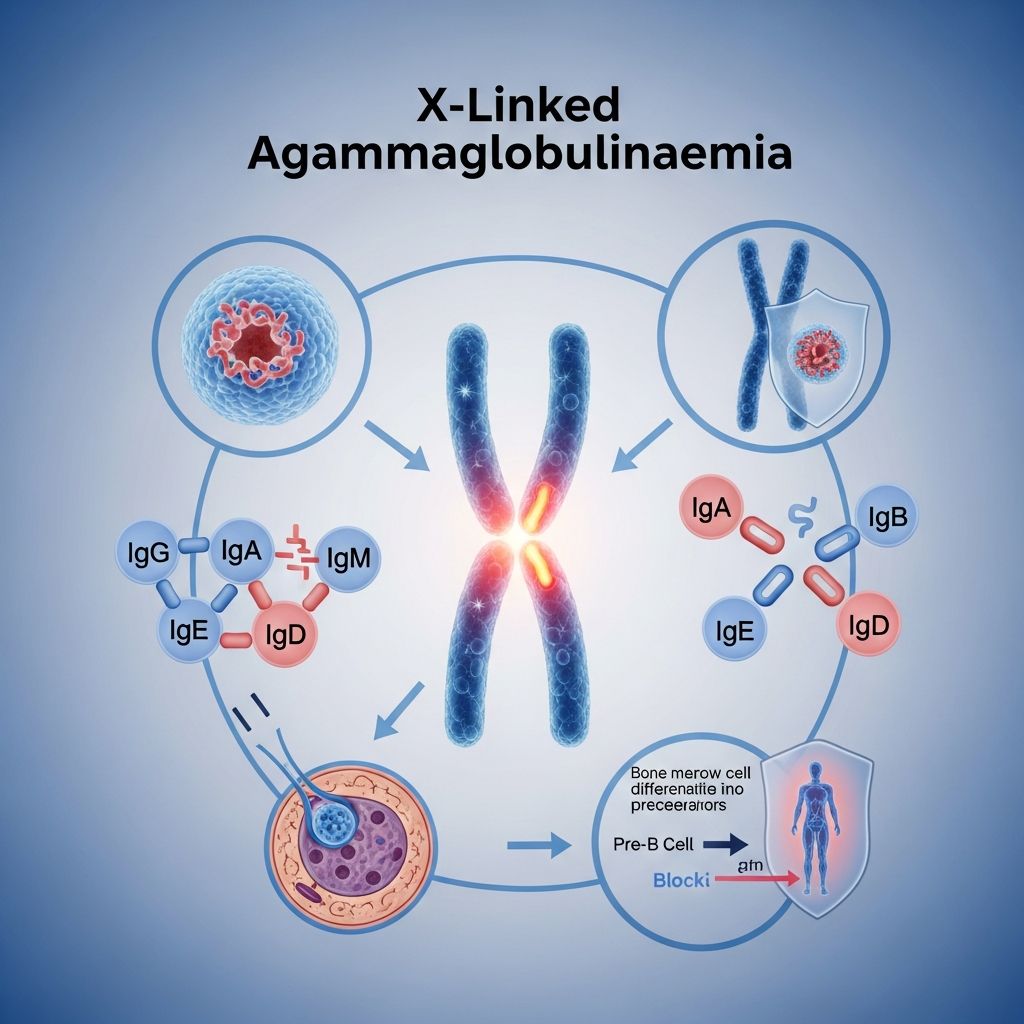
What is X-linked agammaglobulinaemia?
X-linked agammaglobulinaemia (XLA), also known as Bruton agammaglobulinaemia or Bruton tyrosine kinase deficiency, is a rare inherited primary immunodeficiency disorder characterised by the marked reduction or absence of B lymphocytes and plasma cells in the bone marrow and peripheral blood.
XLA was first described by Ogden C Bruton in 1952, who reported a boy with recurrent bacterial infections from the age of 4 months who had agammaglobulinaemia (low or absent immunoglobulins in the blood).
The condition affects approximately 1 in 100,000–200,000 live male births worldwide. It is caused by mutations in the BTK gene located on the X chromosome at Xq22, which encodes Bruton tyrosine kinase (BTK), a key enzyme in B-cell development and maturation.
BTK is essential for B-cell signalling and survival. Mutations lead to a block in B-cell differentiation at the pre-B-cell stage, resulting in profound hypogammaglobulinaemia (very low levels of all immunoglobulins: IgG, IgA, IgM, and IgE) and absent or markedly reduced circulating B cells (<1–2% of lymphocytes, normal 5–15%). T lymphocytes, natural killer cells, and phagocytes function normally, providing some protection against viral, fungal, and intracellular pathogens.
XLA demonstrates X-linked recessive inheritance, almost exclusively affecting males. Females are typically carriers with normal immunity due to X-chromosome inactivation (Lyonisation), though rare symptomatic female cases have been reported due to skewed X-inactivation or uniparental disomy.
Who gets X-linked agammaglobulinaemia (epidemiology)?
- XLA prevalence: ~1:100,000–200,000 male births.
- Accounts for 15–20% of boys with early-onset agammaglobulinaemia.
- Most cases sporadic (de novo mutations in 30–40%), others familial.
- Carrier mothers usually asymptomatic; 15% may have low Ig levels.
- No ethnic predisposition; reported worldwide.
Clinical features of X-linked agammaglobulinaemia
Infants with XLA are initially protected by transplacental maternal IgG antibodies, which wane by 3–6 months of age. Infections typically commence between 6–18 months.
Recurrent bacterial infections (hallmark feature)
Due to absent opsonising antibodies and poor specific immunity:
- Respiratory tract: Otitis media (85%), sinusitis (56%), pneumonia (68%) – often with Haemophilus influenzae, Streptococcus pneumoniae, Staphylococcus aureus, Pseudomonas aeruginosa.
- Gastrointestinal: Chronic diarrhoea (25%), giardiasis, Campylobacter enteritis.
- Skin/soft tissue: Cellulitis, abscesses.
- Systemic: Sepsis, meningitis, osteomyelitis, septic arthritis.
Chronic complications
- Bronchiectasis/bronchiolitis obliterans: From recurrent pneumonia (30–50% untreated).
- Enteropathy: Nodular lymphoid hyperplasia, villous atrophy.
- Neutropenia: Chronic/transient (25%).
- Autoimmunity: Rare (3–10%) – haemolytic anaemia, ITP, inflammatory bowel disease.
- Malignancy: Increased risk – lymphoma, leukaemia, gastric cancer (Helicobacter pylori).
Infections relatively spared
- Viral infections (except enteroviruses – chronic meningoencephalitis).
- Opportunistic infections (PCP, CMV rare unless IgRT delayed).
- Vaccines ineffective (no antibody response); live vaccines contraindicated.
Physical findings
- Absent/small tonsils, lymph nodes, Peyer’s patches.
- Failure to thrive if chronic diarrhoea/severe infections.
DermNet NZ features of X-linked agammaglobulinaemia
XLA patients may develop recurrent bacterial skin infections including cellulitis and staphylococcal abscesses. Eczema is uncommon (unlike SCID). Neutrophilic dermatoses or pyoderma gangrenosum reported rarely in association with autoimmunity.
Diagnosis of X-linked agammaglobulinaemia
Clinical suspicion
- Male <2 years with recurrent pyogenic infections + absent tonsils.
- Family history suggestive (affected maternal uncle/brother).
Laboratory diagnosis
| Test | XLA Finding | Normal |
|---|---|---|
| B cells (CD19+) | <1–2% | 5–15% |
| IgG | <100–200 mg/dL | 600–1500 mg/dL |
| IgA, IgM | Undetectable | Age-dependent |
| Antibody responses | Absent | Normal |
| BTK expression/flow cytometry | Absent/defective | Normal |
Related Stories



Genetic confirmation
BTK sequencing detects pathogenic variants in >95% cases (500+ mutations described: missense, nonsense, deletions, splice-site). Enables family screening, prenatal diagnosis.
Treatment of X-linked agammaglobulinaemia
No cure exists. Lifelong management essential.
Immunoglobulin replacement therapy (IgRT) – cornerstone
Replaces missing antibodies, dramatically reduces severe infections, bronchiectasis.
- IVIG: 400–600 mg/kg every 3–4 weeks (trough IgG >600 mg/dL).
- SCIG: 100–200 mg/kg/week (home administration, stable levels).
Early initiation (<3 years) prevents complications, improves survival to adulthood (>90%).
Antibiotics
- Prophylaxis: Trimethoprim-sulfamethoxazole (PCP), azithromycin (encapsulated bacteria).
- Treatment: Prolonged courses (2–4 weeks), high-dose IV for severe infections.
Supportive care
- Prompt infection evaluation/treatment.
- Respiratory monitoring (bronchiectasis screening).
- GI evaluation (giardiasis).
- Vaccination: Inactivated only; no live vaccines.
- Family counselling/genetic testing.
Experimental/curative options
- HSCT: Successful in small series but high morbidity; RIC regimens promising. Not standard.
- Gene therapy: Preclinical (lentiviral BTK correction).
Complications and prognosis
With IgRT: Normal lifespan, active lives possible. Annual infection rate ~1–3.
Complications despite IgRT (10–30%):
- Bronchiectasis (20–40%).
- Enteroviral CNS disease (5%).
- Autoimmunity/malignancy (rare).
- Chronic lung disease reduces survival.
Prevention and family screening
- Carrier testing (BTK mutation, X-inactivation).
- Prenatal diagnosis (CVS/amniocentesis).
- Preimplantation genetic diagnosis.
- Counselling: 50% risk to sons of carrier mothers.
Frequently asked questions
Is X-linked agammaglobulinaemia curable?
No curative treatment exists. Lifelong immunoglobulin replacement therapy (IVIG/SCIG) effectively controls the condition.
Can girls get X-linked agammaglobulinaemia?
Extremely rare. Manifestation requires homozygous mutations, skewed X-inactivation, or chromosomal abnormalities.
Is XLA contagious?
No. It is a genetic disorder, not infectious.
Do XLA patients need special precautions with vaccines?
Yes. Live vaccines contraindicated. Inactivated vaccines safe but ineffective for antibody production.
What is the life expectancy with modern treatment?
References
- X-Linked Agammaglobulinemia: Symptoms & Care — CSP Pharmacy. 2023. https://csprx.com/pharmacy-blog/x-linked-agammaglobulinemia/
- X-linked agammaglobulinemia: investigation of clinical and… — Yıldırım et al. PMC. 2021-04-01. https://pmc.ncbi.nlm.nih.gov/articles/PMC8012299/
- Revisiting X-linked agammaglobulinemia — Journal of Hematology & Immunology. 2024. https://rupress.org/jhi/article/1/1/e20250020/277662/Revisiting-X-linked-agammaglobulinemiaRevisiting
- X-linked agammaglobulinemia — Orphanet. 2024. https://www.orpha.net/en/disease/detail/47
- X-Linked Agammaglobulinemia: Causes, Symptoms & … — Cleveland Clinic. 2024-06-15. https://my.clevelandclinic.org/health/diseases/24955-x-linked-agammaglobulinemia
Similar Articles








Read full bio of medha deb