Xanthelasma Images: 10 Clinical Photos For Accurate Diagnosis
Explore detailed images and clinical insights into xanthelasma, the common yellowish eyelid plaques linked to lipid disorders.
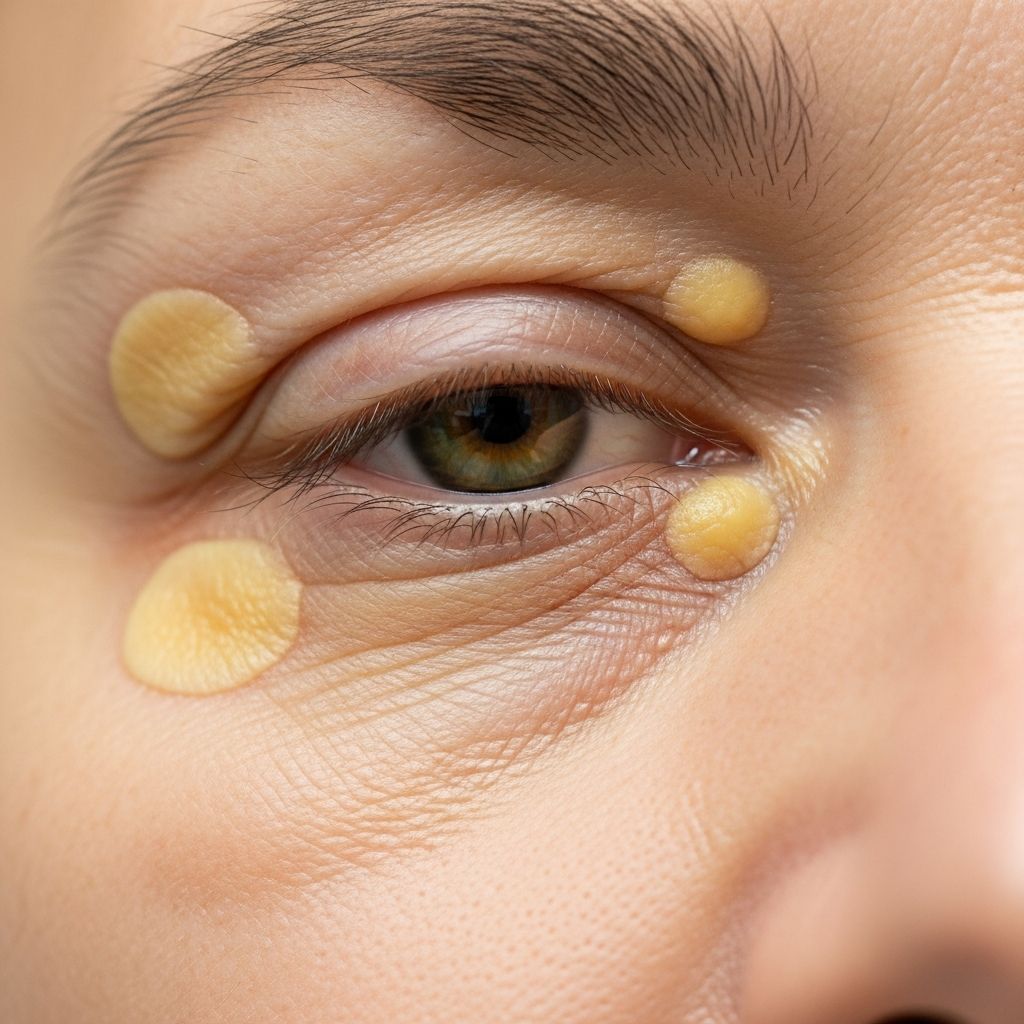
Xanthelasma palpebrarum represents the most prevalent form of cutaneous xanthomata, characterized by soft, yellowish plaques predominantly affecting the eyelids. These lesions arise from lipid accumulation within histiocytes in the dermis and serve as visible markers of potential underlying dyslipidaemia. This image gallery presents a comprehensive visual spectrum of xanthelasma manifestations, aiding clinicians, students, and patients in recognition and diagnosis.
What is Xanthelasma?
Xanthelasma manifests as well-defined, flat or slightly elevated yellow-orange plaques, most commonly located on the upper or lower eyelids near the inner canthus (medial aspect). These lesions feel soft and waxy to the touch, measuring from 1 mm to over 2 cm in diameter. Histopathologically, xanthelasma comprises perivascular and periadnexal foamy histiocytes containing esterified cholesterol, with occasional Touton giant cells in the upper and middle dermis. Although typically asymptomatic, xanthelasma warrants investigation due to its association with hypercholesterolaemia and increased cardiovascular risk in approximately 50% of cases.
Clinical Appearance
Xanthelasma lesions exhibit distinctive features that facilitate clinical identification:
- Color: Bright yellow to orange-yellow, reflecting cholesterol deposition
- Texture: Soft, non-tender, with a chamois-like consistency
- Shape: Oval or polygonal plaques with sharply demarcated borders
- Symmetry: Often bilateral, initially unilateral in some cases
- Surface: Smooth or slightly wrinkled, rarely ulcerated
Lesions progress slowly over months to years, enlarging through peripheral extension rather than vertical growth. In advanced cases, coalescence forms extensive sheets covering entire eyelids.
Image Gallery
This curated collection demonstrates the diverse presentations of xanthelasma across different patients, skin types, and disease stages. Each image includes clinical context to enhance educational value.
Early Xanthelasma
Image 1: Subtle 2-3 mm yellow macules on the nasal upper eyelid of a 45-year-old woman with newly diagnosed hypercholesterolaemia. Lesions appeared asymmetrically over 6 months.
Image 2: Minimal pericanthal yellow discoloration in a 52-year-old man, representing the earliest detectable stage before plaque formation.
Classic Presentation
Image 3: Typical bilateral xanthelasma plaques (1 × 0.5 cm) on upper eyelids adjacent to inner canthi in a 60-year-old woman with familial hypercholesterolaemia. Sharp margins and chamois texture characteristic.
Image 4: Symmetrical oval plaques (8 × 4 mm) on both upper eyelids extending laterally in a 55-year-old type 2 diabetes patient with elevated LDL cholesterol.
Extensive Involvement
Image 5: Confluent xanthelasma covering entire upper eyelids and extending to lower lids bilaterally in a 68-year-old man with longstanding untreated hyperlipidaemia. Lesions measure up to 3 cm horizontally.
Image 6: Advanced sheet-like xanthelasma forming continuous yellow bands across both eyelids in a 72-year-old woman, impairing cosmesis significantly.
Atypical Presentations
Image 7: Lower eyelid xanthelasma without upper lid involvement in a 48-year-old hypertriglyceridaemic patient, demonstrating less common distribution.
Image 8: Multiple discrete xanthelasma plaques scattered across both eyelids and periorbital skin in a 65-year-old with secondary hypercholesterolaemia due to hypothyroidism.
Post-Treatment Images
Image 9: Successful trichloroacetic acid (TCA) ablation showing hypopigmented macules 3 months post-treatment of classic upper eyelid xanthelasma.
Related Stories



Image 10: CO2 laser vaporization result with mild textural change but excellent clearance 6 weeks after single session treatment.
Associations and Risk Factors
While xanthelasma may occur normolipidaemic patients (50%), strong associations exist with:
| Condition | Prevalence in Xanthelasma Patients | Lipid Profile |
|---|---|---|
| Familial hypercholesterolaemia | 20-30% | Elevated LDL-C |
| Primary biliary cholangitis | 10% | Elevated cholesterol |
| Hypertriglyceridaemia | 5-10% | Elevated triglycerides |
| Diabetes mellitus | 10% | Mixed dyslipidaemia |
| Hypothyroidism | 5% | Elevated LDL-C |
All patients require fasting lipid profile assessment and cardiovascular risk stratification. Lesions persisting despite lipid normalization indicate local metabolic factors.
Differential Diagnosis
- Diffuse plane normolipaemic xanthoma: More widespread, poorer margins
- Amiodarone deposits: Violet-brown, medication history
- Sebaceous gland hyperplasia: Central umbilication, yellowish
- Syringoma: Multiple small firm papules
- Apocrine hidrocystoma: Translucent cystic nodule
Biopsy rarely needed; diagnosis clinical supported by lipid studies.
Treatment Options
Treatment primarily cosmetic; recurrence common (20-40%) regardless of method.
Conservative Management
- Lipid-lowering therapy (statins ± ezetimibe)
- Lifestyle modification
- Regular cardiovascular monitoring
Lesion Removal
| Modality | Efficacy | Recurrence | Downtime | Scarring Risk |
|---|---|---|---|---|
| Trichloroacetic acid 70-100% | 80-90% | 25% | 3-7 days | Low |
| CO2 laser ablation | 85-95% | 20% | 5-10 days | Low-moderate |
| Erbium:YAG laser | 90% | 15% | 7 days | Low |
| Surgical excision | 95% | 40% | 10-14 days | Moderate |
| Cryotherapy | 70% | 30% | 5 days | Low |
Choice depends on lesion size, location, patient skin type, and recurrence risk.
Frequently Asked Questions
Will xanthelasma go away on its own?
No, xanthelasma typically progresses slowly without spontaneous resolution. Early intervention prevents extension.
Does xanthelasma mean I have high cholesterol?
Approximately 50% of patients have lipid abnormalities, but normolipidaemic cases occur. Fasting lipid profile recommended.
Is xanthelasma dangerous?
Benign cosmetically distressing lesions; associated cardiovascular risk requires screening, not malignancy.
Can xanthelasma be permanently removed?
No treatment guarantees permanence; recurrence rates 20-40%. Multiple sessions often needed.
Who gets xanthelasma?
Most common ages 40-70, women > men, fair skin types. Family history increases risk.
Patient Education
Patients should understand:
- Lesions signal need for lipid/heart evaluation
- Cosmetic treatments available but recur
- Statins rarely shrink established lesions
- Follow-up essential post-removal
- Sun protection minimizes post-treatment pigmentation
Xanthelasma serves as dermatological window into systemic lipid metabolism, warranting holistic management.
References
- Xanthelasma Palpebrarum: More than Meets the Eye — Rohrich RJ, et al. PMC. 2019-11-01. https://pmc.ncbi.nlm.nih.gov/articles/PMC6848656/
- Xanthelasma (Causes, Symptoms, and Treatment) — Patient.info. 2023-05-15. https://patient.info/doctor/dermatology/xanthelasma
- Xanthomas — DermNet NZ. 2024-08-20. https://dermnetnz.org/topics/xanthoma
- Xanthelasma — Canadian Medical Skin Dermatology. 2023-12-10. https://cmsderm.ca/medical-conditions/xanthelasma/
- Xanthelasma Treatment — Bluebonnet Dermatology. 2024-03-05. https://www.bluebonnetderm.com/xanthelasma/
- Xanthelasma Removal Options — SIP Dermatology. 2024-01-22. https://www.sipderm.com/xanthelasma-removal-surgical-and-non-surgical-options/
Similar Articles








Read full bio of Sneha Tete