YAG Laser Capsulotomy: Procedure Essentials
Master the YAG laser capsulotomy process, from patient selection to post-op care and billing accuracy for optimal outcomes.
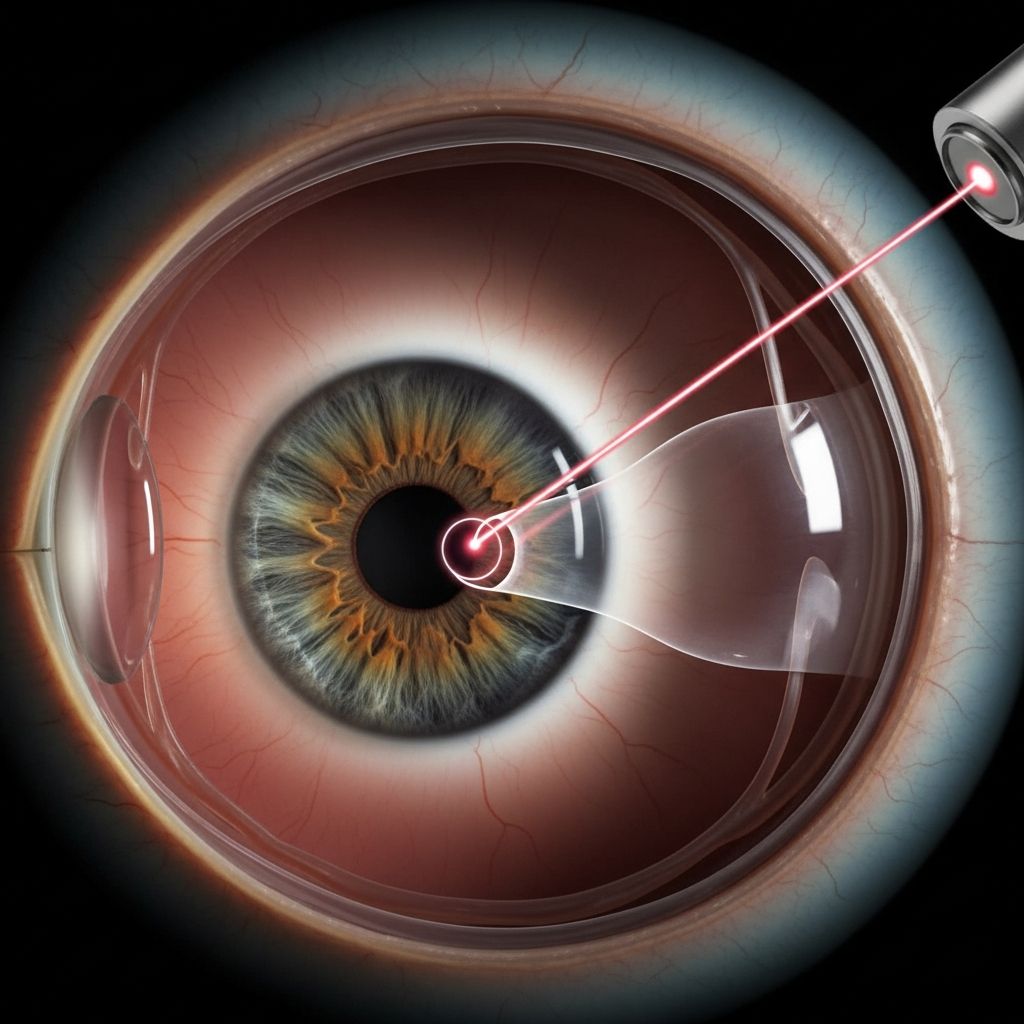
Nd:YAG laser capsulotomy is a minimally invasive outpatient procedure that treats posterior capsule opacification (PCO), a common issue following cataract surgery where the lens capsule clouds, impairing vision. By creating a precise opening in the clouded capsule, this laser treatment restores clear sight quickly and effectively.
Understanding Posterior Capsule Opacification
After cataract surgery, the natural lens is removed, and an artificial intraocular lens (IOL) is placed within the remaining lens capsule. Over time, in up to 20-50% of cases, cells proliferate on the posterior capsule, causing opacification that scatters light and reduces visual acuity. This secondary clouding mimics cataract symptoms like glare and blurred vision but occurs months to years post-surgery.
PCO arises from normal wound healing: lens epithelial cells migrate and form a fibrous membrane behind the IOL. Without intervention, it progressively worsens, necessitating treatment when vision drops below functional levels, such as 20/40 or poorer. Early detection via slit-lamp exam allows timely YAG intervention.
Patient Selection and Preparation Guidelines
Ideal candidates exhibit confirmed PCO with significant visual impairment, no active ocular inflammation, and stable refraction post-cataract surgery. Contraindications include corneal edema, uncontrolled glaucoma, or vitreoretinal pathology that heightens complication risks.
- Pre-procedure evaluation: Comprehensive exam including IOP measurement, fundus visualization, and OCT for macular assessment.
- Dilation: Use mydriatic drops to optimize capsule access.
- Anesthesia: Topical proparacaine drops for comfort.
- Informed consent: Discuss benefits (90-95% success rate), risks (IOP spike, retinal detachment), and alternatives.
Patients should avoid driving post-dilation and use anti-inflammatory drops as prescribed. Fasting is unnecessary for this brief procedure.
Step-by-Step Procedural Overview
The entire process typically lasts 5-10 minutes per eye, performed at a slit-lamp mounted laser. Patients sit with chin on the rest, fixating on a target light while the surgeon aligns the laser.
- Alignment: Contact lens or lens spacer protects the cornea; helium-neon aiming beam locates the posterior capsule 0.1-0.2mm behind the IOL.
- Laser application: Short Nd:YAG pulses (Q-switched, 3-5mJ energy) create plasma cavitation, vaporizing tissue in a microburst without thermal damage.
- Capsulotomy creation: 20-50 pulses form a 3-5mm central opening; start superiorly to allow debris clearance.
- Verification: Confirm patency via retroillumination; address fragments if needed.
- Completion: Remove lens, check IOP, and dispense post-op meds.
The laser passes harmlessly through the cornea and IOL, targeting only the capsule. Smaller openings (under 4mm) minimize complications like IOL shift.
Immediate Benefits and Expected Outcomes
Most patients notice improved clarity within hours, with 95% achieving 20/40 or better vision. Contrast sensitivity and glare reduction follow rapidly. Hyperopic shifts may occur temporarily due to capsule flattening, resolving in 1-4 weeks.
| Outcome Metric | Pre-Procedure | Post-Procedure |
|---|---|---|
| Visual Acuity | 20/50 – 20/100 | 20/30 or better (90% cases) |
| IOP Change | Baseline | +2-5mmHg transient (most) |
| Success Rate | N/A | 92-98% |
Data from peer-reviewed studies confirm efficacy, with low re-treatment rates under 2%.
Potential Risks and Complication Management
Though safe, risks include transient IOP elevation (10-20%, managed with drops), cystoid macular edema (1-2%), and rare retinal detachment (1-2%, higher in myopes).
Related Stories



- IOP rise: Peaks at 1-3 hours; monitor and treat with timolol/apraclonidine.
- Retinal issues: 4x risk vs. uncomplicated cataracts; pre-screen high-risk patients (axial length >24mm).
- IOL displacement: Rare with modern lenses; avoid excessive energy.
- Corneal damage: Minimize with proper spacing.
Larger capsulotomies correlate with higher complication rates, so precision is key. Follow-up at 1 hour, 1 day, and 1 week mitigates issues.
Post-Procedure Care Instructions
Patients receive prednisolone and NSAID drops tapered over 1-4 weeks. Avoid rubbing eyes, heavy lifting, or swimming for 1 week. Sunglasses protect against photophobia.
Warning signs warranting immediate return: vision loss, pain, redness, or floaters. Most resume normal activities next day. Refraction stabilizes by 4 weeks for new glasses.
Technical Considerations for Optimal Results
Energy levels: 1.5-3mJ initially, titrate to effect. Pulse width: 10-20ns. Spot size: 50-100μm. Smaller capsulotomies reduce debris and pressure spikes. Dual-focus lasers enhance safety.
Document: Pre/post acuity, energy used, opening size, complications. This supports coding and quality assurance.
Billing and Documentation Best Practices
Use CPT 66821 for primary procedure; modifiers for bilateral (RT/LT), subsequent, or reduced services. Diagnosis: H26.40-H26.49 for PCO. Append 66821-T for subsequent if prior capsulotomy.
Justify medical necessity: Record visual impairment details, exam findings. Global period: 90 days; no routine post-op E/M billing unless complication. Medicare covers when vision <20/40 and fundus obscured.
| CPT Code | Description | Modifiers |
|---|---|---|
| 66821 | YAG laser capsulotomy | -RT/-LT, -78 (unplanned return) |
| 92012 | Post-op exam if complicated | -24 (unrelated) |
Audit-proof notes include patient symptoms, BCVA, capsule description, laser parameters, and outcome.
FAQs on YAG Laser Capsulotomy
Is YAG capsulotomy painful? No, topical anesthesia ensures comfort; patients report only bright light and clicks.
How soon can I drive after? Wait until dilation wears off (4-6 hours); vision improves immediately.
Does insurance cover it? Yes, as medically necessary for PCO-related vision loss.
Can both eyes be treated same day? Yes, if needed, with interval monitoring.
What if vision doesn’t improve? Rare; check for CME or other issues via OCT.
Advances and Future Directions
Research focuses on IOL designs preventing PCO (sharp edges, hydrophobic materials). Laser refinements like femtosecond tech promise even lower energies. Long-term studies emphasize risk stratification.
For eye care providers, staying updated via AAO guidelines ensures best practices. Patient education enhances satisfaction and compliance.
References
- An Overview of Nd:YAG Laser Capsulotomy — PMC/NCBI. 2015-03-01. https://pmc.ncbi.nlm.nih.gov/articles/PMC4346677/
- What Is YAG Laser Capsulotomy — Laser Eye Center. 2023-01-15. https://www.lasereyecenter.com/what-is-yag-laser-capsulotomy/
- CG-SURG-114 Ophthalmic use of Nd:YAG Laser for Posterior Capsulotomy — Healthy Blue NC. 2024-06-01. https://provider.healthybluenc.com/medpolicies/healthybluenc/active/gl_pw_e001872.html
- YAG Laser Capsulotomy (Posterior Capsulotomy) — Cleveland Clinic. 2023-11-20. https://my.clevelandclinic.org/health/procedures/yag-laser-capsulotomy-posterior-capsulotomy
- Undergoing YAG Laser Capsulotomy — WWL NHS Foundation Trust. 2022-05-10. https://www.wwl.nhs.uk/media/.leaflets/647dd1660bd412.31440864.pdf
Similar Articles








Read full bio of Sneha Tete