Zoon Balanitis Vulvitis Pathology: 4 Key Histopathology Features
Detailed histopathological analysis of Zoon balanitis and vulvitis, plasma cell-rich inflammatory conditions of genital mucosa.
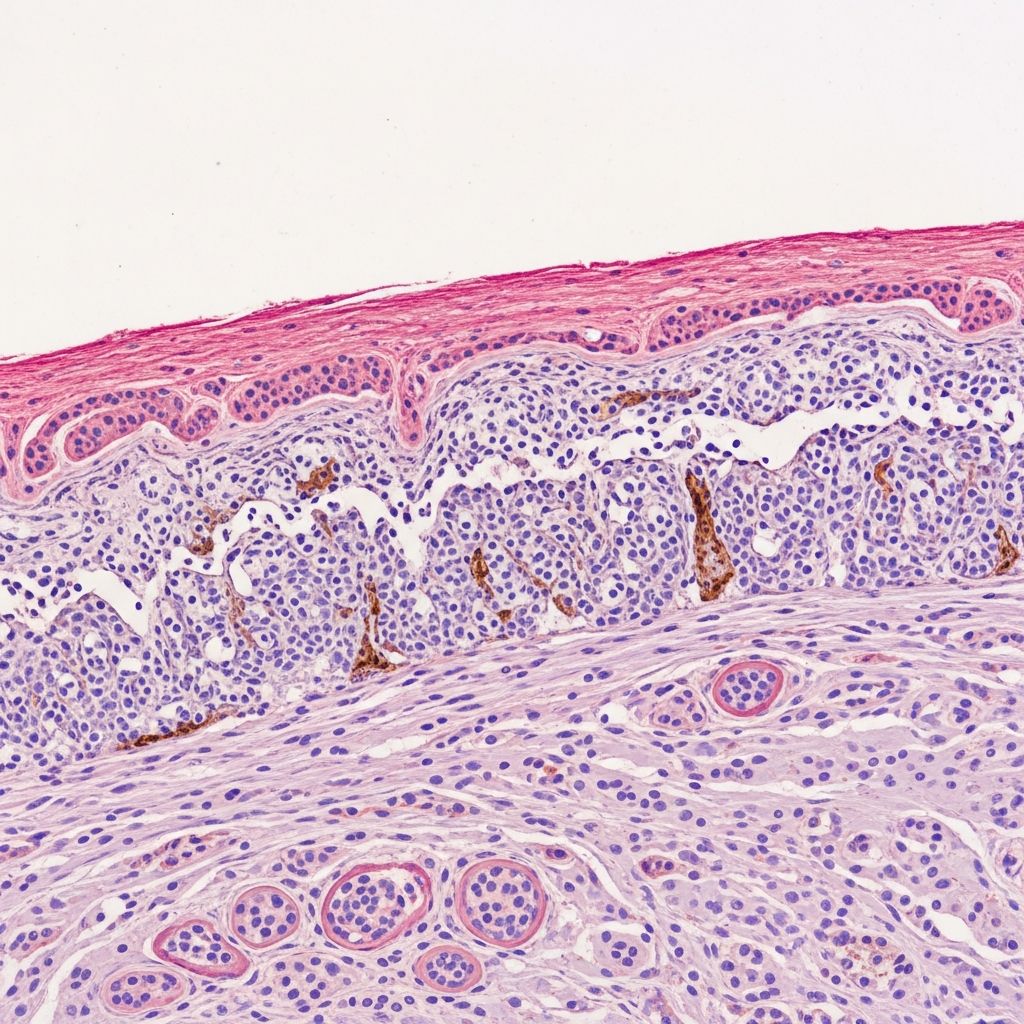
Zoon balanitis/vulvitis, also known as plasma cell balanitis or vulvitis, represents a chronic inflammatory condition characterized by persistent, well-defined erythematous patches on the genital mucosa, primarily due to a dense plasma cell infiltrate on histopathology.
Clinical features
Plasma cell disorders like Zoon balanitis typically manifest as persistent, well-defined irritable red patches on the genitals. In males, Zoon balanitis predominantly affects the glans penis, presenting as a solitary, shiny, orange-red plaque, often in uncircumcised middle-aged to elderly men. The lesion may exhibit a glistening surface with cayenne pepper-like spots or pinpoint haemorrhages, and it is usually asymptomatic but can cause mild itching, tenderness, or irritation.
In females, the analogous condition, Zoon vulvitis or plasma cell vulvitis, most commonly involves the vulvar vestibule or introitus. It appears as multiple well-defined, orange-yellow plaques or erosive lesions on the labia minora, affecting women aged 26–70 years, rarely prepubertal girls. Lesions are often bilateral, symmetrical, and may confluence over time, persisting for years without malignant potential, though dyspareunia, dysuria, or pain can occur.
These conditions are idiopathic but may arise from chronic irritation, trapped debris under foreskin in males, or mucosal trauma/infection responses in females. They mimic secondary syphilis, lichen planus, psoriasis, or intraepithelial neoplasia, necessitating biopsy for confirmation.
Histopathology
Microscopic examination is diagnostic, revealing mucosa that may be attenuated, eroded, or spongiotic, overlying a dense stromal infiltrate rich in plasma cells forming band-like sheets in the upper and mid-dermis. Plasma cells predominate (>50% of infiltrate), accompanied by fewer lymphocytes, eosinophils, neutrophils, and extravasated erythrocytes.
Key features include:
- Lichenoid infiltrate: Band-like dermal accumulation of plasma cells, lymphocytes, with occasional neutrophils and eosinophils.
- Vascular changes: Ectatic dilated vessels with prominent endothelium and red blood cell extravasation, contributing to the cayenne pepper appearance.
- Epidermal alterations: Thinning, erosion, or spongiosis; lozenge-shaped keratinocytes may be seen.
- Absence of atypia: No significant dysplasia, distinguishing from neoplasia.
In Zoon vulvitis, biopsies show similar spongiotic changes and plasma cell-rich infiltrates, with shallow ulcers featuring clean red-orange bases. These findings differentiate it from infections or autoimmune dermatoses.
| Feature | Zoon Balanitis/Vulvitis | Lichen Planus | Psoriasis |
|---|---|---|---|
| Infiltrate | Plasma cells >50%, band-like | Lymphocytes, Civatte bodies | Neutrophils, parakeratosis |
| Vessels | Ectatic, RBC extravasation | Dilated capillaries | Regular dilation |
| Epidermis | Attenuated, eroded | Hypergranulosis, saw-tooth | Acanthosis, Munro microabscesses |
Differential diagnosis
Clinically, Zoon lesions resemble erythroplasia of Queyrat (squamous cell carcinoma in situ), fixed drug eruption, psoriasis, or candidiasis. Histologically, the dense plasma cell infiltrate distinguishes Zoon from these, as secondary syphilis shows treponemes, while lichen sclerosus lacks plasma cell predominance.
- In males: Secondary syphilis, lichen planus, psoriasis, Zostavax vaccine reaction.
- In females: Lichen planus, squamous cell carcinoma, contact dermatitis.
Diagnosis requires exclusion of infection via serology/PCR and biopsy showing >50% plasma cells without atypia.
Treatment and prognosis
Zoon balanitis/vulvitis is benign with no malignant transformation reported, though rare dysplasia cases exist. Management focuses on symptom relief and lesion resolution.
Related Stories



Options include:
- Topical corticosteroids: Potent agents like clobetasol under occlusion for 2–4 weeks, often effective.
- Tacrolimus ointment: 0.1% twice daily, useful for steroid-resistant cases.
- Circumcision: Definitive in males, resolving lesions by eliminating trapped irritants.
- Other: Mupirocin, imiquimod, or laser ablation for refractory disease.
Prognosis is excellent with treatment; recurrence is common without addressing irritants like poor hygiene.
Frequently Asked Questions (FAQs)
What causes Zoon balanitis/vulvitis?
It is idiopathic but linked to chronic irritation from trapped skin cells, urine, or soap under foreskin in uncircumcised men or mucosal trauma in women.
Is Zoon balanitis contagious?
No, it is not infectious or venereal; it cannot be transmitted sexually.
How is the diagnosis confirmed?
By skin biopsy showing dense plasma cell infiltrate (>50%), vascular ectasia, and epidermal attenuation.
Does it lead to cancer?
Generally no malignant changes reported, though rare moderate dysplasia noted; regular follow-up advised.
What is the best treatment for Zoon vulvitis?
Topical tacrolimus or steroids; persistent cases may require biopsy to rule out mimics.
References
- Zoon vulvitis – Chronic benign inflammation — PMC. 2017-11-20. https://pmc.ncbi.nlm.nih.gov/articles/PMC5726712/
- Zoon balanitis/vulvitis pathology — DermNet NZ. N/A. https://dermnetnz.org/topics/zoon-balanitisvulvitis-pathology
- Zoon balanitis: A comprehensive review — PMC. 2016-11-01. https://pmc.ncbi.nlm.nih.gov/articles/PMC5111296/
- Zoon’s Balanitis — Skin Health Info. 2016-03-01. https://www.skinhealthinfo.org.uk/wp-content/uploads/2018/11/Zoons-Balanitis-Update-Mar-2016-lay-reviewed-Mar-20162-1.pdf
- Plasma cell balanitis/vulvitis — DermNet NZ. 2003. https://dermnetnz.org/topics/plasma-cell-balanitisvulvitis
- Male Genital Conditions: Zoon’s Balanitis — DrDavinLim. N/A. https://drdavinlim.com/zoon-balanitis/
Similar Articles








Read full bio of medha deb