Fungal Nail Infections: How To Diagnose, Treat & Prevent
Comprehensive guide to onychomycosis: causes, symptoms, diagnosis, and effective treatments for fungal nail infections.
Fungal nail infections, medically termed
onychomycosis
ortinea unguium
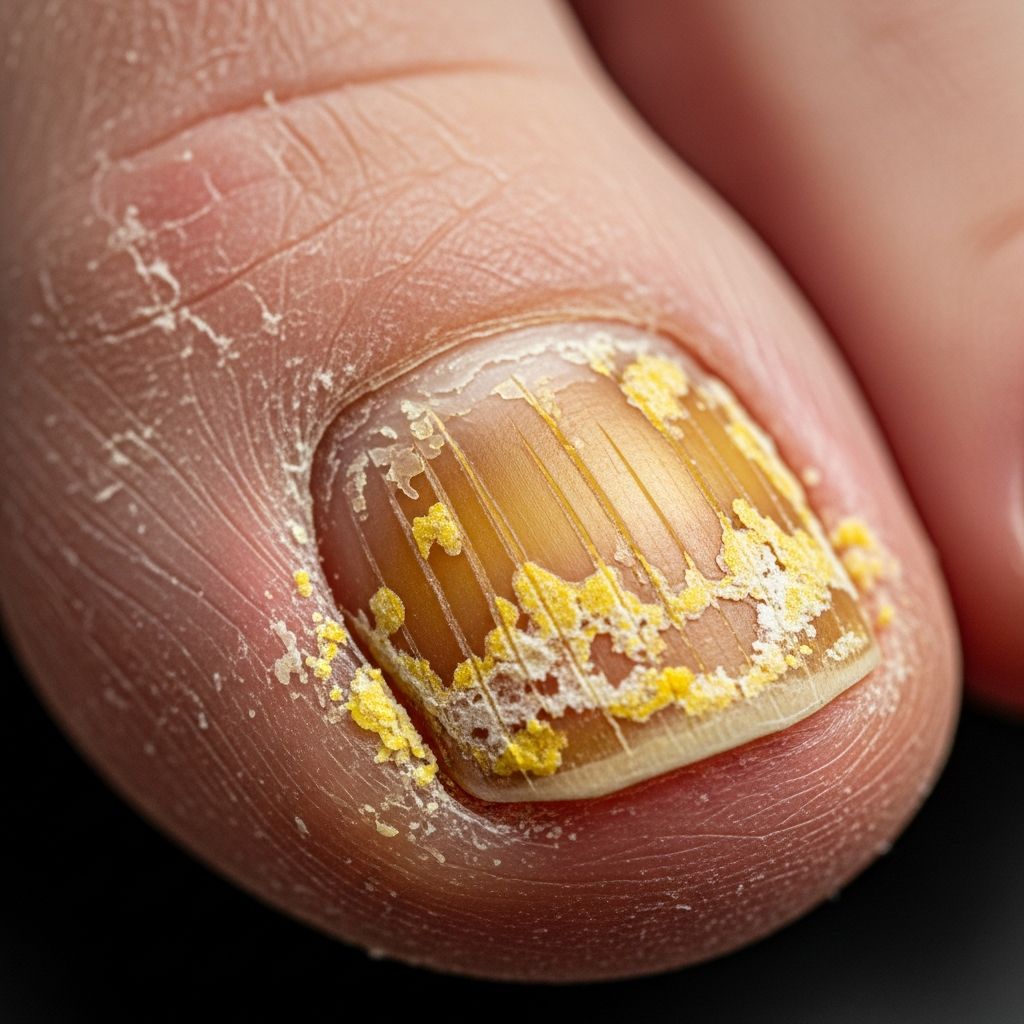
, represent over 50% of all nail disorders, with a global prevalence estimated at 5.5%. These infections primarily affect toenails, especially the first toe, but can involve fingernails and surrounding skin. Caused by dermatophytes, yeasts, or moulds, onychomycosis compromises nail integrity, leading to discolouration, thickening, and brittleness. Emerging research highlights biofilms—protective fungal communities—as contributors to treatment resistance and heightened virulence.What is onychomycosis?
**Onychomycosis** is a chronic fungal infection of the nail unit, encompassing the nail plate, bed, matrix, and surrounding tissues. It arises from parasitic fungi invading keratinized structures, most commonly dermatophytes like *Trichophyton rubrum* and *Trichophyton interdigitale*. Non-dermatophyte moulds (e.g., *Scopulariopsis brevicaulis*) and yeasts (e.g., *Candida albicans*) account for fewer cases but pose diagnostic challenges. The infection often begins at the distal nail edge, progressing proximally, and rarely causes systemic spread except in immunocompromised individuals.
Biofilms, slimy matrices of fungal cells and extracellular substances, shield pathogens from antifungals, explaining recurrence rates up to 50% post-treatment. Prevalence rises with age, affecting 20-50% of those over 60, due to slower nail growth, reduced immunity, and cumulative trauma.
Who gets fungal nail infections?
Onychomycosis affects individuals across ages but peaks in older adults. Risk factors include:
- Age over 60: Slower nail growth and vascular changes predispose nails to infection.
- Family history: Genetic susceptibility increases risk via shared environments or traits.
- Trauma: Injuries create entry points for fungi.
- Athlete’s foot (tinea pedis): Acts as a reservoir, spreading to nails in 30% of cases.
- Diabetes and immunosuppression: Poor circulation and immunity heighten susceptibility.
- Hyperhidrosis and occlusive footwear: Warm, moist environments favour fungal growth.
- Occupations involving water exposure (e.g., swimmers, dishwashers).
Men are affected twice as often as women, likely due to occupational and footwear habits.
What causes fungal nail infections?
Dermatophytes cause 90% of cases, with *T. rubrum* predominant (70%), followed by *T. interdigitale*. Yeasts like *Candida* species infect fingernails, especially in chronic wet exposure, while moulds are rarer. In New Zealand, *T. indotineae* emerges in 2-9% of cases, necessitating susceptibility testing.
Transmission occurs via direct contact with infected skin/nails or fomites (e.g., shared clippers, showers). Endogenous spread from tinea pedis is common. Trauma disrupts barriers, allowing invasion; poor hygiene perpetuates cycles.
What are the clinical features of fungal nail infections?
Manifestations vary by type:
- Distal lateral subungual onychomycosis (DLSO): Most common (80%); yellow-white discolouration, onycholysis (nail-plate separation), hyperkeratosis, and thickening starting distally.
- Superficial white onychomycosis (SWO): White patches on nail surface, easily scraped; often *T. interdigitale*.
- Proximal subungual onychomycosis (PSO): Rare; starts at cuticle, indicating immunosuppression; brown discolouration.
- Total dystrophic onychomycosis (TDO): Advanced stage; thickened, brittle, discoloured nail destruction.
- Lateral onychomycosis: Side involvement, crumbly edges.
Nails become thick, brittle, itchy/painful, with debris accumulation. Surrounding skin may show erythema or scaling. Secondary bacterial infection risks pain and paronychia.
Diagnosis of fungal nail infections
Clinical suspicion requires confirmation to exclude psoriasis, lichen planus, or trauma. Methods include:
Related Stories



- Microscopy (KOH prep): Clippings from crumbling distal end or subungual debris; 10% KOH dissolves keratin, revealing hyphae in 70-80%.
- Culture: Sabouraud agar; identifies species but slow (3-4 weeks), false negatives up to 40% due to prior antifungals or poor sampling.
- PCR: Rapid detection, ideal for resistant strains like *T. indotineae*.
Avoid surface scrapings; target active infection sites pre-treatment.
How is onychomycosis treated?
Treatment targets cure (mycological clearance) and cosmetic improvement. Oral antifungals are most effective (70-80% cure for toenails), topicals for mild cases.
Topical treatments
Suitable for <50% involvement of 1-2 nails or matrix-sparing types (SWO, early DLSO). Apply twice weekly for 6-12 months.
- Amorolfine 5% lacquer
- Ciclopirox 8% lacquer
- Tioconazole solution
Enhance penetration: File nails, clean debris.
Oral treatments
First-line for moderate-severe disease. Monitor LFTs baseline and 4-6 weeks.
| Drug | Dose | Duration (Fingernails/Toenails) | Notes |
|---|---|---|---|
| Terbinafine | 250 mg daily | 6 weeks / 3-6 months | First-line; avoid in pregnancy |
| Itraconazole | 200 mg daily or pulse | 6-12 weeks / 3-6 months | Pulse: 1 week/month; specialist approval |
| Fluconazole | 150-300 mg weekly | 6 months / 12 months | Alternative |
Nail avulsion
For total destruction: Urea paste occlusion (10 days), painless removal; regrowth 3-18 months. Laser as salvage.
Adjuncts
Treat tinea pedis (miconazole cream); debride regularly. Tea tree oil, Vicks VapoRub anecdotal.
What is the outcome for fungal nail infections?
Cure rates: Oral 76% toenails (terbinafine), topical 10-50%. Recurrence 20-50% due to biofilms, reservoirs. Full regrowth: 3-6 months fingernails, 12-18 months toenails. Monitor via photos/grooves. Cosmetic persistence common; patient education key.
How can fungal nail infections be prevented?
- Wear breathable shoes/socks; alternate daily.
- Keep feet dry; treat athlete’s foot promptly.
- Don’t share clippers; disinfect tools.
- Trim nails straight; file smooth.
- Avoid barefoot public areas.
- Moisturize cuticles; gloves for wet work.
Related topics
- Athlete’s foot (tinea pedis)
- Nail anatomy
- Onychomycosis images
- Mycology testing
Frequently Asked Questions
Do fungal nail infections go away on their own?
No, they are chronic and require treatment to resolve.
Can I use home remedies?
Anecdotal options like tea tree oil may help mildly but lack evidence for cure; consult a doctor.
How long does treatment take?
6-12 weeks fingernails, 3-12 months toenails; full regrowth longer.
Are oral antifungals safe?
Generally yes, but require LFT monitoring; contraindicated in liver disease/pregnancy.
Can it spread to others?
Yes, highly contagious; practice hygiene.
References
- Tinea unguium – Fungal skin infections — DermNet NZ. 2023. https://dermnetnz.org/cme/fungal-infections/tinea-unguium
- Onychomycosis (Fungal Nail Infection) — Ada Health. 2024. https://ada.com/conditions/onychomycosis-fungal-nail-infection/
- Management of fungal nail infections — bpacnz. 2025-01-01. https://bpac.org.nz/2025/fungal-nails.aspx
- Fungal Nail Infections — DermNet NZ. 2024. https://dermnetnz.org/topics/fungal-nail-infections
- Onychomycosis — StatPearls, NCBI Bookshelf. 2023-08-07. https://www.ncbi.nlm.nih.gov/books/NBK441853/
Similar Articles








Read full bio of Sneha Tete