Mycetoma: 2 Types, Diagnosis, And Treatment Guide
Chronic granulomatous infection of skin and subcutaneous tissue caused by fungi or bacteria, leading to swelling, sinuses, and grains.
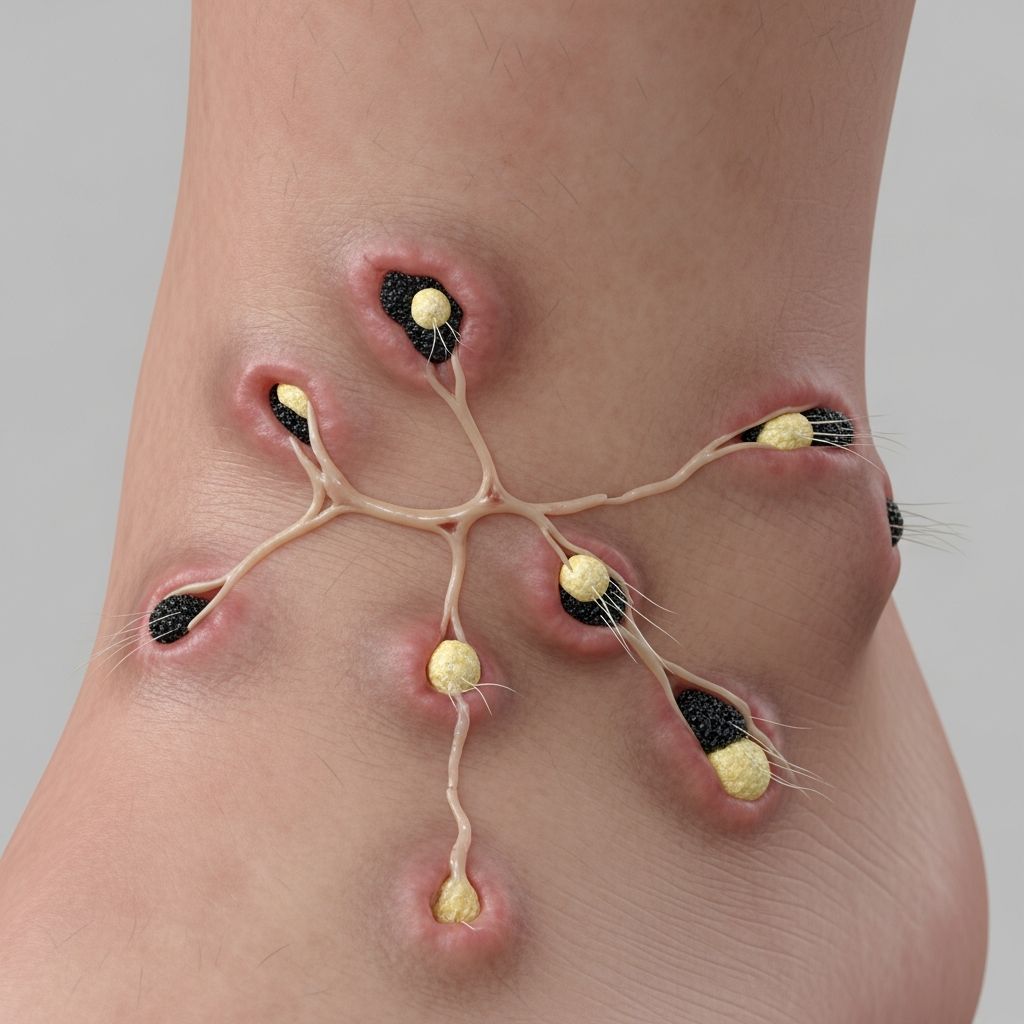
Mycetoma is a chronic, granulomatous infection affecting the skin and subcutaneous tissues, often extending to deeper structures like muscle, bone, and joints. It is characterized by the classic triad of painless swelling, multiple sinus tracts, and discharge of grains or granules, which are aggregates of the causative organism.
What is mycetoma?
Mycetoma, also known as Madura foot, is a localized, slowly progressive, destructive inflammatory disease caused by traumatic inoculation of filamentous bacteria (actinomycetoma) or true fungi (eumycetoma) into the subcutaneous tissue. It predominantly affects individuals in tropical and subtropical regions, particularly those who work barefoot in soil-contaminated environments such as farmers and laborers.
The disease begins subtly with a painless nodule at the site of minor trauma, evolving over months to years into massive swelling with fistulae discharging pus containing pathognomonic grains. These grains vary in color, size, and texture based on the etiological agent, forming the hallmark of the condition.
Who gets mycetoma?
Mycetoma primarily affects males aged 20–40 years, with a male-to-female ratio of approximately 3:1, likely due to occupational exposure risks. It is endemic in the ‘mycetoma belt’ spanning Sudan, Somalia, India, Mexico, and parts of Africa, Latin America, and Asia.
- High-risk groups: Rural agricultural workers, barefoot walkers in endemic areas.
- Predisposing factors: Minor trauma from thorns, splinters, or soil abrasion; poor hygiene; hot, arid climates favoring certain causative agents.
- Rare in children, elderly, or urban populations without exposure.
Causes
Mycetoma is classified etiologically into two main types:
- Actinomycetoma (70–80% of cases in endemic areas): Caused by aerobic actinomycetes bacteria, notably Nocardia spp., Actinomadura madurae, Actinomadura pelletieri, and Streptomyces somaliensis. These produce smaller, softer grains.
- Eumycetoma (20–30%): Caused by true fungi (eumycetes) such as Madurella mycetomatis (most common), Madurella grisea, Pseudallescheria boydii, and various Aspergillus and Fusarium species. Fungal grains are larger, harder, and pigmented (black, white, yellow, or red).
Over 70 species are implicated, with Madurella mycetomatis being the leading fungal agent globally. Molecular tools have identified emerging causative agents previously misclassified.
Clinical features
The incubation period ranges from months to years. Initial presentation is a painless subcutaneous nodule or abscess at the trauma site, which softens, ulcerates, and forms sinus tracts discharging seropurulent fluid with grains.
Characteristic features:
- Swelling: Firm, painless tumefaction of affected part, often foot (Madura foot in 70% cases), leg, hand, or trunk.
- Sinuses: Multiple discharging fistulae with cycles of healing and reactivation, giving a ‘honeycomb’ appearance.
- Grains: Visible in pus; color indicates etiology (black: M. mycetomatis; white/yellow: actinomycetes; red: A. pelletieri).
- Overlying skin: Shiny, stretched, hyperpigmented or hypopigmented; increased local temperature and sweating.
- Advanced: Deformity, contractures, bone involvement (lytic lesions in eumycetoma, mixed lytic-sclerotic in actinomycetoma).
Related Stories



Actinomycetoma progresses faster with more inflammation; eumycetoma is slower but more destructive to bone.
| Grain Color | Consistency | Common Agents |
|---|---|---|
| Black | Hard, cement-like | Madurella mycetomatis (eumycetoma) |
| White/Yellow | Soft | Actinomadura madurae, Nocardia (actinomycetoma) |
| Red/Pink | Firm | Actinomadura pelletieri |
| Brown | Hard | Madurella grisea |
Diagnosis
Diagnosis relies on the clinical triad confirmed by laboratory tests.
- Clinical: Swelling + sinuses + grains (95% specific).
- Microscopy: Grains in pus/squash prep; actinomycetoma shows thin branching filaments (Gram+), eumycetoma thick septate hyphae.
- Culture: Gold standard; Sabouraud agar for fungi, blood agar for actinomycetes. Takes weeks.
- Histopathology: Splendore-Hoene stain highlights grains surrounded by neutrophils, granulation tissue, and fibrosis (type A/B/C reactions).
- Imaging: X-ray (bone involvement), USG (soft tissue cavities), MRI (extent).
- Molecular: PCR for species ID, promising for difficult cases.
Treatment
Treatment is prolonged (6–24 months+), etiology-specific, and often combined with surgery. Early intervention prevents deformity.
Actinomycetoma
Triple therapy: Trimethoprim-sulfamethoxazole (TMP-SMX) + amikacin + dapsone or rifampicin. Cure rates 90–95%.
- Duration: 6–12 months post-clinical resolution.
- Monitoring: Resolution of sinuses, negative cytology for grains, normal radiology.
Eumycetoma
Challenging; antifungals like itraconazole (200mg BID) or voriconazole ± surgery. Ketoconazole or posaconazole alternatives. Cure rates 30–50%.
| Agent | Dose | Duration |
|---|---|---|
| Itraconazole | 200–400 mg/day | 12–24 months |
| Voriconazole | 200 mg BID | 12+ months |
| AmBisome + surgery | Variable | Case-dependent |
Surgery: Debridement or amputation for advanced/recurrent cases.
Complications
- Secondary bacterial infection, sepsis.
- Bone destruction, pathological fractures.
- Contractures, disability, amputation (10–20%).
- Rare dissemination in immunocompromised.
Prevention
- Wear protective footwear in endemic areas.
- Prompt wound care after trauma.
- Early diagnosis and treatment.
- Public health education.
Frequently Asked Questions
What is the difference between actinomycetoma and eumycetoma?
Actinomycetoma is bacterial (actinomycetes), responds well to antibiotics, progresses faster with inflammation. Eumycetoma is fungal, requires antifungals/surgery, slower but bone-destructive.
Is mycetoma contagious?
No, it is not person-to-person transmissible; acquired via environmental trauma.
Can mycetoma be cured?
Yes, with prolonged etiology-specific therapy; actinomycetoma cures higher than eumycetoma. Advanced cases may require amputation.
How is mycetoma diagnosed?
By clinical triad + grain microscopy/culture/histology. Imaging assesses extent.
What does mycetoma look like?
Painless swollen limb with multiple pus-discharging sinuses containing colored grains.
References
- Mycetoma: An Update — van de Sande WWJ. 2017-08-01. https://pmc.ncbi.nlm.nih.gov/articles/PMC5527712/
- Mycetoma pathology — DermNet NZ. 2023. https://dermnetnz.org/topics/mycetoma-pathology
- Actinomycetoma: An Update on Diagnosis and Treatment — MDedge Hospitalist. 2023. https://blogs.the-hospitalist.org/content/actinomycetoma-update-diagnosis-and-treatment
- An updated list of eumycetoma causative agents — Clinical Microbiology Reviews. 2024-01-17. https://journals.asm.org/doi/10.1128/cmr.00034-23
- Mycetoma — DermNet NZ. 2023. https://dermnetnz.org/topics/mycetoma
Similar Articles








Read full bio of medha deb