Pyoderma Gangrenosum: Complete Guide To Diagnosis & Treatment
Rare autoinflammatory skin disorder causing painful, rapidly enlarging ulcers with potential systemic associations.
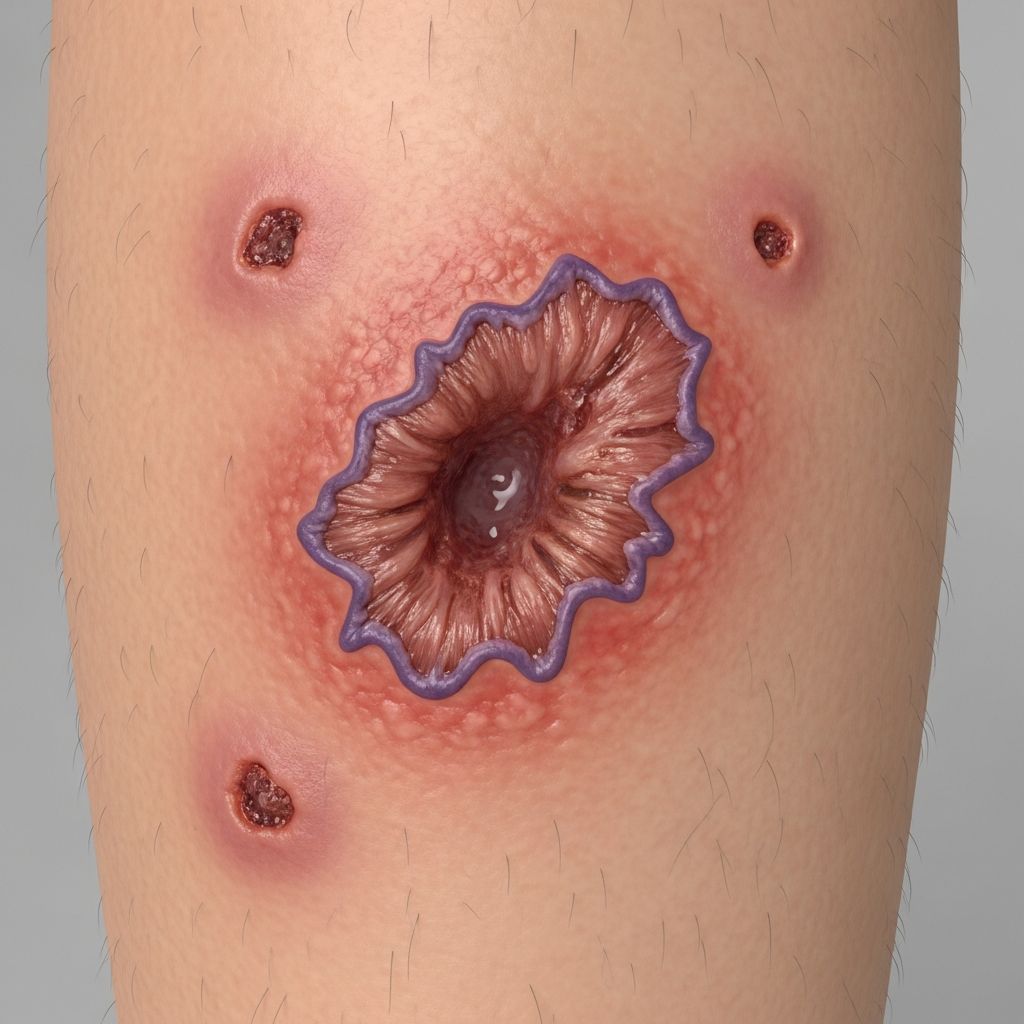
Pyoderma gangrenosum (PG) is a rare, autoinflammatory skin disorder classified among the neutrophilic dermatoses. It manifests as a rapidly enlarging, excruciatingly painful ulcer with characteristic violaceous, undermined borders. Despite its name, PG is not infectious or gangrenous but results from dysregulated immune responses, often triggered by minor trauma via pathergy.
Introduction
Pyoderma gangrenosum typically begins as a small, tender pustule, nodule, or plaque that breaks down to form an ulcer with a necrotic base and overhanging, purple edges. Lesions expand rapidly, sometimes doubling in size within days, and are disproportionately painful to their appearance. PG affects about 1 in 100,000 people annually, with a female predominance (2:1 ratio). It can occur at any age but peaks between 40-60 years. Early recognition is crucial to avoid misdiagnosis as infection and inappropriate surgical intervention, which worsens the condition.
Demographics
PG shows a slight female bias, with most cases diagnosed in middle-aged adults. Children and elderly patients are less commonly affected, though pediatric cases often associate with inflammatory bowel disease. Caucasians predominate in reported series, possibly due to diagnostic biases. Up to 50% of patients have no identifiable extracutaneous disease, but associations rise with age and lesion multiplicity. Comorbidities like inflammatory bowel disease (IBD), rheumatoid arthritis, and hematologic malignancies are frequent, occurring in 30-70% of cases.
Causes
The exact etiology of PG remains elusive, but it involves neutrophil-driven inflammation and immune dysregulation. Pathogenesis includes genetic mutations (e.g., PSTPIP1 in PAPA syndrome), clonal T-cell proliferations, and inflammasome activation leading to excessive cytokine release. Approximately 50% of cases are idiopathic, while others link to systemic conditions:
- Classic associations: IBD (ulcerative colitis > Crohn’s, 10-20%), rheumatoid arthritis (5-10%), hematologic disorders (leukemia, monoclonal gammopathy).
- Less common: Spondyloarthropathies, chronic active hepatitis, thyroid disease.
- Drug-induced: Cocaine, isotretinoin, propylthiouracil, sunitinib, granulocyte colony-stimulating factor.
- Triggers: Pathergy from minor trauma (30-50% of cases), surgery, or venipuncture; sterile folliculitis preceding ulceration.
Genetic syndromes like PAPA (pyogenic arthritis, pyoderma gangrenosum, acne), PASH, or PAPASH feature recurrent PG with mutations in PSTPIP1 or other inflammasome genes.
Clinical Features
PG lesions evolve through stages: pustular/vesiculopustular, ulcerative, and cicatricial. Common variants include:
- Ulcerative (classic, 75%): Begins as pustule/plaque on lower legs; ulcerates with violaceous, undermined borders, ragged necrotic base, seropurulent exudate. Pain is severe; diameter 2-30 cm.
- Bullous/vesiculopustular (15%): Tense blisters on normal skin, especially upper extremities; less ulcerative, associated with myelodysplasia.
- Pustular: Sterile pustules without ulceration, mimicking infections.
- Vegetative/plaque (5%): Superficial, non-undermined ulcers on trunk/head; indolent, less painful.
Mucosal involvement (mouth, genitals) occurs in 10-25%. Multiple lesions (20-30%) or extracutaneous manifestations (5%) include pulmonary infiltrates or sterile arthritis. Systemic symptoms like fever/malaise accompany severe cases.
| Variant | Location | Features | Associations |
|---|---|---|---|
| Ulcerative | Legs (90%) | Rapid growth, undermined edges, extreme pain | IBD, RA |
| Bullous | Arms, trunk | Flaccid blisters, hemorrhagic | Hematologic malignancy |
| Vegetative | Trunk, head | Warty, less aggressive | Idiopathic |
Related Stories



Diagnosis
PG is a clinical diagnosis of exclusion, based on characteristic morphology, rapid progression, pathergy history, and lack of infection. No specific lab test or biomarker exists; peripheral neutrophilia or elevated ESR/CRP may support inflammation. Biopsy shows neutrophilic dermal infiltrate without organisms, but is not pathognomonic (avoid deep punch if pathergy suspected). Essential criteria: rapidly progressive ulcer with undermined violaceous border; exclusion of infection/malignancy/vasculitis. Supportive: pathergy, systemic disease association, histopathology.
Differential Diagnoses
PG mimics many ulcerative conditions; biopsy cultures rule out infection:
- Infectious: Bacterial (ecthyma, Pseudomonas), fungal (sporotrichosis), mycobacterial, amoebiasis.
- Vascular: Venous/arterial ulcers, vasculitis (ANCA-associated), emboli, calciphylaxis.
- Neoplastic: Squamous cell carcinoma, lymphoma, basal cell carcinoma.
- Other: Sweet syndrome, Behçet’s, halogenoderma, factitial ulcers, hidradenitis suppurativa.
Venous ulcers lack undermining and pathergy; malignancies show atypical cells on biopsy.
Treatment
Treatment is medical, stepwise, avoiding surgery in active disease due to pathergy. Goals: halt progression, promote healing, manage pain. Local care includes moist dressings, gentle cleansing, compression for leg ulcers (reduces edema/exudate).
Local Therapy (mild/superficial lesions)
- Topical high-potency steroids (clobetasol) or tacrolimus 0.1%.
- Intralesional triamcinolone (10-40 mg/mL).
- Other: Nicotine patches, dapsone, cromolyn sodium.
Systemic Therapy (moderate-severe, large/progressive ulcers)
- First-line: Prednisone 0.5-1 mg/kg/day or cyclosporine 3-5 mg/kg/day (STOP GAP trial: similar efficacy, cyclosporine faster response).
- Second-line/steroid-sparing: Mycophenolate mofetil, methotrexate, azathioprine, dapsone, IVIG, anti-TNF biologics (infliximab, adalimumab; 70-90% response).
- Emerging: IL-1 inhibitors (anakinra), JAK inhibitors (tofacitinib), anti-IL-17 (secukinumab).
Pain control: Opioids, gabapentinoids for neuropathic pain. Once stable (inactive >2-4 weeks), consider grafting, flaps, or negative pressure therapy. Taper systemic agents slowly over months. Multidisciplinary care (dermatology, gastroenterology, wound specialists) optimizes outcomes.
Outlook / Prognosis
PG course is unpredictable; 50-70% heal with first-line therapy (prednisone/cyclosporine) within 1 year, but recurrence risk is 30-50%. Factors portending poor prognosis: older age, multiple/large ulcers, pathergy, underlying malignancy/IBD. Mortality rises 30% with comorbidities. Scarring is common; patients must avoid trauma lifelong. Regular follow-up monitors for extracutaneous disease.
Frequently Asked Questions (FAQs)
Q: Is pyoderma gangrenosum contagious?
A: No, PG is not infectious; it is an autoinflammatory condition without pathogens.
Q: Can surgery cure pyoderma gangrenosum?
A: Surgery risks worsening ulcers via pathergy; defer until disease is inactive.
Q: What triggers new PG lesions?
A: Minor trauma, injections, or surgery; pathergy occurs in 30-50% of patients.
Q: How long does treatment take?
A: Healing may take months; systemic therapy tapers over 6-12 months to prevent relapse.
Q: Is compression therapy helpful for leg PG?
A: Yes, it reduces swelling, exudate, and inflammation alongside medical treatment.
References
- Pyoderma Gangrenosum – StatPearls — NCBI Bookshelf/NCBI. 2023-07-17. https://www.ncbi.nlm.nih.gov/books/NBK482223/
- Pyoderma Gangrenosum — DermNet NZ. 2023. https://dermnetnz.org/topics/pyoderma-gangrenosum
- Pyoderma Gangrenosum (PG) — OHSU Dermatology. 2024. https://www.ohsu.edu/dermatology/pyoderma-gangrenosum-pg
- Pyoderma Gangrenosum — Cleveland Clinic. 2023-11-01. https://my.clevelandclinic.org/health/diseases/17825-pyoderma-gangrenosum-pg
- Pyoderma Gangrenosum — Legs Matter. 2024. https://legsmatter.org/information-and-support/skin-concerns/pyoderma-gangrenosum/
- Pyoderma Gangrenosum — NHS UK. 2023-05-02. https://www.nhs.uk/conditions/pyoderma-gangrenosum/
Similar Articles








Read full bio of medha deb